Foram encontradas 380 questões.
Analisar a seguinte afirmação:
Item 2: Para que uma função de R em R seja sobrejetora, as retas horizontais devem interceptar o gráfico dela em no máximo um ponto;
Provas
Questão presente nas seguintes provas

Sobre a economia brasileira no período entre 1930 e 1945, é correto afirmar:
Item 0: A Carteira de Crédito Agrícola e Industrial do Banco do Brasil, criada na década de 1930, foi um instrumento utilizado pela política creditícia do Governo Federal.
Provas
Questão presente nas seguintes provas
Um Professor Pobre (PP) encontra em um restaurante seu colega de mestrado, o Banqueiro Bem de Vida (BB). Eles pretendem honrar a tradição de repartir a conta ao meio, embora PP priorize a economia de gastos e BB a sofisticação da comida. Cada um pode pedir um prato barato (b) ou caro (c). Os pay-offs da tabela representam a utilidade ordinal dos resultados para ambos. O garçom anota o pedido de BB em primeiro lugar.
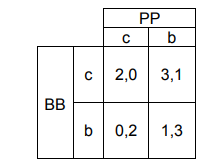
Julgue a proposição abaixo:
Item 3: Caso o garçom anote primeiro o pedido de PP, o equilíbrio de Nash perfeito em subjogos será definido como {b; bc}.
Provas
Questão presente nas seguintes provas
Considere o modelo de inconsistência temporal da política monetária com expectativas racionais (apresentado por Mankiw).
Curva de Phillips: !$ u= u^n - 0,05 (\pi - E \pi) !$
Função de perdas do Banco Central: !$ L (u, \pi)= u + 0,5 \pi^2 !$
em que é taxa de desemprego !$ u^n !$, é taxa natural de desemprego !$ \pi !$, é a taxa de inflação e !$ E \pi !$ é a taxa de inflação esperada. Suponha que o Banco Central é capaz de controlar a inflação de modo perfeito, por meio da política monetária, de tal sorte que ele pode escolher qualquer taxa de inflação. Há duas políticas possíveis: i) o Banco Central se compromete com uma regra fixa para a política monetária; e ii) o Banco Central adota uma política monetária discricionária. As expectativas (racionais) do setor privado são estabelecidas antes de o Banco Central decidir a oferta monetária. Avalie como certo ou errado a afirmativa abaixo:
Item 3:O Banco Central tem incentivo para criar inflação-surpresa com o intuito de reduzir (temporariamente) o nível de desemprego abaixo da taxa natural, acionando o viés inflacionário.
Provas
Questão presente nas seguintes provas
Classifique a afirmativa como certo ou errado:
Item 3: A cesta de bens incluída no deflator implícito da renda muda de ano em ano dependendo daquilo que estiver sendo produzido na economia.
Provas
Questão presente nas seguintes provas
Text 1
The European Commission
Lagarde for president
If ever Europe needed a competent reformer with new ideas, it is now
CHANCES for a new beginning in Europe are rare and should be seized. In the coming months, after five can-kicking years of crisis and austerity, the European Union will clean out its executive suite and appoint new presidents of the European Commission (the EU's executive arm) and European Council (representing national governments), as well as a new foreign-policy chief.
The EU desperately needs a fresh vision. Its citizens are disenchanted with the remote machinations inside Brussels. Insurgent political parties, many of them anti-EU, are snapping at the heels of the centrists. If the EU were a company, its board would have been sacked: if it were a football team, it would have been relegated. It needs new leadership.
Unfortunately, Europe’s leaders have not got the message. The names being canvassed for commission president include two former prime ministers of smallish countries, JeanClaude Juncker (Luxembourg) and Guy Verhofstadt (Belgium), an assortment of obscure European commissioners and the president of the dysfunctional European Parliament, Martin Schulz of Germany. It is an uninspiring list of Eurocrats, still mouthing nostrums about ever-closer union.
One person—who is not a declared candidate—would be far better: Christine Lagarde, head of the IMF. She is a French former finance minister, yet her years in Washington dealing with the euro crisis, as well as running a huge law firm in Chicago, give her the clarity of an outsider’s view about what is wrong with the EU. A liberal, she would be keen to complete the single market, promote free trade and cut the burden of regulation. She is also a persuasive saleswoman in both French and English, a bonus given her own country’s sour view of the EU and Britain’s possible referendum on whether to leave.
One supposed mark against Ms Lagarde is that, unlike the present commission president, José Manuel Barroso, and his two predecessors, she has never been elected. But the most effective recent commission president was not a former prime minister, but Jacques Delors, another French former finance minister, who—although for a while a member of the European Parliament—was also a technocrat. And the job now needs the skills of a technocrat as much as of a politician. (The place for a former prime minister is the presidency of the European Council; Mario Monti, a reforming Italian leader who also served as a commissioner, might do that job well.)
The bigger obstacle to Ms Lagarde becoming commission president lies in the Lisbon treaty. This says that the European Council, mindful of European elections (which are due in May), must nominate a candidate whom the European Parliament then “elects” as president. Political groups in the parliament are exploiting this to put forward their preferred choices now—Mr Schulz for the centre-left Socialists, Mr Verhofstadt for the centrist Liberals and, next month, a front-runner for the centre-right European People’s Party (EPP) who seems likely to be Mr Juncker. The claim is that this process will seem more democratic to ordinary Europeans.
Dream on. Most European voters neither know nor care who any of these people are or what they stand for. The suggestion that EU leaders should accept the candidate of whichever political group gets most seats in May is a recipe not just for ending up with the wrong person, but also for making the commission even more beholden to the parliament.
Don’t let the parliament decide
There is a way through this muddle. As it happens, Ms Lagarde comes from the centreright EPP, which is likely to remain the biggest group in the parliament. The open support of Europe’s three main leaders would probably get her the job. France’s president, François Hollande, is a Socialist, but he would surely welcome a French president. David Cameron knows he is far more likely to win a referendum with a reformer like Ms Lagarde as the face of Europe. Angela Merkel also wants a more open Europe, and her policy of appointing dull unknowns to EU posts has hardly been a resounding success.
The argument for Ms Lagarde is similar to that two years ago for making Mario Draghi president of the European Central Bank: he brought outside experience, market knowledge and good ideas. To many then he seemed tainted by his link to an American investment bank, Goldman Sachs, but he is now the most respected Eurocrat of all. So ignore the parliament, Mrs Merkel, and pick the best woman for the job.
According to the text:
Item 1: The biggest group at the moment is the left-wing EPP;
Provas
Questão presente nas seguintes provas
Considere o modelo de inconsistência temporal da política monetária com expectativas racionais (apresentado por Mankiw).
Curva de Phillips: !$ u= u^n - 0,05 (\pi - E \pi) !$
Função de perdas do Banco Central: !$ L (u, \pi)= u + 0,5 \pi^2 !$
em que é taxa de desemprego !$ u^n !$, é taxa natural de desemprego !$ \pi !$, é a taxa de inflação e !$ E \pi !$ é a taxa de inflação esperada. Suponha que o Banco Central é capaz de controlar a inflação de modo perfeito, por meio da política monetária, de tal sorte que ele pode escolher qualquer taxa de inflação. Há duas políticas possíveis: i) o Banco Central se compromete com uma regra fixa para a política monetária; e ii) o Banco Central adota uma política monetária discricionária. As expectativas (racionais) do setor privado são estabelecidas antes de o Banco Central decidir a oferta monetária. Avalie como certo ou errado a afirmativa abaixo:
Item 0: Considere que a inflação esperada e a inflação efetiva são iguais. A taxa ótima de inflação é igual a zero.
Provas
Questão presente nas seguintes provas
Em um mercado competitivo do bem x, cem consumidores têm funções utilidade definidas por U(x,y) = Inx + y; sendo que y, cujo preço é unitário (py = $1), representa a quantidade consumida dos demais bens. Nesse mercado existem cem firmas, cada qual com função custo total dada por CT(x) = 50x2. Avalie a proposição:
Item 1: A curva de oferta de mercado de x tem elasticidade-preço constante e igual a +2.
Provas
Questão presente nas seguintes provas
Sobre os planos de estabilização das décadas de 1980 e 1990, podemos dizer:
Item 3:Ao contrário do Plano Cruzado, que buscou por alguns meses manter o congelamento cambial como estratégia de estabilização, os executores do Plano Real permitiram que o câmbio flutuasse (não livremente), para reduzir o preço tanto dos bens importados como daqueles precificados em moeda estrangeira.
Provas
Questão presente nas seguintes provas
Considere a seguinte função de massa de probabilidade: e!$ f(x,y) = { \large (x + y^2) \over 27} !$, para !$ x ∈ \{1,2,3 \} !$ e !$ y ∈ \{1,2 \} !$.
Julgue a seguinte afirmativa:
Item 2: !$ Var [Y] = 3 !$;
Provas
Questão presente nas seguintes provas
Cadernos
Caderno Container