Foram encontradas 60 questões.
A codificação em COBOL da estrutura de controle "case" é
realizada pela instrução:
Provas
Questão presente nas seguintes provas

Dado um vetor X com zeros em todas as variáveis e o
algoritmo:
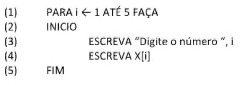
Serão digitados na seqüência os números 34, 81, 79, 25 e 60. Após a digitação do segundo número, o vetor conterá:
Serão digitados na seqüência os números 34, 81, 79, 25 e 60. Após a digitação do segundo número, o vetor conterá:
Provas
Questão presente nas seguintes provas
Dado o fluxograma:
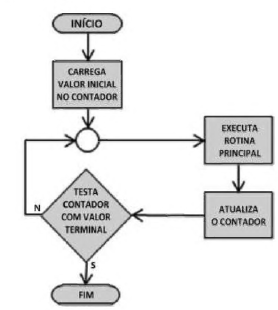
Para que a Rotina Principal no fluxograma acima seja executada cinco vezes deve-se:
I. carregar um como valor inicial, incrementar de um o contador e testar o contador com valor terminal maior que cinco.
II. carregar seis como valor inicial, decrementar de um o contador e testar o contador com valor terminai menor que um.
III. carregar zero como valor inicial, incrementar de um o contador e testar o contador com valor terminal maior que cinco.
IV. carregar cinco como valor inicial, decrementar de um o contador e testar o contador com valor terminai menor que um.
Está correto o que consta em:
Para que a Rotina Principal no fluxograma acima seja executada cinco vezes deve-se:
I. carregar um como valor inicial, incrementar de um o contador e testar o contador com valor terminal maior que cinco.
II. carregar seis como valor inicial, decrementar de um o contador e testar o contador com valor terminai menor que um.
III. carregar zero como valor inicial, incrementar de um o contador e testar o contador com valor terminal maior que cinco.
IV. carregar cinco como valor inicial, decrementar de um o contador e testar o contador com valor terminai menor que um.
Está correto o que consta em:
Provas
Questão presente nas seguintes provas
Dado um algoritmo para troca de valores:
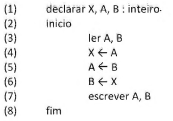
Considerando o algoritmo acima, as variáveis:
I. X, A e B foram criadas com escopo global na área de dados da memória.
II. X, A e B foram criadas com escopo locai na área de dados da memória.
III. A e B poderiam, refazendo o algoritmo, ser qualificadas com escopo local e a variável X com escopo global.
IV. A e B poderiam, refazendo o algoritmo, ser qualificadas com escopo global e a variável X com escopo local.
Está correto o que consta somente em:
Considerando o algoritmo acima, as variáveis:
I. X, A e B foram criadas com escopo global na área de dados da memória.
II. X, A e B foram criadas com escopo locai na área de dados da memória.
III. A e B poderiam, refazendo o algoritmo, ser qualificadas com escopo local e a variável X com escopo global.
IV. A e B poderiam, refazendo o algoritmo, ser qualificadas com escopo global e a variável X com escopo local.
Está correto o que consta somente em:
Provas
Questão presente nas seguintes provas
Dadas três variáveis X, Y e Z contendo valores aleatórios,
numéricos e inteiros, e o algoritmo:
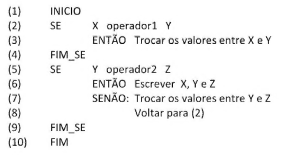
Os valores serão colocados em ordem decrescente na seqüência das variáveis X, Y e Z, para serem exibidos pela instrução (6), sempre do maior para o menor, se no algoritmo acima o operador1 e o operador2 corresponderem, respectivamente, aos operadores:
Os valores serão colocados em ordem decrescente na seqüência das variáveis X, Y e Z, para serem exibidos pela instrução (6), sempre do maior para o menor, se no algoritmo acima o operador1 e o operador2 corresponderem, respectivamente, aos operadores:
Provas
Questão presente nas seguintes provas
Uma instrução EXEC existe para cada job step dentro de um
job, sendo que:
Provas
Questão presente nas seguintes provas
A organização e o modo de acesso de arquivos usados em
um programa COBOL são definidos no parágrafo:
Provas
Questão presente nas seguintes provas
A instrução PROC marca o início de uma procedure. Assim:
I. deve ser a primeira instrução em um procedimento, porém, é opcional para procedure catalogada.
II. uma procedure catalogada estará armazenada em uma biblioteca de procedures, geralmente SYS1.PROCLIB.
III. uma procedure in-stream deve aparecer no mesmo job, após a instrução EXEC que o chama.
Está correto o que consta em:
I. deve ser a primeira instrução em um procedimento, porém, é opcional para procedure catalogada.
II. uma procedure catalogada estará armazenada em uma biblioteca de procedures, geralmente SYS1.PROCLIB.
III. uma procedure in-stream deve aparecer no mesmo job, após a instrução EXEC que o chama.
Está correto o que consta em:
Provas
Questão presente nas seguintes provas
Usando no COBOL a instrução OPEN I-0 para conectar
arquivos VSAM ESDS, no modo de acesso seqüencial, podese
combinar apenas as instruções:
Provas
Questão presente nas seguintes provas
The following text refers to questions .
Informatics education:
Europe cannot afford to miss the boat
Principies for an effective informatics curriculum
The committee performed a comprehensive review of the considerabie existing material on building informatics curricula, including among many others the (UK) Royal Society report, the CSPrinciples site, the Computing at Schools Initiative, and the work of the CSTA. Two major conclusions follow from that review.
The first is the sheer number of existing experiences demonstrating that it is indeed possible to teach informatics successfully in primary and secondary education. The second conclusion is in the form of two core principies for such curricula. Existing experiences use a wide variety of approaches; there is no standard curriculum yet, and it was not part of the Committee's mission to define such a standard informatics curriculum for the whole of Europe. The committee has found, however, that while views diverge on the details, a remarkable consensus exists among experts on the basics of what a school informatics curriculum should (and should not) include. On the basis of that existing work, the Committee has identified two principies: leverage students' creativity, emphasize quality.
Leverage student creativity
A powerful aid for informatics teaching is the topic's potential for stimulating students; creativity. The barriers to innovation are often lower than in other disciplines; the technical equipment (computers) is ubiquitous and considerably less expensive. Opportunities exist even for a beginner: with proper guidance, a Creative student can quickly start writing a program or a Web Service, see the results right away, and make them available to numerous other people. Informatics education should draw on this phenomenon and channel the creativity into useful directions, while warning students away from nefarious directions such as destructive "hacking". The example of HFOSS (Humanitarian Free and Open Software Systems)
shows the way towards constructive societal contributions based on informatics.
Informatics education must not just dwell on imparting information to students. It must draw attention to aspects of informatics that immediately appeal to young students, to encourage interaction, to bring abstract concepts to life through visualization and animation; a typical application of this idea is the careful use of (non- violent) games.
Foster quality
Curious students are always going to learn some IT and in particular some programming outside of informatics education through games scripting, Web site development, or adding software components to social networks. Informatics education must emphasize quality, in particular software quality, including the need for correctness (proper functioning of software), for good user interfaces, for taking the needs of users into consideration including psychological and social concerns. The role of informatics education here is:
• To convey the distinction between mere "coding" and software development as a constructive activity based on scientific and engineering principies.
• To dispel the wrong image of programming as an activity for "nerds" and emphasize its human, user-centered aspects, a focus that helps attract students of both genders.
Breaking the teacher availability deadlock
An obstacle to generalizing informatics education is the lack of teachers. It follows from a chicken-and-egg problem: as long as informatics is not in the curriculum, there is Iittle incentive to educate teachers in the subject; as long as there are no teachers, there is Iittle incentive to introduce the subject.
To bring informatics education to the levei that their schools deserve, European countries will have to take both long-term and short-term initiatives:
• Universities, in particular through their informatics departments, must put in place comprehensive programs to train informatics teachers, able to teach digital literacy and informatics under the same intellectual standards as in mathematics, physics and other Sciences.
• The current chicken-and-egg situation is not an excuse for deferring the start of urgently needed efforts. Existing experiences conclusively show that it is possible to break the deadlock. For example, a recent New York Times article explains how IT companies such as Microsoft and Google, conscious of the need to improve the state of education, allow some of their most committed engineers and researchers in the US to pair up with high school teachers to teach computational thinking. In Russia, it is common for academics who graduated from the best high schools to go back to these schools, also on a volunteer basis, and help teachers introduce the concepts of modern informatics. Ali these efforts respect the principie that outsiders must always be paired with current high-school teachers.
(Excerpt of ' Report ofthe joint Informatics Europe & ACM Europe Working Group on Informatics Education April 2013')
The text tells about the experiences in Microsoft and Google that is:Informatics education:
Europe cannot afford to miss the boat
Principies for an effective informatics curriculum
The committee performed a comprehensive review of the considerabie existing material on building informatics curricula, including among many others the (UK) Royal Society report, the CSPrinciples site, the Computing at Schools Initiative, and the work of the CSTA. Two major conclusions follow from that review.
The first is the sheer number of existing experiences demonstrating that it is indeed possible to teach informatics successfully in primary and secondary education. The second conclusion is in the form of two core principies for such curricula. Existing experiences use a wide variety of approaches; there is no standard curriculum yet, and it was not part of the Committee's mission to define such a standard informatics curriculum for the whole of Europe. The committee has found, however, that while views diverge on the details, a remarkable consensus exists among experts on the basics of what a school informatics curriculum should (and should not) include. On the basis of that existing work, the Committee has identified two principies: leverage students' creativity, emphasize quality.
Leverage student creativity
A powerful aid for informatics teaching is the topic's potential for stimulating students; creativity. The barriers to innovation are often lower than in other disciplines; the technical equipment (computers) is ubiquitous and considerably less expensive. Opportunities exist even for a beginner: with proper guidance, a Creative student can quickly start writing a program or a Web Service, see the results right away, and make them available to numerous other people. Informatics education should draw on this phenomenon and channel the creativity into useful directions, while warning students away from nefarious directions such as destructive "hacking". The example of HFOSS (Humanitarian Free and Open Software Systems)
shows the way towards constructive societal contributions based on informatics.
Informatics education must not just dwell on imparting information to students. It must draw attention to aspects of informatics that immediately appeal to young students, to encourage interaction, to bring abstract concepts to life through visualization and animation; a typical application of this idea is the careful use of (non- violent) games.
Foster quality
Curious students are always going to learn some IT and in particular some programming outside of informatics education through games scripting, Web site development, or adding software components to social networks. Informatics education must emphasize quality, in particular software quality, including the need for correctness (proper functioning of software), for good user interfaces, for taking the needs of users into consideration including psychological and social concerns. The role of informatics education here is:
• To convey the distinction between mere "coding" and software development as a constructive activity based on scientific and engineering principies.
• To dispel the wrong image of programming as an activity for "nerds" and emphasize its human, user-centered aspects, a focus that helps attract students of both genders.
Breaking the teacher availability deadlock
An obstacle to generalizing informatics education is the lack of teachers. It follows from a chicken-and-egg problem: as long as informatics is not in the curriculum, there is Iittle incentive to educate teachers in the subject; as long as there are no teachers, there is Iittle incentive to introduce the subject.
To bring informatics education to the levei that their schools deserve, European countries will have to take both long-term and short-term initiatives:
• Universities, in particular through their informatics departments, must put in place comprehensive programs to train informatics teachers, able to teach digital literacy and informatics under the same intellectual standards as in mathematics, physics and other Sciences.
• The current chicken-and-egg situation is not an excuse for deferring the start of urgently needed efforts. Existing experiences conclusively show that it is possible to break the deadlock. For example, a recent New York Times article explains how IT companies such as Microsoft and Google, conscious of the need to improve the state of education, allow some of their most committed engineers and researchers in the US to pair up with high school teachers to teach computational thinking. In Russia, it is common for academics who graduated from the best high schools to go back to these schools, also on a volunteer basis, and help teachers introduce the concepts of modern informatics. Ali these efforts respect the principie that outsiders must always be paired with current high-school teachers.
(Excerpt of ' Report ofthe joint Informatics Europe & ACM Europe Working Group on Informatics Education April 2013')
Provas
Questão presente nas seguintes provas
Cadernos
Caderno Container