Foram encontradas 50 questões.
TEXT I
Language Proficiency in Aviation
Philip Shawcross
English for Aircraft/ICAEA
We all use language and language tends to be something we take for granted. In point of fact, language is probably one of the most complex and also the most fundamental skills any of us has to master. It is a skill which engages not just our intellect but our personality, our emotions and our relation to the world. Paradoxically, the fact that language is everywhere and yet transparent explains in part why its use and acquisition have often been treated as negligible quantities in the operational and training worlds.
In the flight crew sector, that tends to drive the industry, there is now widespread and well documented recognition that linguistic misunderstandings and incomprehension have been contributory factors in several major accidents. Turning to the maintenance arena, where fortunately the time factor is not so critical, similar snares come to mind where even the application of the principles of Simplified English for Aircraft Maintenance Manuals has not meant that aircraft technicians no longer have reason to be puzzled at times, especially when they are not native speakers of English.
So, in the last few years, the Authorities have sought to address the question of proficiency in the language which is the official lingua franca of aviation, English, in the main aviation professions.
The Aircraft Maintenance Technician of 2004 works in a radically different environment from his forebear, the “mechanic”, of twenty years ago. Aircraft design and maintenance practice have changed substantially in the last two decades. A computer interface, which speaks English and is the nucleus of centralized maintenance, has become the alpha and omega of a working shift. It would be trite and unfair, however, to say the pen has replaced the wrench, but there is an element of truth in this. Technical documentation is also computer-based, generating new more discursive and synthetic reading habits, although it has in no way resulted in a paper-free environment. In non-English speaking countries, translation is fast becoming a thing of the past for economic, commercial, reactivity and safety reasons.
As regards documentation, eighteen years down the road, AECMA Simplified English has become accepted as the industry norm creating a few problems but attenuating many more. In its wake, the documentary styles of the various manufacturers’ documentation have tended to converge. Research sponsored by the FAA (Federal Aviation Administration) and published this year has revealed in a comparative study that the use of Simplified English has reduced the error rate in reading comprehension among technicians from 18% to 14% for native English speakers and from 31% to 13% for non-native speakers. Perhaps that also says something about native speakers of English!
native speakers of English! The recent regulatory environment imposed by civil aviation authorities worldwide which defines the standards to which technicians are trained and work and delineates the process of release to service has brought with it increased paperwork as has the concern for part traceability. Standardisation and the need for savings have steered most airlines away from in-house training development and towards the use of manufacturer courseware … again in English.
Finally, the global economy and hard times have spurred the airlines towards various forms of cooperation, alliance, load sharing and partnership. National boundaries have less and less significance. Simultaneously, the maintenance workforce is increasingly mobile, multicultural and cosmopolitan. Sociological and personal reasons only reinforce the professional need for a common language both in the hangar and at the ramp.
As you can see, all these trends have something “invisible” in common: a much increased reliance upon language and upon a single language, English. Some very thorough and illuminating research is being conducted since 2001 by C.G. Drury at New York State University, Buffalo, under the auspices of the William J. Hughes Technical Center of the FAA. This study addresses the question of Language error in Aviation Maintenance. It is in response to an FAA concern that non-native English speakers in repair stations in the USA and abroad may be prone to an increased error rate that could potentially affect airworthiness.
Language proficiency is not just a question of understanding or not understanding information. It circumscribes the whole way people are able to behave because it affects their self-confidence, their awareness of the world around them and the scope of their capacity to report this to other.
Extracted from: http://www.inglesaeronautico.com/documentos/ language_proficiency.pdf
Mark the only option in which the figures of speech that have been highlighted have been correctly interpreted.
Provas

TEXT I
Language Proficiency in Aviation
Philip Shawcross
English for Aircraft/ICAEA
We all use language and language tends to be something we take for granted. In point of fact, language is probably one of the most complex and also the most fundamental skills any of us has to master. It is a skill which engages not just our intellect but our personality, our emotions and our relation to the world. Paradoxically, the fact that language is everywhere and yet transparent explains in part why its use and acquisition have often been treated as negligible quantities in the operational and training worlds.
In the flight crew sector, that tends to drive the industry, there is now widespread and well documented recognition that linguistic misunderstandings and incomprehension have been contributory factors in several major accidents. Turning to the maintenance arena, where fortunately the time factor is not so critical, similar snares come to mind where even the application of the principles of Simplified English for Aircraft Maintenance Manuals has not meant that aircraft technicians no longer have reason to be puzzled at times, especially when they are not native speakers of English.
So, in the last few years, the Authorities have sought to address the question of proficiency in the language which is the official lingua franca of aviation, English, in the main aviation professions.
The Aircraft Maintenance Technician of 2004 works in a radically different environment from his forebear, the “mechanic”, of twenty years ago. Aircraft design and maintenance practice have changed substantially in the last two decades. A computer interface, which speaks English and is the nucleus of centralized maintenance, has become the alpha and omega of a working shift. It would be trite and unfair, however, to say the pen has replaced the wrench, but there is an element of truth in this. Technical documentation is also computer-based, generating new more discursive and synthetic reading habits, although it has in no way resulted in a paper-free environment. In non-English speaking countries, translation is fast becoming a thing of the past for economic, commercial, reactivity and safety reasons.
As regards documentation, eighteen years down the road, AECMA Simplified English has become accepted as the industry norm creating a few problems but attenuating many more. In its wake, the documentary styles of the various manufacturers’ documentation have tended to converge. Research sponsored by the FAA (Federal Aviation Administration) and published this year has revealed in a comparative study that the use of Simplified English has reduced the error rate in reading comprehension among technicians from 18% to 14% for native English speakers and from 31% to 13% for non-native speakers. Perhaps that also says something about native speakers of English!
native speakers of English! The recent regulatory environment imposed by civil aviation authorities worldwide which defines the standards to which technicians are trained and work and delineates the process of release to service has brought with it increased paperwork as has the concern for part traceability. Standardisation and the need for savings have steered most airlines away from in-house training development and towards the use of manufacturer courseware … again in English.
Finally, the global economy and hard times have spurred the airlines towards various forms of cooperation, alliance, load sharing and partnership. National boundaries have less and less significance. Simultaneously, the maintenance workforce is increasingly mobile, multicultural and cosmopolitan. Sociological and personal reasons only reinforce the professional need for a common language both in the hangar and at the ramp.
As you can see, all these trends have something “invisible” in common: a much increased reliance upon language and upon a single language, English. Some very thorough and illuminating research is being conducted since 2001 by C.G. Drury at New York State University, Buffalo, under the auspices of the William J. Hughes Technical Center of the FAA. This study addresses the question of Language error in Aviation Maintenance. It is in response to an FAA concern that non-native English speakers in repair stations in the USA and abroad may be prone to an increased error rate that could potentially affect airworthiness.
Language proficiency is not just a question of understanding or not understanding information. It circumscribes the whole way people are able to behave because it affects their self-confidence, their awareness of the world around them and the scope of their capacity to report this to other.
Extracted from: http://www.inglesaeronautico.com/documentos/ language_proficiency.pdf
The sentence “Perhaps that also says something about native speakers of English!” implies that
Provas
TEXT I
Language Proficiency in Aviation
Philip Shawcross
English for Aircraft/ICAEA
We all use language and language tends to be something we take for granted. In point of fact, language is probably one of the most complex and also the most fundamental skills any of us has to master. It is a skill which engages not just our intellect but our personality, our emotions and our relation to the world. Paradoxically, the fact that language is everywhere and yet transparent explains in part why its use and acquisition have often been treated as negligible quantities in the operational and training worlds.
In the flight crew sector, that tends to drive the industry, there is now widespread and well documented recognition that linguistic misunderstandings and incomprehension have been contributory factors in several major accidents. Turning to the maintenance arena, where fortunately the time factor is not so critical, similar snares come to mind where even the application of the principles of Simplified English for Aircraft Maintenance Manuals has not meant that aircraft technicians no longer have reason to be puzzled at times, especially when they are not native speakers of English.
So, in the last few years, the Authorities have sought to address the question of proficiency in the language which is the official lingua franca of aviation, English, in the main aviation professions.
The Aircraft Maintenance Technician of 2004 works in a radically different environment from his forebear, the “mechanic”, of twenty years ago. Aircraft design and maintenance practice have changed substantially in the last two decades. A computer interface, which speaks English and is the nucleus of centralized maintenance, has become the alpha and omega of a working shift. It would be trite and unfair, however, to say the pen has replaced the wrench, but there is an element of truth in this. Technical documentation is also computer-based, generating new more discursive and synthetic reading habits, although it has in no way resulted in a paper-free environment. In non-English speaking countries, translation is fast becoming a thing of the past for economic, commercial, reactivity and safety reasons.
As regards documentation, eighteen years down the road, AECMA Simplified English has become accepted as the industry norm creating a few problems but attenuating many more. In its wake, the documentary styles of the various manufacturers’ documentation have tended to converge. Research sponsored by the FAA (Federal Aviation Administration) and published this year has revealed in a comparative study that the use of Simplified English has reduced the error rate in reading comprehension among technicians from 18% to 14% for native English speakers and from 31% to 13% for non-native speakers. Perhaps that also says something about native speakers of English!
native speakers of English! The recent regulatory environment imposed by civil aviation authorities worldwide which defines the standards to which technicians are trained and work and delineates the process of release to service has brought with it increased paperwork as has the concern for part traceability. Standardisation and the need for savings have steered most airlines away from in-house training development and towards the use of manufacturer courseware … again in English.
Finally, the global economy and hard times have spurred the airlines towards various forms of cooperation, alliance, load sharing and partnership. National boundaries have less and less significance. Simultaneously, the maintenance workforce is increasingly mobile, multicultural and cosmopolitan. Sociological and personal reasons only reinforce the professional need for a common language both in the hangar and at the ramp.
As you can see, all these trends have something “invisible” in common: a much increased reliance upon language and upon a single language, English. Some very thorough and illuminating research is being conducted since 2001 by C.G. Drury at New York State University, Buffalo, under the auspices of the William J. Hughes Technical Center of the FAA. This study addresses the question of Language error in Aviation Maintenance. It is in response to an FAA concern that non-native English speakers in repair stations in the USA and abroad may be prone to an increased error rate that could potentially affect airworthiness.
Language proficiency is not just a question of understanding or not understanding information. It circumscribes the whole way people are able to behave because it affects their self-confidence, their awareness of the world around them and the scope of their capacity to report this to other.
Extracted from: http://www.inglesaeronautico.com/documentos/ language_proficiency.pdf
Choose the only alternative that the author does NOT mention in support of the idea that the professional environment of aircraft maintenance crews nowadays is different from that of their peers in the past.
Provas
TEXT I
Language Proficiency in Aviation
Philip Shawcross
English for Aircraft/ICAEA
We all use language and language tends to be something we take for granted. In point of fact, language is probably one of the most complex and also the most fundamental skills any of us has to master. It is a skill which engages not just our intellect but our personality, our emotions and our relation to the world. Paradoxically, the fact that language is everywhere and yet transparent explains in part why its use and acquisition have often been treated as negligible quantities in the operational and training worlds.
In the flight crew sector, that tends to drive the industry, there is now widespread and well documented recognition that linguistic misunderstandings and incomprehension have been contributory factors in several major accidents. Turning to the maintenance arena, where fortunately the time factor is not so critical, similar snares come to mind where even the application of the principles of Simplified English for Aircraft Maintenance Manuals has not meant that aircraft technicians no longer have reason to be puzzled at times, especially when they are not native speakers of English.
So, in the last few years, the Authorities have sought to address the question of proficiency in the language which is the official lingua franca of aviation, English, in the main aviation professions.
The Aircraft Maintenance Technician of 2004 works in a radically different environment from his forebear, the “mechanic”, of twenty years ago. Aircraft design and maintenance practice have changed substantially in the last two decades. A computer interface, which speaks English and is the nucleus of centralized maintenance, has become the alpha and omega of a working shift. It would be trite and unfair, however, to say the pen has replaced the wrench, but there is an element of truth in this. Technical documentation is also computer-based, generating new more discursive and synthetic reading habits, although it has in no way resulted in a paper-free environment. In non-English speaking countries, translation is fast becoming a thing of the past for economic, commercial, reactivity and safety reasons.
As regards documentation, eighteen years down the road, AECMA Simplified English has become accepted as the industry norm creating a few problems but attenuating many more. In its wake, the documentary styles of the various manufacturers’ documentation have tended to converge. Research sponsored by the FAA (Federal Aviation Administration) and published this year has revealed in a comparative study that the use of Simplified English has reduced the error rate in reading comprehension among technicians from 18% to 14% for native English speakers and from 31% to 13% for non-native speakers. Perhaps that also says something about native speakers of English!
native speakers of English! The recent regulatory environment imposed by civil aviation authorities worldwide which defines the standards to which technicians are trained and work and delineates the process of release to service has brought with it increased paperwork as has the concern for part traceability. Standardisation and the need for savings have steered most airlines away from in-house training development and towards the use of manufacturer courseware … again in English.
Finally, the global economy and hard times have spurred the airlines towards various forms of cooperation, alliance, load sharing and partnership. National boundaries have less and less significance. Simultaneously, the maintenance workforce is increasingly mobile, multicultural and cosmopolitan. Sociological and personal reasons only reinforce the professional need for a common language both in the hangar and at the ramp.
As you can see, all these trends have something “invisible” in common: a much increased reliance upon language and upon a single language, English. Some very thorough and illuminating research is being conducted since 2001 by C.G. Drury at New York State University, Buffalo, under the auspices of the William J. Hughes Technical Center of the FAA. This study addresses the question of Language error in Aviation Maintenance. It is in response to an FAA concern that non-native English speakers in repair stations in the USA and abroad may be prone to an increased error rate that could potentially affect airworthiness.
Language proficiency is not just a question of understanding or not understanding information. It circumscribes the whole way people are able to behave because it affects their self-confidence, their awareness of the world around them and the scope of their capacity to report this to other.
Extracted from: http://www.inglesaeronautico.com/documentos/ language_proficiency.pdf
According to paragraph 2, it is correct to say that
Provas
TEXT I
Language Proficiency in Aviation
Philip Shawcross
English for Aircraft/ICAEA
We all use language and language tends to be something we take for granted. In point of fact, language is probably one of the most complex and also the most fundamental skills any of us has to master. It is a skill which engages not just our intellect but our personality, our emotions and our relation to the world. Paradoxically, the fact that language is everywhere and yet transparent explains in part why its use and acquisition have often been treated as negligible quantities in the operational and training worlds.
In the flight crew sector, that tends to drive the industry, there is now widespread and well documented recognition that linguistic misunderstandings and incomprehension have been contributory factors in several major accidents. Turning to the maintenance arena, where fortunately the time factor is not so critical, similar snares come to mind where even the application of the principles of Simplified English for Aircraft Maintenance Manuals has not meant that aircraft technicians no longer have reason to be puzzled at times, especially when they are not native speakers of English.
So, in the last few years, the Authorities have sought to address the question of proficiency in the language which is the official lingua franca of aviation, English, in the main aviation professions.
The Aircraft Maintenance Technician of 2004 works in a radically different environment from his forebear, the “mechanic”, of twenty years ago. Aircraft design and maintenance practice have changed substantially in the last two decades. A computer interface, which speaks English and is the nucleus of centralized maintenance, has become the alpha and omega of a working shift. It would be trite and unfair, however, to say the pen has replaced the wrench, but there is an element of truth in this. Technical documentation is also computer-based, generating new more discursive and synthetic reading habits, although it has in no way resulted in a paper-free environment. In non-English speaking countries, translation is fast becoming a thing of the past for economic, commercial, reactivity and safety reasons.
As regards documentation, eighteen years down the road, AECMA Simplified English has become accepted as the industry norm creating a few problems but attenuating many more. In its wake, the documentary styles of the various manufacturers’ documentation have tended to converge. Research sponsored by the FAA (Federal Aviation Administration) and published this year has revealed in a comparative study that the use of Simplified English has reduced the error rate in reading comprehension among technicians from 18% to 14% for native English speakers and from 31% to 13% for non-native speakers. Perhaps that also says something about native speakers of English!
native speakers of English! The recent regulatory environment imposed by civil aviation authorities worldwide which defines the standards to which technicians are trained and work and delineates the process of release to service has brought with it increased paperwork as has the concern for part traceability. Standardisation and the need for savings have steered most airlines away from in-house training development and towards the use of manufacturer courseware … again in English.
Finally, the global economy and hard times have spurred the airlines towards various forms of cooperation, alliance, load sharing and partnership. National boundaries have less and less significance. Simultaneously, the maintenance workforce is increasingly mobile, multicultural and cosmopolitan. Sociological and personal reasons only reinforce the professional need for a common language both in the hangar and at the ramp.
As you can see, all these trends have something “invisible” in common: a much increased reliance upon language and upon a single language, English. Some very thorough and illuminating research is being conducted since 2001 by C.G. Drury at New York State University, Buffalo, under the auspices of the William J. Hughes Technical Center of the FAA. This study addresses the question of Language error in Aviation Maintenance. It is in response to an FAA concern that non-native English speakers in repair stations in the USA and abroad may be prone to an increased error rate that could potentially affect airworthiness.
Language proficiency is not just a question of understanding or not understanding information. It circumscribes the whole way people are able to behave because it affects their self-confidence, their awareness of the world around them and the scope of their capacity to report this to other.
Extracted from: http://www.inglesaeronautico.com/documentos/ language_proficiency.pdf
The main purpose of this text is to
Provas
A figura mostra um slide de uma apresentação em uma janela do PowerPoint 2003.
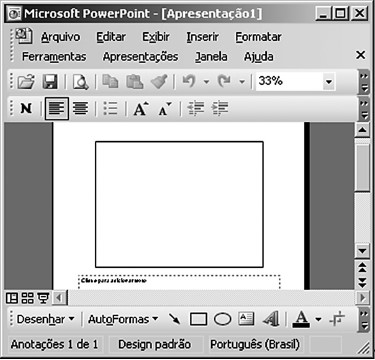
O botão  da barra de ferramentas é utilizado para
Provas
Para a operação com arquivos no ambiente Windows XP são feitas as afirmativas abaixo.
I – Um arquivo com 100KB ocupa mais espaço em disco do que um arquivo com 1GB.
II – Um arquivo do tipo HTML pode ser visualizado através do Internet Explorer.
III – O Windowns XP apresenta recursos que permitem criptografar arquivos.
Está(ão) correta(s) a(s) afirmativa(s)
Provas
O sistema de arquivos que pode ser utilizado pelo Windows XP e que permite um maior nível de segurança e mais recursos, quando comparado aos demais, é
Provas
Um computador é de 16 bits se
Provas
Os softwares de OCR são utilizados para tratar informações geradas a partir do periférico
Provas
Caderno Container