Foram encontradas 40 questões.
"How does TBI (Task Based Instruction) in practice differ from more traditional teaching approaches? Recall our earlier discussion above of the principles of a P-P-P lesson or teaching format: Presentation: The new grammar structure is presented, often by means of a conversation or short text. The teacher explains the new structure and checks students' comprehension of it. Practice: Students practice using the new structure in a controlled context, through drills or substitution exercises. Production: Students practice using the new structure in different contexts often using their own content or information, in order to develop fluency with the new pattern. Advocates of TBI reject this model on the basis that (a) it doesn't work; and (b) it doesn't reflect current understanding of second language acquisition. They claim that students do not develop fluency or progress in their grammatical development through a P-P-P methodology."
Provas

Review of the Literature: Importance of Active Learning
Swain (1985) avowed that language learning is more effective ______________________________the target language is used interactively, particularly in regard to understanding the language in general, and improving their reading or listening skills in particular._______________________ Ellis (1993), interaction within the classroom leads to many advantages for language learning such as comprehension checks, language practice and so on. Long and Porter (1985) found that when second language learners worked in groups, they were more motivated, took more initiative, and were less anxious concerning their learning. ______________________________, there may be a relationship between student oral participation and teachers' questioning techniques and types of classroom activities (Wei, 2008). Wei (2008) also found that students oral participation is increased if application and presentation activities are used; appropriate vocabulary is offered when students need it to continue; questions related to students' prior experiences are asked; and an informal and friendly classroom atmosphere is present. Khamwan (2007) found that after training the students to use interactional strategies _____________________ tools for initiating their interaction, their responses to the teacher's questions were longer and more meaningful. ______________________________, the average number of interaction turns was about two turns per three minutes. It was found that the students could comprehend the lesson better. They could ask their teacher when they could not understand something._________________________________, more students could respond to the teacher's questions. All above mentioned studies have supported the significance of learner's participation and interaction. Many research studies discuss the advantages of active learning techniques that can help students to initiate an interaction with their teachers and ultimately clarify unclear points to enhance their understanding of the lessons and improve creativities. [...] GHOLAMI, Valeh. Towards an Interactive EFL Class: Using Active Learning Strategies .Vol.4, No.19, 2014. (pág.190-1 91)
Provas
Inserted in this context, which one of the items below is not necessarily a concept to be regarded?
Provas
Read the text below in order to answer the question.
Chapter 3
CYBER-SCHOOLING AND TECHNOLOGICAL CHANGE
Multiliteracies for new times
Carmen Luke
Introduction: technological innovation and dissemination
In the last few years, talk about the information superhighway has saturated the media, the marketplace, and the public imagination. Social critics and commentators tell us we are in the midst of a technological and information revolution which will change for ever the way we communicate and conduct our everyday affairs. But what is the information revolution? How do the new technologies impact on our lives now and what might these changes mean for the future? What might all this mean for education, for teachers and students, for teaching and learning?
My aim in this chapter is to provide a guided tour of a range of issues currently being raised about new information technologies (IT) and computer mediation communications (CMC), in relation to schooling and literacy. What is interesting in current debates is that researchers and social commentators are looking at much broader and more long-term social and cultural consequences of the impact of CMC. Even among educators, concerns are not confined exclusively to pedagogical and curriculum issues. It seems that questions about the significant and permanent social changes seeping into every crevice of our everyday work and private lives are on everyone's mind. Many of the issues that are being raised today, and which I will sketch out here, deal with abstract notions about the virtual and 'real'; about time and space; about 'body-less' interactions and comunities of learners; about global access, global culture, and so forth. But despite what appears to be a highly abstract debate, it nonetheless has concrete implications for schooling as we know it and all the traditional industrial model precepts and practices developed within that model. And yet the radical technological changes we now hear about in the media - most of which are framed in either a technophobic 'crisis' or else protechnology 'panacea' rhetoric - have been with us for quite some time.
Of all the innovations in communications technologies over the past two decades, the video cassette recorder (VCR), computer, and now the global network of the Internet have had the most profound effect on home entertainment, education, and workplace practice.
[...]
Today, the Internet is generating equally profound changes in the way we communicate, and how we access, produce, and distribute information and knowledge. Yet the Internet too is generating virulent responses from the public and social critics about its 'anarchic' nature: the inability to control it, to censor it, to manage and limit it. The Internet gets a lot of bad press particularly in relation to that age-old concern over various forms of pornography, privacy and sexual harassment, issues concerning 'electronic stalking', and questions of ownership, monopoly, and unequal access. By the same token, the huge educational (and entrepreneurial) potential of the Internet - popularised as the information superhighway - often gets lauded to the point of blind faith.
Literacy requirements have changed and will continue to change as new technologies come on the marketplace and quickly blend into our everyday private and work lives.
[...]
I - Internet is generating new ways to access, produce, and distribute information and knowledge. II - Scholarship system has barely taken hypertextuality into consideration. III - Teaching students about new technologies has not been a high priority in the school curriculum. IV - Even among educators, the discussion about the impact of technological changes in our everyday lives is not confined exclusively to pedagogical and curriculum issues.
The CORRECT answer is:
Provas
Read the text below in order to answer the question.
Chapter 3
CYBER-SCHOOLING AND TECHNOLOGICAL CHANGE
Multiliteracies for new times
Carmen Luke
Introduction: technological innovation and dissemination
In the last few years, talk about the information superhighway has saturated the media, the marketplace, and the public imagination. Social critics and commentators tell us we are in the midst of a technological and information revolution which will change for ever the way we communicate and conduct our everyday affairs. But what is the information revolution? How do the new technologies impact on our lives now and what might these changes mean for the future? What might all this mean for education, for teachers and students, for teaching and learning?
My aim in this chapter is to provide a guided tour of a range of issues currently being raised about new information technologies (IT) and computer mediation communications (CMC), in relation to schooling and literacy. What is interesting in current debates is that researchers and social commentators are looking at much broader and more long-term social and cultural consequences of the impact of CMC. Even among educators, concerns are not confined exclusively to pedagogical and curriculum issues. It seems that questions about the significant and permanent social changes seeping into every crevice of our everyday work and private lives are on everyone's mind. Many of the issues that are being raised today, and which I will sketch out here, deal with abstract notions about the virtual and 'real'; about time and space; about 'body-less' interactions and comunities of learners; about global access, global culture, and so forth. But despite what appears to be a highly abstract debate, it nonetheless has concrete implications for schooling as we know it and all the traditional industrial model precepts and practices developed within that model. And yet the radical technological changes we now hear about in the media - most of which are framed in either a technophobic 'crisis' or else protechnology 'panacea' rhetoric - have been with us for quite some time.
Of all the innovations in communications technologies over the past two decades, the video cassette recorder (VCR), computer, and now the global network of the Internet have had the most profound effect on home entertainment, education, and workplace practice.
[...]
Today, the Internet is generating equally profound changes in the way we communicate, and how we access, produce, and distribute information and knowledge. Yet the Internet too is generating virulent responses from the public and social critics about its 'anarchic' nature: the inability to control it, to censor it, to manage and limit it. The Internet gets a lot of bad press particularly in relation to that age-old concern over various forms of pornography, privacy and sexual harassment, issues concerning 'electronic stalking', and questions of ownership, monopoly, and unequal access. By the same token, the huge educational (and entrepreneurial) potential of the Internet - popularised as the information superhighway - often gets lauded to the point of blind faith.
Literacy requirements have changed and will continue to change as new technologies come on the marketplace and quickly blend into our everyday private and work lives.
[...]
( ) Technological changes have a profound impact on education and on our everyday lives. ( ) Multiliteracy is a concept profoundly linked to technological changes. ( ) The Internet has changed the way we conceive the reading of a text. ( ) In terms of critical literacy, the basic principles of hypertextuality are different from print texts.
The CORRECT sequence is
Provas
Read the text and choose the correct answer.
English learners and the four skills
When it comes to English language skills, reading is the most frequent activity - among those that already study and those that intend to, 76% read frequently. Many however, report difficulties with conversation and listening - even among those that have already studied or are studying English. The respondents' selfassessments show that the greatest difference between those that have studied or are currently studying English and those that intend to in the future is the skill of 'listening'. Those intending to study English considered this the area that they are least proficient in. The perception that their speaking ability is insufficient led the participants to cite speaking (50% of respondents) and listening (37% of respondents) among the skills that are most important to develop in a course. This is perceived to be more important than grammar. The preferred methods of teaching tend to be those that stimulate conversation; respondents prefer classes in English that "force" the development of the students' abilities. Respondents tended to think that this conversation should be stimulated before going in-depth into language and grammar rules. To them, the best way of practicing this is discussing current affairs directly relevant to their professional and personal lives. The reduced importance placed on writing and reading relative to speaking is also attributable to the availability of tools for written communication.
Frequency of use of English skill
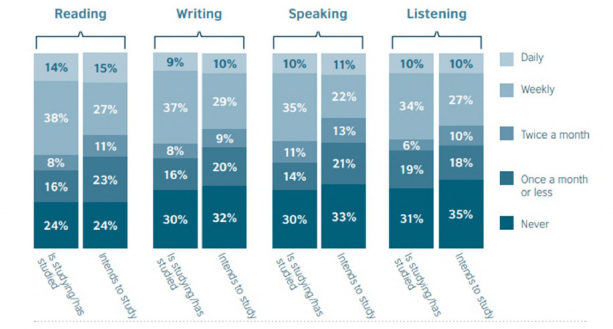
BRITISH COUNCIL. Learning English in Brazil: Understanding the aims and expectations of the Brazilian emerging middle classes. 1 st Edition, São Paulo.
2014 (p.22)
Provas
What Swales has stated is seemingly clear that genre has a number of characteristic and features such as a) genre has a particular communication event, b) genre has a specific goal (goal oriented), c) genre is different and various in accordance to its typical features, d) each genre has a matter of limitation and rules including content, physical form, and shape, and e) every genre belongs to a certain discourse community. In line with discourse community, (Widdoson, 2007) adds that genre is shaped or existing due to the existing discourse community. It is a fact that different discourse community has different genre. Talking about discourse community and genre in connection to the discourse community, Swales (1990), as cited by (Ohoiwutun, 1996), clarifies that characteristics of discourse community in terms of the usage of language in social context is a) a certain discourse community has certain communication goals approved, b) the discourse community communicate within its members, c) a certain discourse community use a certain pattern of communication for its members, d) the discourse community tends to have more than one types of genre to communicate , and e) the discourse community, at last gains a number specific register. (p.45)
Dirgeyasa, I Wy. Genre-Based Approach: What and How to Teach and to Learn Writing. English Language Teaching; Vol. 9, No. 9; 2016
Provas
Provas
Which one of the statements below does not constitute "a new configuration" under the referred document?
Provas
( ) Reading has to do with the distribution of knowledge and power in a society. ( ) Writing is related to the production of meaningful and contextualized uses of the foreign language. ( ) The reader is considered someone who assumes a position or an epistemological relation with regard to values, ideologies, discourses, and world perspectives. ( ) Writing is defined as a set of various sociocultural practices.
The CORRECT sequence is:
Provas
Caderno Container