Foram encontradas 70 questões.
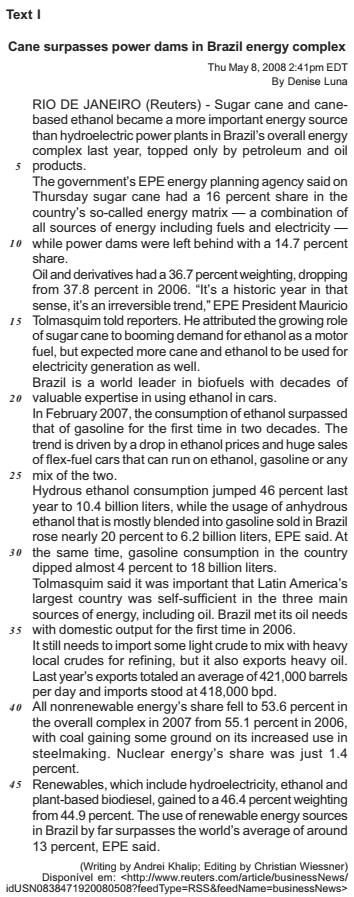
Cane surpasses power dams in Brazil energy complex
Thu May 8, 2008 2:41pm EDT
By Denise Luna
RIO DE JANEIRO (Reuters) - Sugar cane and cane-based ethanol became a more important energy source than hydroelectric power plants in Brazil’s overall energy complex last year, topped only by petroleum and oil products.
The government’s EPE energy planning agency said on Thursday sugar cane had a 16 percent share in the country’s so-called energy matrix — a combination of all sources of energy including fuels and electricity — while power dams were left behind with a 14.7 percent share.
Oil and derivatives had a 36.7 percent weighting, dropping from 37.8 percent in 2006. “It’s a historic year in that sense, it’s an irreversible trend,” EPE President Mauricio Tolmasquim told reporters. He attributed the growing role of sugar cane to booming demand for ethanol as a motor fuel, but expected more cane and ethanol to be used for electricity generation as well.
Brazil is a world leader in biofuels with decades of valuable expertise in using ethanol in cars.
In February 2007, the consumption of ethanol surpassed that of gasoline for the first time in two decades. The trend is driven by a drop in ethanol prices and huge sales of flex-fuel cars that can run on ethanol, gasoline or any mix of the two.
Hydrous ethanol consumption jumped 46 percent last year to 10.4 billion liters, while the usage of anhydrous ethanol that is mostly blended into gasoline sold in Brazil rose nearly 20 percent to 6.2 billion liters, EPE said. At the same time, gasoline consumption in the country dipped almost 4 percent to 18 billion liters.
Tolmasquim said it was important that Latin America’s largest country was self-sufficient in the three main sources of energy, including oil. Brazil met its oil needs with domestic output for the first time in 2006.
It still needs to import some light crude to mix with heavy local crudes for refining, but it also exports heavy oil. Last year’s exports totaled an average of 421,000 barrels per day and imports stood at 418,000 bpd.
All nonrenewable energy’s share fell to 53.6 percent in the overall complex in 2007 from 55.1 percent in 2006, with coal gaining some ground on its increased use in steelmaking. Nuclear energy’s share was just 1.4 percent.
Renewables, which include hydroelectricity, ethanol and plant-based biodiesel, gained to a 46.4 percent weighting from 44.9 percent. The use of renewable energy sources in Brazil by far surpasses the world’s average of around 13 percent, EPE said.
(Writing by Andrei Khalip; Editing by Christian Wiessner) Disponível em: <http://www.reuters.com/article/businessNews/idUSN0838471920080508?feedType=RSS&feedName=businessNews>
The fragment “The use of renewable energy sources in Brazil by far surpasses the world’s average of around 13 percent,” means that Brazil
Provas

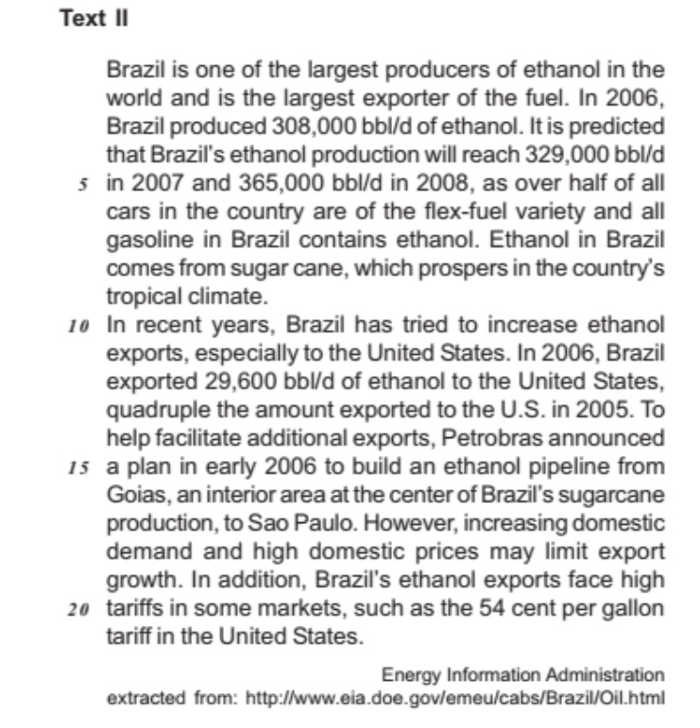
Brazil is one of the largest producers of ethanol in the world and is the largest exporter of the fuel. In 2006, Brazil produced 308,000 bbl/d of ethanol. It is predicted that Brazil’s ethanol production will reach 329,000 bbl/d in 2007 and 365,000 bbl/d in 2008, as over half of all cars in the country are of the flex-fuel variety and all gasoline in Brazil contains ethanol. Ethanol in Brazil comes from sugar cane, which prospers in the country’s tropical climate.
In recent years, Brazil has tried to increase ethanol exports, especially to the United States. In 2006, Brazil exported 29,600 bbl/d of ethanol to the United States, quadruple the amount exported to the U.S. in 2005. To help facilitate additional exports, Petrobras announced a plan in early 2006 to build an ethanol pipeline from Goias, an interior area at the center of Brazil’s sugarcane production, to Sao Paulo. However, increasing domestic demand and high domestic prices may limit export growth. In addition, Brazil’s ethanol exports face high tariffs in some markets, such as the 54 cent per gallon tariff in the United States.
Energy Information Administration extracted from: http://www.eia.doe.gov/emeu/cabs/Brazil/Oil.html
According to Paragraph 2 in the text, Brazilian exports of canebased ethanol
Provas
Comparing Text I and Text II, it is correct to say that
Provas


Provas


Provas
Segundo as NBR ISO 9000/2000 e NBR ISO 9004/2000, são princípios de gestão da qualidade todos os itens abaixo, EXCETO
Provas
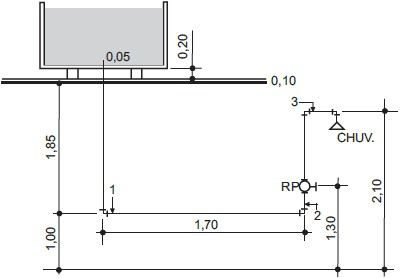
Considere que a instalação hidráulica predial abaixo conduz uma vazão de 0,20 !$ \ell !$/s, sendo que o ramal 1-2 possui diâmetro de 1” e perda de carga unitária 0,0135 m/m, enquanto o sub-ramal 2-3 possui diâmetro 3/4” e perda de carga unitária 0,0560 m/m.
|
Singularidades |
Comprimentos equivalentes |
|
Joelho de 90º com redução de 1” para 3/4” |
0,8 m |
|
Joelho de 90º de 3/4” |
0,7 m |
|
Registro de globo aberto 3/4” |
6,7 m |
Desprezando os efeitos da carga cinética e as perdas de cargas a partir do ponto 3 (logo após o 3º joelho de 90º), e considerando a tabela acima, se a pressão disponível no ponto 1 (logo após o 1º joelho de 90º) é igual a 2,659 m.c.a., então a pressão disponível no chuveiro, em m.c.a, é
Provas
De acordo com a NBR 13752:1993 (Perícias de engenharia na construção civil), define-se decrepitude como sendo a depreciação de um bem decorrente
Provas
De acordo com a NBR 5674:1999 (Manutenção de edificações - Procedimento), considere as afirmativas a seguir.
I - O projeto de um serviço de manutenção deve incluir, entre outros, as especificações detalhadas dos materiais, os procedimentos de execução e os desenhos e plantas, incluindo detalhes.
II - Todos os serviços de manutenção devem ser definidos em planos de curto, médio e longo prazos, de maneira a minimizar a interferência dos serviços de manutenção no uso da edificação e a interferência dos usuários sobre a execução dos serviços de manutenção.
III - Para a programação dos serviços de manutenção devem ser consideradas, entre outras, as solicitações e reclamações dos usuários e também as restrições climáticas e ambientais.
IV - A contratação de serviços de terceiros para manutenção de edificações pode ser feita com base em contrato global ou por administração, não podendo ser baseada em preço unitário.
Estão CORRETAS as afirmativas
Provas
Em relação ao conforto nas edificações, a climatização de ambientes é uma das ações que visam a melhorar o bem-estar das pessoas em edificações residenciais, comerciais e industriais. Desta forma, acerca dos conhecimentos de instalações de ar condicionado, julgue os itens a seguir.
I - De um modo geral, o condicionamento de ar controla, além da temperatura, a umidade relativa e a pureza do ar.
II - A espessura das chapas com que são construídos os dutos das redes de ar condicionado é função da temperatura mínima esperada e do ambiente.
III - As ligações dos dutos às unidades condicionadoras deverão ser feitas por meio de conexões flexíveis.
IV - A tubulação de água de condensação não necessita de isolamento térmico.
Estão corretos APENAS os itens
Provas
Caderno Container