Foram encontradas 603 questões.
The term redundancy refers to a parallel or alternate path in a system architecture to meet system requirements in two or more independent ways. The purpose of a redundant system is to improve reliability. There are two general approaches to redundancy implementation: system redundancy and component redundancy. System redundancy involves the connection of two identical systems in parallel between system inputs and system outputs. In the event of a failure of the active system, the inactive or backup system can be switched on to replace the failed system. A variation of system redundancy is the use of a hot backup system. In this approach, both prime and backup systems are in the “on” state. There are manual and automatic approaches to recognizing system failures and effecting a switchover from the failed system to the backup system.
Software and firmware play a dominant role in the implementation of redundant systems. Many of the built-in tests are in software or embedded in firmware. Setting and resetting the watchdog timer and updating the checkpoint restart memory are software functions. Switchover and restart are also software functions.
The concept of component redundancy suggests making redundant only those subsystems or components that are relatively unreliable. In many cases, by making a few critical components in a system redundant, one can provide enough improvement in overall reliability to meet the system reliability requirements. For example, in a redundant automobile braking system the brake pedal and linkage are not redundant (simplex) while the master brake cylinder is redundant. The same concerns in system redundancy implementation regarding failure detection and switch over are also found in component redundancy implementation. In the braking system just described, a failure of one master cylinder results in degraded braking performance. This system is better described as fault tolerant.
A. Behforooz, F. J. Hudson. Software engineering
fundamentals. F. J. Oxford University Press.
fundamentals. F. J. Oxford University Press.
As found in the text, it is correct to state that
Provas
Questão presente nas seguintes provas

The term redundancy refers to a parallel or alternate path in a system architecture to meet system requirements in two or more independent ways. The purpose of a redundant system is to improve reliability. There are two general approaches to redundancy implementation: system redundancy and component redundancy. System redundancy involves the connection of two identical systems in parallel between system inputs and system outputs. In the event of a failure of the active system, the inactive or backup system can be switched on to replace the failed system. A variation of system redundancy is the use of a hot backup system. In this approach, both prime and backup systems are in the “on” state. There are manual and automatic approaches to recognizing system failures and effecting a switchover from the failed system to the backup system.
Software and firmware play a dominant role in the implementation of redundant systems. Many of the built-in tests are in software or embedded in firmware. Setting and resetting the watchdog timer and updating the checkpoint restart memory are software functions. Switchover and restart are also software functions.
The concept of component redundancy suggests making redundant only those subsystems or components that are relatively unreliable. In many cases, by making a few critical components in a system redundant, one can provide enough improvement in overall reliability to meet the system reliability requirements. For example, in a redundant automobile braking system the brake pedal and linkage are not redundant (simplex) while the master brake cylinder is redundant. The same concerns in system redundancy implementation regarding failure detection and switch over are also found in component redundancy implementation. In the braking system just described, a failure of one master cylinder results in degraded braking performance. This system is better described as fault tolerant.
A. Behforooz, F. J. Hudson. Software engineering
fundamentals. F. J. Oxford University Press.
fundamentals. F. J. Oxford University Press.
According to the text, choose the option regarding hot backup systems.
Provas
Questão presente nas seguintes provas
The term redundancy refers to a parallel or alternate path in a system architecture to meet system requirements in two or more independent ways. The purpose of a redundant system is to improve reliability. There are two general approaches to redundancy implementation: system redundancy and component redundancy. System redundancy involves the connection of two identical systems in parallel between system inputs and system outputs. In the event of a failure of the active system, the inactive or backup system can be switched on to replace the failed system. A variation of system redundancy is the use of a hot backup system. In this approach, both prime and backup systems are in the “on” state. There are manual and automatic approaches to recognizing system failures and effecting a switchover from the failed system to the backup system.
Software and firmware play a dominant role in the implementation of redundant systems. Many of the built-in tests are in software or embedded in firmware. Setting and resetting the watchdog timer and updating the checkpoint restart memory are software functions. Switchover and restart are also software functions.
The concept of component redundancy suggests making redundant only those subsystems or components that are relatively unreliable. In many cases, by making a few critical components in a system redundant, one can provide enough improvement in overall reliability to meet the system reliability requirements. For example, in a redundant automobile braking system the brake pedal and linkage are not redundant (simplex) while the master brake cylinder is redundant. The same concerns in system redundancy implementation regarding failure detection and switch over are also found in component redundancy implementation. In the braking system just described, a failure of one master cylinder results in degraded braking performance. This system is better described as fault tolerant.
A. Behforooz, F. J. Hudson. Software engineering
fundamentals. F. J. Oxford University Press.
fundamentals. F. J. Oxford University Press.
Taking into consideration what is found in the text, choose the correct option.
Provas
Questão presente nas seguintes provas
The term redundancy refers to a parallel or alternate path in a system architecture to meet system requirements in two or more independent ways. The purpose of a redundant system is to improve reliability. There are two general approaches to redundancy implementation: system redundancy and component redundancy. System redundancy involves the connection of two identical systems in parallel between system inputs and system outputs. In the event of a failure of the active system, the inactive or backup system can be switched on to replace the failed system. A variation of system redundancy is the use of a hot backup system. In this approach, both prime and backup systems are in the “on” state. There are manual and automatic approaches to recognizing system failures and effecting a switchover from the failed system to the backup system.
Software and firmware play a dominant role in the implementation of redundant systems. Many of the built-in tests are in software or embedded in firmware. Setting and resetting the watchdog timer and updating the checkpoint restart memory are software functions. Switchover and restart are also software functions.
The concept of component redundancy suggests making redundant only those subsystems or components that are relatively unreliable. In many cases, by making a few critical components in a system redundant, one can provide enough improvement in overall reliability to meet the system reliability requirements. For example, in a redundant automobile braking system the brake pedal and linkage are not redundant (simplex) while the master brake cylinder is redundant. The same concerns in system redundancy implementation regarding failure detection and switch over are also found in component redundancy implementation. In the braking system just described, a failure of one master cylinder results in degraded braking performance. This system is better described as fault tolerant.
A. Behforooz, F. J. Hudson. Software engineering
fundamentals. F. J. Oxford University Press.
fundamentals. F. J. Oxford University Press.
The text deals with the concept of redundancy which
Provas
Questão presente nas seguintes provas
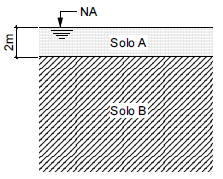
A figura acima, mostra o desenho do perfil de um terreno natural sob condições geostáticas em que a posição do nível de água freático coincide com a superfície do terreno. Os pesos específicos saturados dos solos A e B são iguais a 18 kN/m³ e 20 kN/m³, respectivamente. Admitindo-se que as camadas de solo abaixo do nível das águas estejam saturadas e que o coeficiente de empuxo no repouso do solo B é igual a 0,5, pode-se afirmar que a tensão total horizontal ( !$ σ_h !$), em kPa, a uma profundidade igual a 4m, a partir da superfície do terreno, é tal que
Provas
Questão presente nas seguintes provas
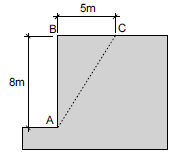
A figura acima mostra o corte de um trecho do terreno indicado pelas letras A, B e C relativo a um serviço de terraplenagem. Admitindo-se que as características geométricas da seção transversal apresentada no desenho se repitam por uma grande distância na direção normal ao plano do desenho e sabendo-se que o fator de empolamento do solo local é igual a 20%, pode-se afirmar que o volume de solo (V) a ser transportado por unidade de comprimento normal ao plano do desenho, expresso em m3/m, devido à operação de corte é tal que
Provas
Questão presente nas seguintes provas
Caso o pórtico seja maciço e tenha seção transversal quadrada com lado igual a 12 cm, a tensão normal de tração máxima !$ ( \sigma ) !$ atuante na seção transversal no apoio B, em MPa, é tal que
Provas
Questão presente nas seguintes provas
Considere o pórtico, com peso desprezível, submetido a um carregamento uniformemente distribuído e igual a 20 kN/m apresentado na figura abaixo:
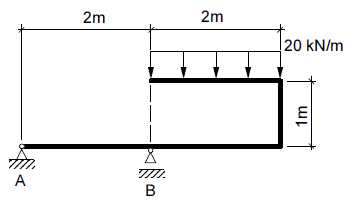
Para as condições do desenho, o módulo do momento fletor ( !$ M_a !$) no apoio B, em kNm, é tal que
Provas
Questão presente nas seguintes provas
A pedologia é ciência relativamente recente que estuda o solo, tendo como base a descrição e o exame do seu perfil em meio natural. A descrição completa do solo, realizada em estudo no campo, deve incluir a delimitação dos horizontes e camadas (O, A, B, C e R) com identificação e registro das características morfológicas de cada um(a) individualmente, caracterizando transição entre horizontes ou camadas, profundidade e espessura, cor, textura, estrutura, consistência etc. Depois de descritos e caracterizados, os solos são classificados em sistemas taxonômicos organizados e delimitados em mapas cartográficos.
Braga et al. Introdução à engenharia
ambiental, 2.ª ed. São Paulo: Pearson Prentice
Hall, 2005 (com adaptações ) .
ambiental, 2.ª ed. São Paulo: Pearson Prentice
Hall, 2005 (com adaptações ) .
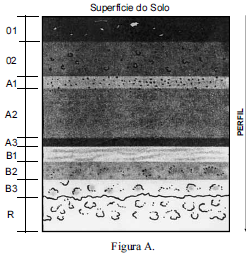
A respeito de pedologia e horizontes do solo, assinale a opção correta.
Provas
Questão presente nas seguintes provas
2379952
Ano: 2008
Disciplina: Engenharia Ambiental e Sanitária
Banca: CESPE / CEBRASPE
Orgão: TCE-TO
Disciplina: Engenharia Ambiental e Sanitária
Banca: CESPE / CEBRASPE
Orgão: TCE-TO
Os gráficos abaixo possuem ambos os eixos na mesma escala. No mesmo município, os gráficos representam eventos de chuva idênticos e as cotas verificadas no rio da localidade. O segundo evento ocorreu 20 anos depois do primeiro.
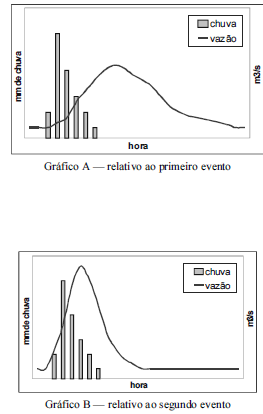
Com base na análise dos gráficos acima, assinale a opção correta.
Provas
Questão presente nas seguintes provas
Cadernos
Caderno Container