Foram encontradas 94 questões.
Durante o treinamento de uma rede neural artificial para classificação de imagens, foi observado o comportamento descrito pelo gráfico abaixo, que mostra a evolução do erro conforme o número de iterações.
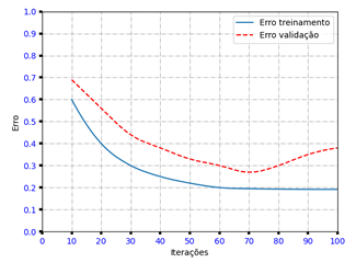
O classificador em questão foi treinado em um conjunto de dados particionado (holdout) em 60%/30%/10% (treinamento/validação/teste). Entretanto, os especialistas envolvidos consideraram o modelo obtido insatisfatório após analisarem o gráfico.
Considerando essas informações, duas técnicas que poderiam ser utilizadas para contornar o problema encontrado são:
Provas

Apesar dos esforços que têm aperfeiçoado o processo de planejamento orçamentário na administração pública brasileira, há previsão da realização de alterações orçamentárias ao longo do exercício financeiro. Tais alterações são limitadas, entre outros fatores, por imposições legais e restrições de recursos.
Um desafio para o controle externo analisar o montante e o impacto da abertura de créditos adicionais no orçamento é a:
Provas
Observe a charge a seguir.

A interpretação de texto refere-se à decodificação dos significados dos componentes textuais, enquanto a compreensão diz respeito aos processos geradores de significação.
A pergunta abaixo que diz respeito à interpretação, e não à compreensão, é:
Provas
Um relatório produzido em determinada seção do serviço público trazia, inadequadamente, uma série de frases em discurso direto.
O chefe da seção solicitou, então, ao funcionário autor do relatório que modificasse tais frases para o discurso indireto, o que foi imediatamente feito; a frase em que essa modificação solicitada foi realizada de forma adequada é:
Provas
Há dois textos de temática semelhante a seguir.
Texto 1 – “Um mestre (Jesus) em que parece haver tanta autoridade, ainda que sua doutrina seja obscura, merece que seja crido por palavra... pode-se reconhecer sua autoridade, tendo em vista o respeito que lhe rendem Moisés e Elias; isto é, a lei e os profetas, como já expliquei... Não procuremos as razões das verdades que ele nos ensina: toda a razão, é que ele as falou.”
Texto 2 – “Certas pessoas têm fé porque seus pais os ensinaram a crer. Num sentido, é satisfatório: nenhum axioma filosófico abalará essa fé; num outro sentido, é insatisfatório, porque sua fé não vem de conhecimento pessoal.
Outros chegam à fé pela convicção após estudos. Isso é satisfatório num ponto: eles conhecem Deus por íntima convicção; por outro lado, é insatisfatório porque se outros lhes demonstram a falsidade de seu raciocínio, eles podem tornar-se descrentes.”
Comparando os dois textos, é correto afirmar que:
Provas
Internal audit’s role in ESG reporting
Conversations and focus on sustainability, typically grouped into environmental, social and governance (ESG) issues, are quickly evolving — from activist investor groups and inquisitive regulators pushing for change to governing bodies and C-suite executives struggling to understand and embrace the concept. At the forefront of this new risk area is pressure for organizations to make public commitments to sustainability and provide routine updates to ESG-related strategies, goals, and metrics that are accurate and relevant. However, ESG reporting is still immature, and there is not a lot of definitive guidance for organizations in this space. For example, there is no single standard for what should be reported.
What is clear is that strong governance over ESG — as with effective governance overall — requires alignment among the principal players as outlined in The Internal Institute of Auditors (IIA) Three Lines Model. As with any risk area, internal audit should be well-positioned to support the governing body and management with objective assurance, insights, and advice on ESG matters.
Embarking on the ESG journey
Efforts to mitigate the accelerating effects of climate change and address perceived historical social inequities are two powerful issues driving change globally. These movements have enhanced awareness of how all organizations impact, influence, and interact with society and the environment.
They also have spurred organizations to better recognize and manage ESG risks (i.e., risks associated with how organizations operate in respect to their impact on the world around them). This broad risk category includes areas that are dynamic and often driven by factors that can be difficult to measure objectively.
Still, there is growing urgency for organizations to understand and manage ESG risks, particularly as investors and regulators focus on organizations producing high-quality reporting on sustainability efforts. What’s more, that pressure is being reflected increasingly in executive performance as more organizations tie incentive compensation metrics to ESG goals.
As ESG reporting becomes increasingly common, it should be treated with the same care as financial reporting. Organizations need to recognize that ESG reporting must be built on a strategically crafted system of internal controls and accurately reflect how an organization’s ESG efforts relate to each other, the organization’s finances, and value creation.
Internal audit can and should play a significant role in an organization’s ESG journey. It can add value in an advisory capacity by helping to identify and establish a functional ESG control environment. It also can offer critical assurance support by providing an independent and objective review of the effectiveness of ESG risk assessments, responses, and controls.
Source: Adapted from https://na.theiia.org/about-ia/PublicDocuments/White-Paper-Internal-Audits-Role-in-ESG-Reporting.pdf
The sentence that best expresses the idea that parties involved in the administration should follow a similar orientation:
Provas
Internal audit’s role in ESG reporting
Conversations and focus on sustainability, typically grouped into environmental, social and governance (ESG) issues, are quickly evolving — from activist investor groups and inquisitive regulators pushing for change to governing bodies and C-suite executives struggling to understand and embrace the concept. At the forefront of this new risk area is pressure for organizations to make public commitments to sustainability and provide routine updates to ESG-related strategies, goals, and metrics that are accurate and relevant. However, ESG reporting is still immature, and there is not a lot of definitive guidance for organizations in this space. For example, there is no single standard for what should be reported.
What is clear is that strong governance over ESG — as with effective governance overall — requires alignment among the principal players as outlined in The Internal Institute of Auditors (IIA) Three Lines Model. As with any risk area, internal audit should be well-positioned to support the governing body and management with objective assurance, insights, and advice on ESG matters.
Embarking on the ESG journey
Efforts to mitigate the accelerating effects of climate change and address perceived historical social inequities are two powerful issues driving change globally. These movements have enhanced awareness of how all organizations impact, influence, and interact with society and the environment.
They also have spurred organizations to better recognize and manage ESG risks (i.e., risks associated with how organizations operate in respect to their impact on the world around them). This broad risk category includes areas that are dynamic and often driven by factors that can be difficult to measure objectively.
Still, there is growing urgency for organizations to understand and manage ESG risks, particularly as investors and regulators focus on organizations producing high-quality reporting on sustainability efforts. What’s more, that pressure is being reflected increasingly in executive performance as more organizations tie incentive compensation metrics to ESG goals.
As ESG reporting becomes increasingly common, it should be treated with the same care as financial reporting. Organizations need to recognize that ESG reporting must be built on a strategically crafted system of internal controls and accurately reflect how an organization’s ESG efforts relate to each other, the organization’s finances, and value creation.
Internal audit can and should play a significant role in an organization’s ESG journey. It can add value in an advisory capacity by helping to identify and establish a functional ESG control environment. It also can offer critical assurance support by providing an independent and objective review of the effectiveness of ESG risk assessments, responses, and controls.
Source: Adapted from https://na.theiia.org/about-ia/PublicDocuments/White-Paper-Internal-Audits-Role-in-ESG-Reporting.pdf
According to the text, “C-suite executives” (first paragraph), that is, those in top positions within a company, have been:
Provas
Internal audit’s role in ESG reporting
Conversations and focus on sustainability, typically grouped into environmental, social and governance (ESG) issues, are quickly evolving — from activist investor groups and inquisitive regulators pushing for change to governing bodies and C-suite executives struggling to understand and embrace the concept. At the forefront of this new risk area is pressure for organizations to make public commitments to sustainability and provide routine updates to ESG-related strategies, goals, and metrics that are accurate and relevant. However, ESG reporting is still immature, and there is not a lot of definitive guidance for organizations in this space. For example, there is no single standard for what should be reported.
What is clear is that strong governance over ESG — as with effective governance overall — requires alignment among the principal players as outlined in The Internal Institute of Auditors (IIA) Three Lines Model. As with any risk area, internal audit should be well-positioned to support the governing body and management with objective assurance, insights, and advice on ESG matters.
Embarking on the ESG journey
Efforts to mitigate the accelerating effects of climate change and address perceived historical social inequities are two powerful issues driving change globally. These movements have enhanced awareness of how all organizations impact, influence, and interact with society and the environment.
They also have spurred organizations to better recognize and manage ESG risks (i.e., risks associated with how organizations operate in respect to their impact on the world around them). This broad risk category includes areas that are dynamic and often driven by factors that can be difficult to measure objectively.
Still, there is growing urgency for organizations to understand and manage ESG risks, particularly as investors and regulators focus on organizations producing high-quality reporting on sustainability efforts. What’s more, that pressure is being reflected increasingly in executive performance as more organizations tie incentive compensation metrics to ESG goals.
As ESG reporting becomes increasingly common, it should be treated with the same care as financial reporting. Organizations need to recognize that ESG reporting must be built on a strategically crafted system of internal controls and accurately reflect how an organization’s ESG efforts relate to each other, the organization’s finances, and value creation.
Internal audit can and should play a significant role in an organization’s ESG journey. It can add value in an advisory capacity by helping to identify and establish a functional ESG control environment. It also can offer critical assurance support by providing an independent and objective review of the effectiveness of ESG risk assessments, responses, and controls.
Source: Adapted from https://na.theiia.org/about-ia/PublicDocuments/White-Paper-Internal-Audits-Role-in-ESG-Reporting.pdf
The excerpt “Efforts to mitigate the accelerating effects of climate change” (third paragraph) indicates that, if effective, the speed of climate change will be:
Provas
Uma sociedade empresária possui duas alternativas de investimento, mutuamente excludentes (não podem ocorrer simultaneamente), X e Y, ambas com a mesma duração e com valor presente líquido positivo.
A taxa interna de retorno (TIR) para o projeto X é de 15%; para o projeto Y, de 13%; e para o projeto diferencial Y-X, de 11%.
O projeto X é preferível ao Y somente para taxas mínimas de atratividade da empresa:
Provas
A Declaração de Lima, aprovada pela Organização Internacional de Entidades Fiscalizadoras Superiores (Intosai), estabelece diretrizes para preceitos de auditoria e afirma que as Entidades Fiscalizadoras Superiores (EFS) só podem desempenhar suas tarefas objetiva e eficazmente quando são independentes da entidade auditada e protegidas contra influências externas.
No sistema constitucional brasileiro de 1988, a independência das EFSs é assegurada por meio do(a):
Provas
Caderno Container