Foram encontradas 240 questões.
Oferta interna de energia, Brasil, 1940-2012
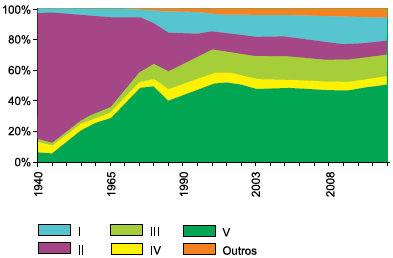
(Empresa de Pesquisa Energética (Brasil). Balanço energético nacional 2013, 2013. Adaptado.)
Considerando as características da matriz energética brasileira, no gráfico,
Provas

O quilombo significou uma alternativa concreta à ordem escravista — e, por isso, tornou-se um problema real e bastante amedrontador para a sociedade colonial e para as autoridades, que precisavam combatê-lo de modo sistemático. Mas, ao mesmo tempo, o quilombo era parte da sociedade que o reprimia, em função dos diversos vínculos que tinha com os diferentes setores desta. Tais vínculos, de natureza muito variada, incluíam a criação de toda sorte de relações comerciais com as populações vizinhas, a formação de redes mais ou menos complexas para obtenção de informações e, como não poderia deixar de ser, o cultivo de um sem- -número de laços afetivos e amorosos que se entrecruzavam nas periferias urbanas e nas fazendas.
(Lilia M. Schwarcz e Heloisa M. Starling. Brasil: uma biografia, 2018.)
Os quilombos existentes no Brasil colonial podem ser caracterizados como espaços
Provas
Leia o texto para responder a questão.
When will the Amazon hit a tipping point?
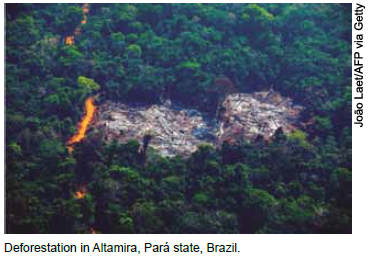
Scientists say climate change, deforestation and fires could cause the world’s largest rainforest to dry out. The big question is how soon that might happen. Seen from a monitoring tower above the treetops near Manaus, in the Brazilian Amazon, the rainforest canopy stretches to the horizon as an endless sea of green. It looks like a rich and healthy ecosystem, but appearances are deceiving. This rainforest — which holds 16,000 separate tree species — is slowly drying out.
Over the past century, the average temperature in the forest has risen by 1-1.5 oC. In some parts, the dry season has expanded during the past 50 years, from four months to almost five. Severe droughts have hit three times since 2005. That’s all driving a shift in vegetation. In 2018, a study reported that trees that do best in moist conditions, such as tropical legumes from the genus Inga, are dying. Those adapted to drier climes, such as the Brazil nut tree (Bertholletia excelsa), are thriving.
At the same time, large parts of the Amazon, the world’s largest rainforest, are being cut down and burnt. Tree clearing has already shrunk the forest by around 15% from its 1970s extent of more than 6 million square kilometres; in Brazil, which contains more than half the forest, more than 19% has disappeared. Last year, deforestation in Brazil spiked by around 30% to almost 10,000 km2, the largest loss in a decade. And in August 2019, videos of wildfires in the Amazon made international headlines. The number of fires that month was the highest for any August since an extreme drought in 2010.
(www.nature.com, 25.02.2020. Adaptado.)
According to the first paragraph, the Amazon rainforest
Provas
Artigo 1º – Todos os escravos, que entrarem no território ou portos do Brasil, vindos de fora, ficam livres [...].
Artigo 2º – Os importadores de escravos no Brasil incorrerão na pena corporal do artigo cento e setenta e nove do Código Criminal, imposta aos que reduzem à escravidão pessoas livres [...].
(Lei de 7 de novembro de 1831. https://camara.leg.br.)
A Lei de 7 de novembro de 1831, também conhecida como “Lei Feijó”,
Provas
A figura mostra a visão aérea de um parque onde existem ruas que podem ser utilizadas para corridas e caminhadas. Nesse parque há uma pista ABCA em que uma pessoa corre dando voltas sucessivas.
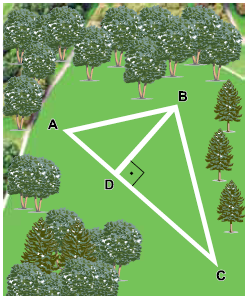
Considerando que as medidas dos segmentos AB, BC e AC são, respectivamente, 60 m, 80 m e 100 m, e que o tempo cronometrado para dar uma volta no trecho BCDB foi de 40 s, a velocidade escalar média desenvolvida por essa pessoa nessa volta foi de
Provas
Analise o quadro, que apresenta assuntos debatidos em determinada organização internacional.
| Debates e críticas realizadas |
| 1. Ao sistema financeiro internacional desregulado e especulativo. |
| 2. Às desigualdades sociais manifestas em diversas escalas. |
| 3. Às várias formas de violação dos direitos humanos e sociais nas diferentes regiões do planeta. |
| 4. Aos limites da democracia representativa, com defesa da democracia participativa. |
| 5. Às práticas autoritárias e antidemocráticas levadas a cabo por governantes. |
| 6. Às guerras predatórias com fins econômicos. |
| 7. À destruição da biodiversidade e dos ecossistemas do planeta. |
| 8. Ao consumo exagerado e ambientalmente insustentável. |
(Kazuo Nakano e Vanessa Marx. www.diplomatique.org.br, 05.04.2009. Adaptado.)
Os oito itens listados no quadro são pautas históricas
Provas
No livro Sapiens: A brief history of humankind, do autor Yuval Noah Harari, há o seguinte trecho:
Like it or not, we are members of a large and particularly noisy family called the great apes. Our closest living relatives include chimpanzees, gorillas and orangutans. The chimpanzees are the closest. Just 6 million years ago, a single female ape had two daughters. One became the ancestor of all chimpanzees, the other is our own grandmother.
(Sapiens: A brief history of humankind, 2014.)
Em trecho anterior, o autor indica que o surgimento de organismos vivos data de 3,8 bilhões de anos atrás. Comparada a essa informação anterior, a expressão “Just 6 million years ago”, presente no trecho transcrito, justifica-se por indicar que a origem da espécie humana é , pois corresponde a do período do surgimento dos organismos vivos.
Os termos que completam as lacunas da frase são, respectivamente:
Provas
Leia o texto para responder a questão.
Education for Sustainable Development
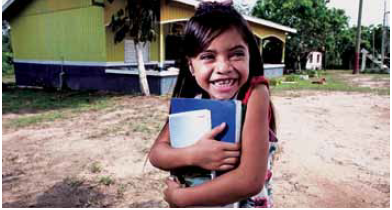
Projects from Botswana, Brazil and Germany win UNESCO-Japan prize on Education for Sustainable Development.
With a world population of 7 billion people and limited natural resources, we, as individuals and societies, need to learn to live together sustainably. We need to take action responsibly based on the understanding that what we do today can have implications on the lives of people and the planet in future. Education for Sustainable Development empowers people to change the way they think and work towards a sustainable future.
UNESCO aims to improve access to quality education on sustainable development at all levels and in all social contexts, to transform society by reorienting education and help people develop knowledge, skills, values and behaviours needed for sustainable development. It is about including sustainable development issues, such as climate change and biodiversity into teaching and learning. Individuals are encouraged to be responsible actors who resolve challenges, respect cultural diversity and contribute to creating a more sustainable world.
(https://en.unesco.org. Adaptado.)
According to the second paragraph, one of sustainable development initiatives to be tackled by education should be to
Provas
Analise as reações.
Reação 1 – Obtenção de água sanitária
C!$ \ell !$2 (g) + 2NaOH (aq) !$ \rightarrow !$ NaC!$ \ell !$O (aq) + NaC!$ \ell !$ (aq) + H2O (!$ \ell !$)
Reação 2 – Reação de carga de uma bateria chumbo/ácido
2PbSO4 (s) + 2H2O (\ell) !$ \rightarrow !$ Pb (s) + PbO2 (s) + 2H2SO4 (aq)
Reação 3 – Combustão de magnésio metálico
Mg (s) + !$ \large{1 \over 2} !$ O2 (g) !$ \rightarrow !$ MgO (s)
Reação 4 – Obtenção de cal
CaCO3 (s) !$ \rightarrow !$ CaO (s) + CO2 (g)
São exemplos de oxirredução, que apresentam um reagente atuando simultaneamente como oxidante e redutor, as reações
Provas
Leia o texto para responder a questão.
“Culture is language”: why an indigenous tongue is thriving in Paraguay
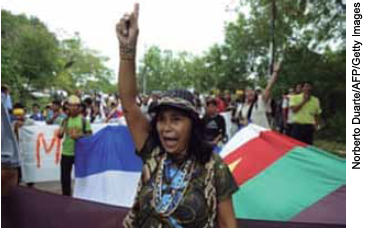
Paraguayan Guaraní — a language descended from several indigenous tongues — remains one of the main languages of 70% of Paraguay’s population.
On a hillside monument in Asunción, a statue of the mythologized indigenous chief Lambaré stands alongside other great leaders from Paraguayan history. The other historical heroes on display are of mixed ancestry, but the idea of a noble indigenous heritage is strong in Paraguay, and — uniquely in the Americas — can be expressed by most of the country’s people in an indigenous language: Paraguayan Guaraní. “Guaraní is our culture — it’s where our roots are,” said Tomasa Cabral, a market vendor in the city.
Elsewhere in the Americas, European colonial languages are pushing native languages towards extinction, but Paraguayan Guaraní — a language descended from several indigenous tongues — remains one of the main languages of 70% of the country’s population. And unlike other widely spoken native tongues — such as Quechua, Aymara or the Mayan languages — it is overwhelmingly spoken by non-indigenous people.
Miguel Verón, a linguist and member of the Academy of the Guaraní Language, said the language had survived partly because of the landlocked country’s geographic isolation and partly because of the “linguistic loyalty” of its people. “The indigenous people refused to learn Spanish,” he said. “The imperial governors had to learn to speak Guaraní.” But while it remains under pressure from Spanish, Paraguayan Guaraní is itself part of the threat looming over the country’s other indigenous languages. Paraguay’s 19 surviving indigenous groups each have their own tongue, but six of them are listed by Unesco as severely or critically endangered.
The benefits of speaking the country’s two official languages were clear. Spanish remains the language of government, and Paraguayan Guaraní is widely spoken in rural areas, where it is a key requisite for many jobs. But the value of maintaining other tongues was incalculable, said Alba Eiragi Duarte, a poet from the Ava Guaraní people. “Our culture is transmitted through our own language: culture is language. When we love our language, we love ourselves.”
(William Costa. www.theguardian.com, 03.09.2020. Adaptado.)
The text is mainly about
Provas
Caderno Container