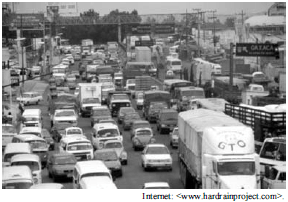
Mexico City once had the world’s worst air, with skies so poisonous that birds dropped dead in flight. Today, efforts to clean the smog are showing visible progress, revealing stunning views of snow-capped volcanoes — and offering a model for the developing world. International experts are praising the country’s progress. Many say its determined efforts to control auto emissions and other environmental effects of rapid urbanization offer practical lessons to cities in China, India and other fast-growing countries. Mexican officials have attacked the root causes of pollution that plagues many large urban centers with spiraling growth. They plan to further reduce vehicle emissions, which are the city’s greatest source of pollution. Pemex, the state oil monopoly, plans to build a US$9.3 billion plant to produce low-sulfur fuel. Mexico City Mayor Marcelo Ebrard is expanding the low-emissions Metrobus system, which has eliminated 80,000 tons of carbon monoxide annually since 2005. Officials plan to add hybrid buses. A suburban train system is to replace hundreds of thousands of vehicles.
The potential payoff for such efforts is now in sight: Mexico City does not even rank among the top 10 polluted cities worldwide. Mexico City appears to have cut most of its pollutants at least by half, while recent studies show a number of cities in China and India recording higher levels of the most serious pollutants. In 1992, the United Nations declared Mexico City the most polluted on the planet. High ozone levels were thought to cause 1,000 deaths and 35,000 hospitalizations a year. Mexico was forced to act. It replaced the city’s sootbelching old cars, removed lead from gasoline, embraced natural gas, expanded public transportation, and relocated refineries and factories. Change was gradual, but the pace has quickened in recent years. The presence of lead in the air has dropped by 90 percent since 1990. Suspended particles – pieces of dust, soot or chemicals that lodge in lungs and cause asthma, emphysema or cancer – have been cut by 70 percent. Carbon monoxide and other pollutants also have been drastically reduced.
Anne-Marie O’Connor. Mexico City drastically reduced air pollutants since the 1990s. In: The Washington Post. Internet: <www.washingtonpost.com>.
Judge the item based on the text above.
In order to address the pollution problem, both the quality and type of the fuel used in Mexico City were changed.
