READ TEXT I AND ANSWER QUESTION:
TEXT I
The Naked Truth: Is New Passenger Scanner a Terrorist Trap or Virtual Strip Search?
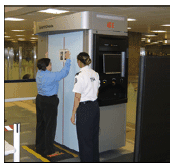
New airport x-ray sees through clothes without revealing details
March 1, 2007
For the next two to three months, passengers randomly selected for additional screening at Phoenix’s Sky Harbor International Airport will have the option of a typical pat down by security personnel or a one-minute, full body scan from a new type of xray machine that allows screeners to see through clothes. The federal government is testing so-called backscatter x-ray machines there, which can detect potentially threatening objects under a person’s clothes by picking up x-rays scattered by materials. (Traditional x-ray machines pick up signals that pass through or are absorbed.)
“It’s using edge detection to detect anomalies,” says Joe Reiss, vice president of marketing at American Science and Engineering (AS&E), the Boston-based manufacturer of the SmartCheck machine. “If you are a suicide bomber and have a vest on, that would appear as clear as day in an image.”
But critics charge the system is an invasion of privacy. “You should not have to go naked to board an aircraft,” says Barry Steinhardt of the American Civil Liberties Union. If full backscatter images were used, screeners would see every detail of each individual scanned. AS&E, however, has built an algorithm into its machine that matches individuals to a general outline of the male or female form. “It looks like the chalk outline of a body rather than the x-ray image of a body,” says Amy Kudwa, a spokesperson for the federal Transportation Security Administration (TSA), which is conducting the trial. “It is a nonintrusive technology; it does not require a pat down.”
The downside is that by removing some of the potentially salacious detail, the developers may have diminished the device’s effectiveness in detecting threats, according to Steinhardt. “The more explicit the image, the better the technology is for actually detecting weapons,” he says. “The more obscured the image, the less realistic the image, the less likelihood it is going to detect contraband.” In other words, he says: “You can have what amounts to a virtual strip search that may have some minor security benefit. Or you can have the illusion of security which will not detect the contraband.”
The machine, however, has passed all tests set for it thus far, Reiss says. “The exact threats are classified. It has been evaluated for detecting certain threats by our engineers and TSA’s and it has performed well.”
(http://www.sciam.com/print_version.cfm?articleID=0AD11209-E7F2-99DF- 30E0585C3218F3D2)
The underlined word in “threatening objects” suggests these objects are:
