Voyager 1 leaves the Solar System
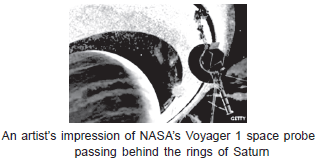
An artist’s impression of NASA’s Voyager 1 space probe passing behind the rings of Saturn The Voyager 1 spacecraft has become the first man-made object to leave the solar system. The probe was launched 36 years ago and has spent years hurtling away from the sun. Now a new analysis has revealed that the craft crossed into interstellar space in August last year.
Voyager 1 was launched into space in 1977 to study the planets beyond our own. But after passing them one by one, it just kept on(a) going. And now scientists believe the probe left the edge of our solar system on the 25th August last year. It crossed a region known as the heliopause, where particles thrown out from the sun pile up against the matter and magnetic fields from other stars. Now, at nearly(b) 12 billion miles from earth, it’s in interstellar space - a cold, dark part of the Milky Way filled with gas and dust. Ed Stone , the Voyager’s chief(c) scientist says: “This is one of those journeys of exploration, like circumnavigating the globe for the first time, or having a footprint(d) on the moon for the first time. This is the first time we have been exploring now, this new region of space, interstellar space.”
As Voyager 1 ventures into the unknown it will send data back to NASA. Eventually though, it will fall silent — its power supply is expected to run out(e) in the next 10 years. But if the probe is ever happened upon by extraterrestrial beings as it floats through space they’ll find a record containing pictures and messages.
VOYAGER 1 leaves the Solar System. Disponível em: <www.bbc.co.uk/worldservice/learningenglish/language/wordsinthenews/2013/09/130913_witn_voyager_story.shtml>. Acesso em: 2 fev. 2014
“probe”: sonda.
Considering vocabulary used in the text, the only word or expression which is not correctly defined on the right is in alternative
Provas
Questão presente nas seguintes provas
