The World’s Largest Tropical Wetland Has Become an Inferno
By Catrin Einhorn, Maria Magdalena Arréllaga, Blacki Migliozzi and Scott Reinhard
This year, roughly a quarter of the vast Pantanal wetland in Brazil, one of the most biodiverse places on Earth, has burned in wildfires worsened by climate change. What happens to a rich and unique biome when so much is destroyed?
The unprecedented fires in the wetland have attracted less attention than blazes in Australia, the Western United States and the Amazon, its celebrity sibling to the north. But while the Pantanal is not a global household name, tourists in the know flock there because it is home to exceptionally high concentrations of breathtaking wildlife: Jaguars, tapirs, endangered giant otters and bright blue hyacinth macaws. Like a vast tub, the wetland swells with water during the rainy season and empties out during the dry months. Fittingly, this rhythm has a name that evokes a beating heart: the flood pulse.
The wetland, which is larger than Greece and stretches over parts of Brazil, Paraguay and Bolivia, also offers unseen gifts to a vast swath of South America by regulating the water cycle upon which life depends. Its countless swamps, lagoons and tributaries purify water and help prevent floods and droughts. They also store untold amounts of carbon, helping to stabilize the climate.
(…)
Naturally occurring fire plays a role in the Pantanal, in addition to the burning by ranchers. The flames are usually contained by the landscape’s mosaic of water. But this year’s drought sucked these natural barriers dry. The fires are far worse than any since satellite records began.
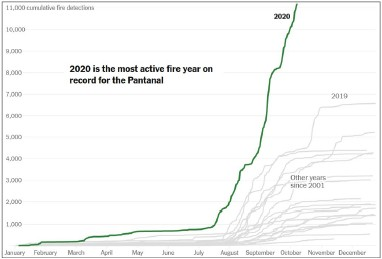
Note: Cumulative sum of fire detections across the Pantanal Biome. Data as of Oct. 12. Instruments on Terra and Aqua satellites have experienced periodic failures. Source: NASA Terra and Aqua satellite data, based on detections with greater than 95 percent confidence levels.
The fires are also worse than any in the memory of the Guató people, an Indigenous group whose ancestors have lived in the Pantanal for thousands of years.
Guató leaders in an Indigenous territory called Baía dos Guató said the fires spread from the ranches that surround their land, and satellite images confirm that the flames swept in from the outside. When fire started closing in on the home of Sandra Guató Silva, a community leader and healer, she fought to save it with the help of her son, grandson and a boat captain with a hose.
(...)
Now Ms. Guató Silva mourns the loss of nature itself. “It makes me sick,” she said. “The birds don’t sing anymore. I no longer hear the song of the Chaco chachalaca bird. Even the jaguar that once scared me is suffering. That hurts me. I suffer from depression because of this. Now there is a hollow silence. I feel as though our freedom has left us, has been taken from us with the nature that we have always protected.”
Disponível em: https://www.nytimes.com/interactive/2020/10/13/climate/pantanal-brazil-fires.html Acesso em: 12 nov. 2020.
By analyzing the data presented by The New York Times agency graph, it is correct to affirm that the fires started being detected across the Pantanal Biome in:
