O texto seguinte servirá de base para responder à questão.
Downstream: Refining and Marketing
While refining is a complex process, the goal is straightforward: to take crude oil, which is virtually unusable in its natural state, and transform it into petroleum products used for a variety of purposes such as heating homes, fueling vehicles and making petrochemical plastics.
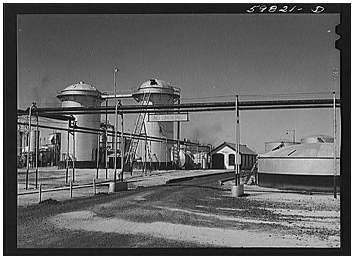
Wolcott, Marion Post. Barnsdall oil refinery. Kansas, 1941.
A number of processes are involved in refining depending on the wanted end product. Hydrotreating is used to remove unwanted elements, such as sulphur and nitrogen from hydrocarbons; cracking breaks molecules into smaller fragments to produce gasoline and other lighter hydrocarbons. The gases produced by cracking are used to create other products like synthetic rubber and plastics. When making gasoline, refiners need high octane numbers to prevent engine knocking. Despite knowing the dangers of lead, tetraethyl lead was added to gasoline in the United States in the 1920s in order to increase the octane. Since the U.S. government banned lead in vehicle gasoline in 1996 as part of the U.S. Clean Air Act, refineries use alkylation and reforming to develop high-octane gasoline.
(From Oil and Gas Industry: A Research Guide, Library of Congress https://guides.loc.gov/oil-and-gas-industry/downstream, accessed on February 19th, 2025)
