- Gramática - Língua InglesaVerbos | Verbs
- Gramática - Língua InglesaDiscurso direto e indireto | Reported speech
Postclassic Period
The end of the Terminal Classic Period has been viewed
as the death knell for the Maya civilization, and the
Postclassic Period has traditionally been described as a
militaristic, decadent, and degenerate phase in Maya
history. But more enlightened views would see that the
militarism was part and parcel with other features that
suggest a tendency towards secularism and the resultant
downplaying of the ceremonial rituals that dominated the
Classic Period. Moreover, much of our interpretations of
the Postclassic were projected from ethnohistoric
accounts of the Spanish intrusions in the region. Very
little attention has been directed towards understanding
the Postclassic through archaeology, although recent
research on the period, particularly at Santa Rita in
northern Belize, suggests continuity from the Classic
Period.The focus of cultural developments moved from
the Central Maya Lowlands north, to the Yucatan, where
the Spanish first contacted the Maya culture.
Once the Spanish established their base in northern
Yucatan by 1546, they began to impose their views and
customs upon the Maya. This was a time of great
disruption. The Maya people suffered from introduction of
European diseases suppression of native traditions
conscription of labor.
Tragically, the vast majority of Maya documents were
destroyed by Spanish religious zealots. The Auto de Fe
of Fray DeLanda is among the most famed. Credited with
providing scraps of information on the Mayan language,
in truth he is responsible for burning the majority of the
known text at the time. The created a huge void of information about the language and practices of this
advanced civilization. The Maya of the Yucatan struggled
to maintain their life ways under Spanish rule. The Maya
forest garden and milpa strategy, unfamiliar to and
unappreciated by the Spanish, was not accepted.
After the conquest of the northern Yucatan, the southern
Maya Itza kingdom still dominated the southern lowlands,
where Tikal once ruled. Hostile to their neighbors and
ensconced in the Maya forest, they were able to maintain
their independence for nearly two centuries after the
Spanish arrived.
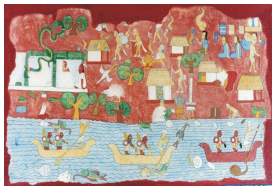
Postclassic Mural
It was not until 1696 that the Spanish conquered the last
of the independent Maya city-states, the Itza of Tayasal,
the descendants of the ancient Maya realm. The Central
Maya Lowlands, which today include most of Belize and
the Peten of Guatemala, are still home to Maya who can
trace their ancestry back into prehistory as attested by
the patronyms of local villagers: Teck, Bacab, Mai,
Cocom, and Panti to name a few.
https://www.marc.ucsb.edu/research/maya/ancient-maya-civilization/po
stclassic-period
