Foram encontradas 78 questões.
TEXTO II
GATES E JOBS
Quando as órbitas se cruzam
Em astronomia, quando as órbitas de duas estrelas se entrecruzam por causa da interação gravitacional, tem-se um sistema binário. Historicamente, ocorrem situações análogas quando uma era é moldada pela relação e rivalidade de dois grandes astros orbitando: Albert Einstein e Niels Bohr na física no século XX, por exemplo, ou Thomas Jefferson e Alexander Hamilton na condução inicial do governo americano. Nos primeiros trinta anos da era do computador pessoal, a partir do final dos anos 1970, o sistema estelar binário definidor foi composto por dois indivíduos de grande energia, que largaram os estudos na universidade, ambos nascidos em 1955.
Bill Gates e Steve Jobs, apesar das ambições semelhantes no ponto de convergência da tecnologia e dos negócios, tinham origens bastante diferentes e personalidades radicalmente distintas.
À diferença de Jobs, Gates entendia de programação e tinha uma mente mais prática, mais disciplinada e com grande capacidade de raciocínio analítico. Jobs era mais intuitivo, romântico, e dotado de mais instinto para tornar a tecnologia usável, o design agradável e as interfaces amigáveis. Com sua mania de perfeição, era extremamente exigente, além de administrar com carisma e intensidade indiscriminada. Gates era mais metódico; as reuniões para exame dos produtos tinham horário rígido, e ele chegava ao cerne das questões com uma habilidade ímpar. Jobs encarava as pessoas com uma intensidade cáustica e ardente; Gates às vezes não conseguia fazer contato visual, mas era essencialmente bondoso.
“Cada qual se achava mais inteligente do que o outro, mas Steve em geral tratava Bill como alguém levemente inferior, sobretudo em questões de gosto e estilo”, diz Andy Hertzfeld. “Bill menosprezava Steve porque ele não sabia de fato programar.” Desde o começo da relação, Gates ficou fascinado por Jobs e com uma ligeira inveja de seu efeito hipnótico sobre as pessoas. Mas também o considerava “essencialmente esquisito” e “estranhamente falho como ser humano”, e se sentia desconcertado com a grosseria de Jobs e sua tendência a funcionar “ora no modo de dizer que você era um merda, ora no de tentar seduzi-lo”. Jobs, por sua vez, via em Gates uma estreiteza enervante.
Suas diferenças de temperamento e personalidade iriam levá-los para lados opostos da linha fundamental de divisão na era digital. Jobs era um perfeccionista que adorava estar no controle e se comprazia com sua índole intransigente de artista; ele e a Apple se tornaram exemplos de uma estratégia digital que integrava solidamente o hardware, o software e o conteúdo numa unidade indissociável. Gates era um analista inteligente, calculista e pragmático dos negócios e da tecnologia; dispunha-se a licenciar o software e o sistema operacional da Microsoft para um grande número de fabricantes.
Depois de trinta anos, Gates desenvolveu um respeito relutante por Jobs. “De fato, ele nunca entendeu muito de tecnologia, mas tinha um instinto espantoso para saber o que funciona”, disse. Mas Jobs nunca retribuiu valorizando devidamente os pontos fortes de Gates. “Basicamente Bill é pouco imaginativo e nunca inventou nada, e é por isso que acho que ele se sente mais à vontade agora na filantropia do que na tecnologia”, disse Jobs, com pouca justiça. “Ele só pilhava despudoradamente as ideias dos outros.”
(ISAACSON, Walter. Steve Jobs: a biografia. São Paulo:
Companhia das Letras, 2011. p. 189-191. Adaptado)
Assinale a opção que NÃO contém uma estratégia argumentativa utilizada no texto II.
Provas
Questão presente nas seguintes provas

Raios X são produzidos em tubos de vácuo nos quais elétrons são acelerados por uma ddp de 4,0⋅104 V e, em seguida, submetidos a uma intensa desaceleração ao colidir com um alvo metálico.
Assim, um valor possível para o comprimento de onda, em angstrons, desses raios X é,
Provas
Questão presente nas seguintes provas
TEXT II
Why Bilinguals Are Smarter
Speaking two languages rather than just one has obvious practical benefits in an increasingly globalized world. But in recent years, scientists have begun to show that the advantages of bilingualism are even more fundamental than being able to converse with a wider range of people. Being bilingual, it turns out, makes you smarter. It can have a profound effect on your brain, improving cognitive skills not related to language and even protecting from dementia in old age.
This view of bilingualism is remarkably different from the understanding of bilingualism through much of the 20th century. Researchers, educators and policy makers long considered a second language to be an interference, cognitively speaking, that delayed a child’s academic and intellectual development. They were not wrong about the interference: there is ample evidence that in a bilingual’s brain both language systems are active even when he is using only one language, thus creating situations in which one system obstructs the other. But this interference, researchers are finding out, isn’t so much a handicap as a blessing in disguise. It forces the brain to resolve internal conflict, giving the mind a workout that strengthens its cognitive muscles.
Bilinguals, for instance, seem to be more adept than monolinguals at solving certain kinds of mental puzzles. In a 2004 study by the psychologists Ellen Bialystok and Michelle Martin-Rhee, bilingual and monolingual preschoolers were asked to sort blue circles and red squares presented on a computer screen into two digital bins — one marked with a blue square and the other marked with a red circle. In the first task, the children had to sort the shapes by color, placing blue circles in the bin marked with the blue square and red squares in the bin marked with the red circle. Both groups did this with comparable ease. Next, the children were asked to sort by shape, which was more challenging because it required placing the images in a bin marked with a conflicting color. The bilinguals were quicker at performing this task.
The collective evidence from a number of such studies suggests that the bilingual experience improves the brain’s so-called executive function — a command system that directs the attention processes that we use for planning, solving problems and performing various other mentally demanding tasks. These processes include ignoring distractions to stay focused, switching attention willfully from one thing to another and holding information in mind — like remembering a sequence of directions while driving.
Why does the fight between two simultaneously active language systems improve these aspects of cognition? Until recently, researchers thought the bilingual advantage was centered primarily in an ability for inhibition that was improved by the exercise of suppressing one language system: this suppression, it was thought, would help train the bilingual mind to ignore distractions in other contexts. But that explanation increasingly appears to be inadequate, since studies have shown that bilinguals perform better than monolinguals even at tasks that do not require inhibition, like threading a line through an ascending series of numbers scattered randomly on a page.
The bilingual experience appears to influence the brain from infancy to old age (and there is reason to believe that it may also apply to those who learn a second language later in life).
In a 2009 study led by Agnes Kovacs of the International School for Advanced Studies in Trieste, Italy, 7-month-old babies exposed to two languages from birth were compared with peers raised with one language. In an initial set of tests, the infants were presented with an audio stimulus and then shown a puppet on one side of a screen. Both infant groups learned to look at that side of the screen in anticipation of the puppet. But in a later set of tests, when the puppet began appearing on the opposite side of the screen, the babies exposed to a bilingual environment quickly learned to switch their anticipatory gaze in the new direction while the other babies did not.
Bilingualism’s effects also extend into the twilight years. In a recent study of 44 elderly Spanish-English bilinguals, scientists led by the neuropsychologist Tamar Gollan of the University of California, San Diego, found that individuals with a higher degree of bilingualism — measured through a comparative evaluation of proficiency in each language — were more resistant than others to the beginning of dementia and other symptoms of Alzheimer’s disease: the higher the degree of bilingualism, the later the age of occurrence.
Nobody ever doubted the power of language. But who would have imagined that the words we hear and the sentences we speak might be leaving such a deep imprint?
Adapted from
http://www.nytimes.com/2012/03/18/opinion/sunday/the-benefitsof-bilingualism.html
The psychological study done in 2004 (3rd paragraph) showed that
Provas
Questão presente nas seguintes provas
Uma esfera homogênea, rígida, de densidade !$ μ_1 !$ e de volume V se encontra apoiada e em equilíbrio na superfície inferior de um recipiente, como mostra a figura 1. Nesta situação a superfície inferior exerce uma força !$ N_1 !$ sobre a esfera.
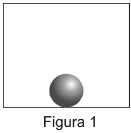
A partir dessa condição, o recipiente vai sendo preenchido lentamente por um líquido de densidade !$ μ !$, de tal forma que esse líquido esteja sempre em equilíbrio hidrostático. Num determinado momento, a situação de equilíbrio do sistema, no qual a esfera apresenta metade de seu volume submerso, é mostrada na figura 2.
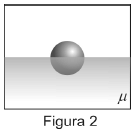
Quando o recipiente é totalmente preenchido pelo líquido, o sistema líquido-esfera se encontra em uma nova condição de equilíbrio com a esfera apoiada na superfície superior do recipiente (figura 3), que exerce uma força de reação normal !$ N_2 !$ sobre a esfera.
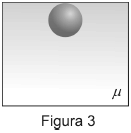
Nessas condições, a razão !$ \large{N_2 \over N_1} !$ é dada por
Provas
Questão presente nas seguintes provas
Na região próxima a uma bobina percorrida por corrente elétrica contínua, existe um campo de indução magnética !$ \vec{B} !$ , simétrico ao seu eixo (eixo x), cuja magnitude diminui com o aumento do módulo da abscissa x, como mostrado na figura abaixo.
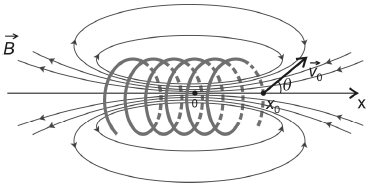
Uma partícula de carga negativa é lançada em !$ x = x_0 !$ com uma velocidade !$ \vec{v}_0 !$ , formando um ângulo !$ θ !$ com o sentido positivo do eixo x.
O módulo da velocidade !$ \vec{v} !$ descrita por essa partícula, devido somente à ação desse campo magnético, em função da posição x, é melhor representado pelo gráfico
Provas
Questão presente nas seguintes provas
TEXT I
Read the text below to answer question according to it.
BRAZILIAN AIR FORCE ACADEMY

AFA (Air Force Academy), located at Pirassununga, State of São Paulo, is responsible for the training of Pilots, Administrative and Aeronautics Infantry Officers for the Brazilian Air Force.
The history of the Brazilian military pilots schools goes back to 1913, when the Brazilian Aviation School was founded, at Campo dos Afonsos, State of Rio de Janeiro. Its mission was to provide instruction at similar levels to those of the best European schools at the time; Blériot and Farman aircraft, made in France, were available for the instruction of the pupils. The Great War 1914-1918, however, forced its instructors to leave and the school was closed.
At that time, both the Brazilian Army and Navy had their own air arms, the Military Aviation and the Naval Aviation. The Navy bought Curtiss F seaplanes in May 1916 to equip the latter, and in August of the same year, the Naval Aviation School was created.
The Military Aviation, however, only activated its Military Aviation School after the Great War, on 10 July 1919. Among the aircrafts used at the school, one could find the Sopwith 1A2, Bréguet 14A2, and Spad 7.
Until the beginning of the 1940s, both schools continued with their activities. The Brazilian Government was concerned with the air war in Europe and decided to concentrate under a single command the military aviation activities. Thus, on 20 January 1941, the Air Ministry was created and both the Army and Navy air arms were disbanded, their personnel and equipment forming the Brazilian Air Force. On 25 March 1941, the Aeronautics School was based at Campo dos Afonsos, and its students became known as Aeronautics Cadets from 1943 to the current days.
As early as 1942, it became clear that the Aeronautics School would need to be transferred to another place, offering better climate and little
interference with the flight instruction of the future pilots.
The town of Pirassununga was chosen among others, and, in 1952, the first buildings construction was initiated. The transfer of the School activities to Pirassununga occurred from 1960 to 1971. The School was redesigned as the Air Force Academy in 1969.
The motto of the Academy is the Latin expression “Macte Animo! Generose Puer, sic itur ad astra”, extracted from the poem Thebaida, by the Roman poet Tatius. It is an exhortation to the cadets, which can be translated as Courage! This is the way, oh noble youngster, to the stars.
The instruction of the Aeronautics Cadets, during the four-year-long course, has its activities centred in the words COURAGE - LOYALTY - HONOUR - DUTY - MOTHERLAND. The future officers take courses on several subjects, including Calculus, Computer Science, Mechanics, Portuguese and English, given by civilian lecturers, Air Force instructors and supervisors. The military instruction itself is given on a daily basis, and the Cadets are trained on different subjects, including parachuting, and sea and jungle survival.
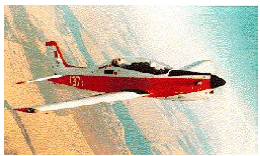
Flight instruction at the Academy with T-27 Tucano aircraft.
According to the chosen specialization, the Cadet will receive specific instruction:
Pilots: Instruction on precision maneuvering, aerobatics, formation flying and by instruments, with 75 flying hours on the primary/basic training aircraft T-25 Universal, beginning on the 2nd term of the 1st year and completed in the 3rd year. Advanced training is given on T-27 Tucano aircraft, with 125 flying hours.
Administrative: Training on the scientific and technological modern foundations of economics and financial management, and logistics training.
Aeronautics Infantry: Instruction on defense and security techniques of military Aeronautics installations, anti-aircraft measures, command of troops and firefighting teams, military laws and regulations, armament usage, military service and call-up procedures.
During their leisure time, the Cadets participate on the activities of seven different clubs: Aeromodelling, Literature, Informatics, Firearms shooting, Gauchos Heritage (for those coming from the South of Brazil), Gerais Club and Sail Flying. The clubs are directed by the Cadets themselves, under supervision of Air Force officers.
The Academy also houses the Brazilian Air Force Air Demonstration Squadron - The Smoke Squadron.
Flying as the eagles do!
Adapted from http://www.rudnei.cunha.nom.br/FAB/en/afa.html
The sentence “The Military Aviation [...] activated its Military Aviation School after the Great War [...]” can be rewritten, with the same meaning, as .
Provas
Questão presente nas seguintes provas
TEXTO I
A MAÇÃ DE OURO
A Apple supera a Microsoft em valor de mercado, premiando o espírito visionário e libertário de Steve Jobs
A Microsoft e a Apple vieram ao mundo praticamente ao mesmo tempo, em meados dos anos 1970, criadas na garagem de jovens estudantes. Mas as empresas não trilharam caminhos paralelos. A Microsoft desenvolveu o sistema operacional mais popular do mundo e rapidamente se tornou uma das maiores corporações americanas, rivalizando com gigantes da velha indústria. A Apple, ao contrário, demorou a decolar. Fazia produtos inovadores, mas que vendiam pouco. Isso começou a mudar quando Steve Jobs, um de seus fundadores, que fora afastado nos anos 80, assumiu o comando criativo da empresa, em 1996. A Apple estava à beira da falência e só ganhou sobrevida porque recebeu um aporte de 150 milhões de dólares de Microsoft. Jobs iniciou o lançamento de produtos genuinamente revolucionários nas áreas que mais crescem na indústria de tecnologia. Primeiro com o iPod e a loja virtual iTunes. Depois vieram o iPhone e, agora, o iPad. Desde o início de 2005, o preço das ações da empresa foi multiplicado por oito. Na semana passada, a Apple alcançou o cume. Tornou-se a companhia de tecnologia mais valiosa do mundo, superando a Microsoft. Na sexta-feira, a empresa de Jobs tinha valor de mercado de 233 bilhões de dólares, contra 226 bilhões de dólares da companhia de Bill Gates.
A Marca, para além da disputa pessoal entre os maiores gênios da nova economia, coroa a estratégia definida por Jobs. Quando ele retornou à Apple, tamanha era a descrença no futuro da empresa que Michael Dell, fundador da Dell, afirmou que o melhor a fazer era fechar as portas e devolver o dinheiro a seus acionistas. Hoje, a Dell vale um décimo da Apple. O mérito de Jobs foi ter a presciência do rumo que o mercado tomaria.
BARRUCHO, Luís Guilherme & TSUBOI, Larissa. A maçã de ouro. In:
Revista Veja, 02 de jun. 2010, p.187. Adaptado)
Analise o período abaixo:
“A Apple estava à beira da falência e só ganhou sobrevida porque recebeu um aporte de 150 milhões de dólares da Microsoft.”
Nele, pode-se afirmar que
Provas
Questão presente nas seguintes provas
A figura abaixo apresenta a configuração instantânea de uma onda plana longitudinal em um meio ideal. Nela, estão representadas apenas três superfícies de onda !$ \alpha !$, !$ \beta !$ e !$ γ !$, separadas respectivamente por !$ λ !$ e !$ λ/2 !$, onde !$ λ !$ é o comprimento de onda da onda.
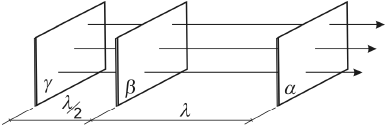
Em relação aos pontos que compõem essas superfícies de onda, pode-se fazer as seguintes afirmativas:
I - estão todos mutuamente em oposição de fase;
II - estão em fase os pontos das superfícies !$ \alpha !$ e !$ γ !$ ;
III - estão em fase apenas os pontos das superfícies !$ \alpha !$ e !$ \beta !$ ;
IV - estão em oposição de fase apenas os pontos das superfícies !$ γ !$ e !$ \beta !$.
Nessas condições, é (são) verdadeira(s)
Provas
Questão presente nas seguintes provas
Sejam !$ a !$ e !$ b !$ dois números reais positivos.
As retas !$ r !$ e !$ s !$ se interceptam no ponto (a , b)
Se !$ \left({\large{a \over 2}}, 0 \right) ∈ \, r !$ e !$ \left( 0, \large{b \over 2} \right) ∈ \, s !$, então uma equação para a reta !$ t !$, que passa por (0 , 0) e tem a tangente do ângulo agudo formado entre !$ r !$ e !$ s !$ como coeficiente angular, é
Provas
Questão presente nas seguintes provas
Um dado cúbico tem três de suas faces numeradas com “0”, duas com “1” e uma com “2”. Um outro dado, tetraédrico, tem duas de suas faces numeradas com “0”, uma com “1” e uma com “2”. Sabe-se que os dados não são viciados.
Se ambos são lançados simultaneamente, a probabilidade de a soma do valor ocorrido na face superior do dado cúbico com o valor ocorrido na face voltada para baixo no tetraédrico ser igual a 3 é de
Provas
Questão presente nas seguintes provas
Cadernos
Caderno Container