Foram encontradas 64 questões.
Directions: Answer question according to the text.
TEXT
WHY DO SUPERVILLAINS FASCINATE US? A PSYCHOLOGICAL PERSPECTIVE
Why are we fascinated by supervillains? Posing the question is much like asking why evil itself intrigues us, but there's much more to our continued interest in supervillains than meets the eye.
Not only do Lex Luthor, Dracula and the Red Skull run unconstrained by conventional morality, they exist outside the limits of reality itself. Their evil, even at its most realistic, retains a touch of the unreal.
But is our fascination with fantastic fiends !$ ^1 !$ healthy? From a psychological perspective, views vary on what drives our enduring interest in superhuman bad guys.
Shadow confrontation: Psychiatrist Carl Jung believed we need to confront and understand our own hidden nature to grow as human beings. Healthy confrontation with our shadow selves can unearth new strengths (e.g., Bruce Wayne creating his Dark Knight persona to fight crime), whereas unhealthy attempts at confrontation may involve dwelling on or unleashing the worst parts of ourselves.
Wish fulfillment: Sigmund Freud viewed human nature as inherently antisocial, biologically driven by the undisciplined id's pleasure principle to get what we want when we want it – born to be bad but held back by society. Even if the psyche fully develops its ego (source of self-control) and superego (conscience), Freudians say the id still dwells !$ ^2 !$ underneath, and it wishes for many selfish things – so it would love to be supervillainous.
Hierarchy of needs: Humanistic psychologist Abraham Maslow held that people who haven't met their most basic needs will have difficulty maturing. If starved for food, you're unlikely to feel secure. If starved for love and companionship, you'll have trouble building self-esteem. People who dwell on their deficits may envy and resent others who have more than they do. Some people who are unable to overcome social shortcomings fantasize about obtaining any means, good or bad, to satisfy every need and greed.
Conditioning: Ivan Pavlov would say we can learn to associate supervillains with other things we value – like entertainment, strength, freedom or the heroes themselves. Behaviorist B.F. Skinner would likely argue that we can find it reinforcing to watch or read about supervillains, but without knowing what's reinforcing about them, that's a bit like saying it's rewarding because it's rewarding.
Our Motivations for Seeking Out Supervillains
Throughout history, humans have been captivated by stories of heroes facing off against superhuman foes !$ ^3 !$. But what specific rewards, needs, wishes and dark dreams do supervillains satisfy?
Freedom: Superpowered characters enjoy freedoms the rest of us don't. Nobody can arrest Superman unless he lets them (at least not without kryptonite handcuffs). As much time as supervillains spend locked up, they seem to escape as often as they please, to run unconstrained by rules and regulations. Cosplayers who dress like Wonder Woman and Captain America can't do any crazy thing that crosses their minds without seeming to mock and insult our heroes, whereas those dressed as villains get to go wild. Supervillainy feels liberating.
Power: Maybe you envy the power these evil characters wield !$ ^4 !$. While that's also a reason to adore superheroes, good guys don't ache to dominate. Stories like Watchmen and Kingdom Come show how heroes become menaces !$ ^5 !$ when they try to take over.
So when dreaming of superpowers, maybe you relate to characters who dream of power as well, from the Scarecrow (who controls individuals' fears) to Doctor Doom (who's perpetually out to dominate the world).
Better villain than victim: Physiologically, anger activates us and feels better than anxiety or fear. One who feels victimized and cannot figure out constructive ways to stand up, be strong or become heroic might twist the need for self-assertion into destruction. Alternately, a healthy person simply might focus on how all characters assert themselves in any given story.
Better villain equals better hero: A hero only appears as heroic as the challenge he or she must overcome. Great heroes require great villains. Without supercriminals, the world's finest heroes seem like overpowered brutes nabbing thugs !$ ^6 !$ unworthy of them. Through myths, legends and lore across time, we have needed heroes who rise to the occasion, overcome great odds !$ ^7 !$ and take down giants.
Facing our fears: Instead of dreading the darkness, you might reduce that dread by shining a light and seeing what's out there. Fiction can help us feel empowered and enlightened without literally traipsing into mob hangouts !$ ^8 !$ and poorly lit alleyways !$ ^9 !$.
Exploring the unknown: Our need to challenge the unknown has driven the human race to cover the globe. This powerful curiosity makes us wonder about everything that baffles !$ ^{10} !$ us, including the world's worst fiends. Knowledge is power, or at least feels like it. When gritty details repulse us, exploring evil through the filter of fiction can help us contemplate humanity's worst without turning away or dwelling almost voyeuristically on real human tragedy. Even when the fiction is about improbable people doing impossible things, the story's fantastic nature reassures us that this cannot happen – and therefore we don't have to turn away.
Supervillains' Ultimate Purpose
In the end, our interest in supervillains can be healthy or unhealthy. Even the more maladaptive reasons for such fascination tend to arise from motivations that were originally healthy and natural – frustrated drives that went the wrong way.
Remember, though, that superheroic fiction ultimately begins and ends with the heroes. Comic book writers and artists create supervillains, who move in and out as guest stars and supporting cast, first and foremost to reveal how heroic the comics' stars can be.
(Adapted from https://www.wired.com/2012/07/why-do-supervillainsfascinate- us/)
Glossary:
1. fiend – an evil and cruel person
2. to dwell – remain
3. foe – an enemy
4. to wield – influence, use power
5. menace – threat
6. to nab thugs – arrest criminals
7. odds – probability
8. to traipse into mob hangouts – walk among places where gangs, criminals meet
9. poorly lit alleyways – narrow road or path with little light
10. to baffle – confuse somebody completely
Identify the option that summarizes the item “ freedom”.
Provas
Questão presente nas seguintes provas

TEXTO I
Violência: presente e passado da história
Vilma Homero
Ao olhar para o passado, costumamos imaginar que estamos nos afastando dos tempos da "barbárie pura e simples" para alcançar uma almejada "civilização", calcada sobre relações livres, iguais e fraternas, típicas do homem culto. Um olhar sobre a história, no entanto, põe em xeque esta visão utópica. Organizado pelos historiadores Regina Bustamante e José Francisco de Moura, o livro Violência na História, publicado pela Mauad Editora com apoio da FAPERJ, reúne diversos ensaios que mostram, ao longo do tempo, diferentes aspectos da violência, propondo uma reflexão mais demorada sobre o tema. Nos ensaios reunidos no livro, podemos vislumbrar como, desde a antiguidade e ao longo da história humana, a violência se insere, sob diversos vieses, nas relações de poder, seja entre Estado e cidadãos, entre livres e escravos, entre homens e mulheres, ou entre diferentes religiões. "Durante a Idade Média, por exemplo, vemos como a violência se manifesta na religiosidade, durante o movimento das Cruzadas. Ou, hoje, no caso dos movimentos sociais, como ela acontece em relação aos excluídos das favelas. O sentido é amplo. A desigualdade social, por exemplo, é um tipo de violência; a expropriação do patrimônio cultural, que significa não permitir que a memória cultural de determinado grupo se manifeste, também", prossegue a organizadora. (...) A própria palavra "violência", que etimologicamente deriva do latim vis, com significado de força, virilidade, pode ser positiva em termos de transformação social, no sentido de uma violência revolucionária, usada como forma de se tentar transformar uma sociedade em determinado momento. (...) Essas variadas abordagens vão aparecendo ao longo do livro.
(...) Na Roma antiga, as penas, aplicadas após julgamento, ganhavam um sentido religioso. Despido de sua humanidade, o réu era declarado homo sacer. Ou seja, sua vida passava a ser consagrada aos deuses. Segundo a pesquisadora Norma Mendes, "havia o firme propósito de fazer da morte dos condenados um espetáculo de caráter exemplar, revestido de sentido religioso e de dominação, cuja função era o reforço, manutenção e ratificação das relações de poder." (...) O historiador Francisco Carlos Teixeira da Silva é um dos que traz a discussão para o presente, analisando as transformações políticas do último século. "Desde Voltaire até Kant e Hegel, acreditava-se no contínuo aperfeiçoamento da condição humana como uma marcha inexorável em direção à razão. (...) O Holocausto, perpetrado em um dos países mais avançados e cultos à época, deixou claro que a luta pela dignidade humana é um esforço contínuo e, pior de tudo, lento. (...) E, sobretudo, mais de 50 anos depois da II Guerra Mundial, a ocorrência de outros genocídios – Ruanda, Iugoslávia, Camboja etc. – leva a refletir sobre a convivência entre os homens nesse começo do século XXI." O historiador prossegue: "De forma paradoxal, a globalização, conforme se aprofunda e pluga os homens a escalas planetárias, é fortemente acompanhada pelo localismo e o particularismo religioso, étnico ou cultural, promovendo ódios e incompreensões crescentes. Na Bósnia ou em Kosovo, na Faixa de Gaza ou na Irlanda do Norte, a capacidade de entendimento chegou a seu mais baixo nível de tolerância, e transpor uma linha, imaginária ou não, entre bairros pode representar a morte." Como nem tudo se limita às questões políticas e às guerras, o livro ainda analisa as formas que a violência assume nas relações de gênero, na religião, na cultura e aborda também a questão dos direitos humanos, vista sob a perspectiva de diferentes sistemas culturais.
(http://www.faperj.br/?id=1518.2.4. Acesso em 05 de março de 2018.)
Pela leitura do texto, pode-se inferir que o livro Violência na História apresenta textos que
Provas
Questão presente nas seguintes provas
Considere, no plano cartesiano, a figura abaixo, em que os segmentos horizontais são paralelos ao eixo !$ \overleftrightarrow{Ox} !$ e os segmentos verticais são paralelos ao eixo !$ \overleftrightarrow{Oy} !$
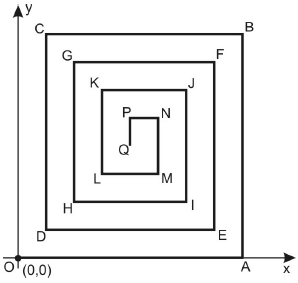
Sabe-se que:
• os comprimentos de segmentos consecutivos da poligonal, que começa na origem O(0, 0 ) e termina em Q , formam uma progressão aritmética decrescente de razão r e primeiro termo !$ a_1 !$ , em que !$ \left( - {\large{1 \over 15}} < r < 0 \right) !$
Sabe-se que:
• dois comprimentos consecutivos da poligonal são sempre perpendiculares;
• !$ \overline{OA}=a_1, \overline{AB}=a_2, \overline{BC}=a_3 !$, e, assim sucessivamente, até !$ \overline{PQ}=a_{16} !$
Suponha que uma formiga parta da origem O(0, 0 ) , e percorra a trajetória descrita pela poligonal até chegar ao ponto Q
Com base nas informações acima, analise as proposições abaixo.
I. Se !$ a_1= 1 !$ e !$ r=-\large{1 \over 16} !$, então a distância d percorrida pela formiga até chegar ao ponto Q é tal que !$ d=\large{17 \over 2}a_1 !$
II. Quando a formiga estiver na posição do ponto L(x,y), então !$ x = − 6r !$
III. Se !$ a1 = 1 !$, então de A até C , a formiga percorrerá a distância !$ d = 2 + 3r !$
Quanto a veracidade das proposições, tem-se
Provas
Questão presente nas seguintes provas
Directions: Answer question according to the text.
TEXT
WHY DO SUPERVILLAINS FASCINATE US? A PSYCHOLOGICAL PERSPECTIVE
Why are we fascinated by supervillains? Posing the question is much like asking why evil itself intrigues us, but there's much more to our continued interest in supervillains than meets the eye.
Not only do Lex Luthor, Dracula and the Red Skull run unconstrained by conventional morality, they exist outside the limits of reality itself. Their evil, even at its most realistic, retains a touch of the unreal.
But is our fascination with fantastic fiends!$ ^1 !$ healthy? From a psychological perspective, views vary on what drives our enduring interest in superhuman bad guys.
Shadow confrontation: Psychiatrist Carl Jung believed we need to confront and understand our own hidden nature to grow as human beings. Healthy confrontation with our shadow selves can unearth new strengths (e.g., Bruce Wayne creating his Dark Knight persona to fight crime), whereas unhealthy attempts at confrontation may involve dwelling on or unleashing the worst parts of ourselves.
Wish fulfillment: Sigmund Freud viewed human nature as inherently antisocial, biologically driven by the undisciplined id's pleasure principle to get what we want when we want it – born to be bad but held back by society. Even if the psyche fully develops its ego (source of self-control) and superego (conscience), Freudians say the id still dwells!$ ^2 !$ underneath, and it wishes for many selfish things – so it would love to be supervillainous.
Hierarchy of needs: Humanistic psychologist Abraham Maslow held that people who haven't met their most basic needs will have difficulty maturing. If starved for food, you're unlikely to feel secure. If starved for love and companionship, you'll have trouble building self-esteem. People who dwell on their deficits may envy and resent others who have more than they do. Some people who are unable to overcome social shortcomings fantasize about obtaining any means, good or bad, to satisfy every need and greed.
Conditioning: Ivan Pavlov would say we can learn to associate supervillains with other things we value – like entertainment, strength, freedom or the heroes themselves. Behaviorist B.F. Skinner would likely argue that we can find it reinforcing to watch or read about supervillains, but without knowing what's reinforcing about them, that's a bit like saying it's rewarding because it's rewarding.
Our Motivations for Seeking Out Supervillains
Throughout history, humans have been captivated by stories of heroes facing off against superhuman foes!$ ^3 !$. But what specific rewards, needs, wishes and dark dreams do supervillains satisfy?
Freedom: Superpowered characters enjoy freedoms the rest of us don't. Nobody can arrest Superman unless he lets them (at least not without kryptonite handcuffs). As much time as supervillains spend locked up, they seem to escape as often as they please, to run unconstrained by rules and regulations. Cosplayers who dress like Wonder Woman and Captain America can't do any crazy thing that crosses their minds without seeming to mock and insult our heroes, whereas those dressed as villains get to go wild. Supervillainy feels liberating.
Power: Maybe you envy the power these evil characters wield!$ ^4 !$. While that's also a reason to adore superheroes, good guys don't ache to dominate. Stories like Watchmen and Kingdom Come show how heroes become menaces!$ ^5 !$ when they try to take over.
So when dreaming of superpowers, maybe you relate to characters who dream of power as well, from the Scarecrow (who controls individuals' fears) to Doctor Doom (who's perpetually out to dominate the world).
Better villain than victim: Physiologically, anger activates us and feels better than anxiety or fear. One who feels victimized and cannot figure out constructive ways to stand up, be strong or become heroic might twist the need for self-assertion into destruction. Alternately, a healthy person simply might focus on how all characters assert themselves in any given story.
Better villain equals better hero: A hero only appears as heroic as the challenge he or she must overcome. Great heroes require great villains. Without supercriminals, the world's finest heroes seem like overpowered brutes nabbing thugs!$ ^6 !$ unworthy of them. Through myths, legends and lore across time, we have needed heroes who rise to the occasion, overcome great odds!$ ^7 !$ and take down giants.
Facing our fears: Instead of dreading the darkness, you might reduce that dread by shining a light and seeing what's out there. Fiction can help us feel empowered and enlightened without literally traipsing into mob hangouts!$ ^8 !$ and poorly lit alleyways!$ ^9 !$.
Exploring the unknown: Our need to challenge the unknown has driven the human race to cover the globe. This powerful curiosity makes us wonder about everything that baffles!$ ^{10} !$ us, including the world's worst fiends. Knowledge is power, or at least feels like it. When gritty details repulse us, exploring evil through the filter of fiction can help us contemplate humanity's worst without turning away or dwelling almost voyeuristically on real human tragedy. Even when the fiction is about improbable people doing impossible things, the story's fantastic nature reassures us that this cannot happen – and therefore we don't have to turn away.
Supervillains' Ultimate Purpose
In the end, our interest in supervillains can be healthy or unhealthy. Even the more maladaptive reasons for such fascination tend to arise from motivations that were originally healthy and natural – frustrated drives that went the wrong way.
Remember, though, that superheroic fiction ultimately begins and ends with the heroes. Comic book writers and artists create supervillains, who move in and out as guest stars and supporting cast, first and foremost to reveal how heroic the comics' stars can be.
(Adapted from https://www.wired.com/2012/07/why-do-supervillainsfascinate- us/)
Glossary:
1. fiend – an evil and cruel person
2. to dwell – remain
3. foe – an enemy
4. to wield – influence, use power
5. menace – threat
6. to nab thugs – arrest criminals
7. odds – probability
8. to traipse into mob hangouts – walk among places where gangs, criminals meet
9. poorly lit alleyways – narrow road or path with little light
10. to baffle – confuse somebody completely
Mark the alternative which has the sentence below correctly reported.
“[...] is our fascination with fantastic fiends healthy?”
The author
Provas
Questão presente nas seguintes provas
Pela legislação brasileira, atualmente, os ditos “Jogos de Azar” estão proibidos. Tais jogos são, na maioria das vezes, sustentados pelas perdas dos jogadores que financiam os que vão ter sorte. Esses jogos têm por condição de existência que, na diferença entre as probabilidades de sorte e azar, predomine o azar.
Ainda que proibidos, bancas de alguns desses jogos são comumente encontradas em festas populares Brasil afora.
Exemplo desses jogos é aquele em que o jogador tem 1 bolinha para lançar sobre uma rampa, levemente inclinada, e deverá acertar uma das “casinhas” numeradas de 1 a 6 Geralmente, o dono da banca de jogo impõe condições para que o jogador ganhe um prêmio.
Suponha que uma condição de sorte seja, desconsiderando quaisquer outras influências, lançar a bolinha três vezes sucessivas de modo que, ao final dos três lançamentos, seja observado que a soma dos números das casinhas é igual a 12
Desse modo, a probabilidade de se ter sorte nesse jogo é
Provas
Questão presente nas seguintes provas
Duas lentes esféricas delgadas 1 e 2, com índices de refração !$ n_1 !$ e !$ n_2 !$, respectivamente, são usadas para observar a figura plana mostrada abaixo, quando o observador, objeto e lente estão imersos em um meio homogêneo, transparente e isótropo com índice de refração n maior do que os índices !$ n_1 !$ e !$ n_2 !$.

As imagens observadas são apresentadas nas figuras 1 e 2 em comparação com o objeto observado.
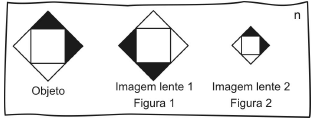
Se a mesma observação for realizada, porém com o observador, objeto e lente imersos em um outro meio com índice de refração n’ menor do que !$ n_1 !$ e !$ n_2 !$, das opções abaixo a que apresenta as imagens que poderão ser observadas, respectivamente, pelas lentes 1 e 2 serão
Provas
Questão presente nas seguintes provas
Directions: Answer question according to the text.
TEXT
WHY DO SUPERVILLAINS FASCINATE US? A PSYCHOLOGICAL PERSPECTIVE
Why are we fascinated by supervillains? Posing the question is much like asking why evil itself intrigues us, but there's much more to our continued interest in supervillains than meets the eye.
Not only do Lex Luthor, Dracula and the Red Skull run unconstrained by conventional morality, they exist outside the limits of reality itself . Their evil, even at its most realistic, retains a touch of the unreal.
But is our fascination with fantastic fiends!$ ^1 !$ healthy? From a psychological perspective, views vary on what drives our enduring interest in superhuman bad guys.
Shadow confrontation: Psychiatrist Carl Jung believed we need to confront and understand our own hidden nature to grow as human beings. Healthy confrontation with our shadow selves can unearth new strengths (e.g., Bruce Wayne creating his Dark Knight persona to fight crime), whereas unhealthy attempts at confrontation may involve dwelling on or unleashing the worst parts of ourselves.
Wish fulfillment: Sigmund Freud viewed human nature as inherently antisocial, biologically driven by the undisciplined id's pleasure principle to get what we want when we want it – born to be bad but held back by society. Even if the psyche fully develops its ego (source of self-control) and superego (conscience), Freudians say the id still dwells!$ ^2 !$ underneath, and it wishes for many selfish things – so it would love to be supervillainous.
Hierarchy of needs: Humanistic psychologist Abraham Maslow held that people who haven't met their most basic needs will have difficulty maturing. If starved for food, you're unlikely to feel secure. If starved for love and companionship, you'll have trouble building self-esteem. People who dwell on their deficits may envy and resent others who have more than they do. Some people who are unable to overcome social shortcomings fantasize about obtaining any means, good or bad, to satisfy every need and greed.
Conditioning: Ivan Pavlov would say we can learn to associate supervillains with other things we value – like entertainment, strength, freedom or the heroes themselves . Behaviorist B.F. Skinner would likely argue that we can find it reinforcing to watch or read about supervillains, but without knowing what's reinforcing about them, that's a bit like saying it's rewarding because it's rewarding.
Our Motivations for Seeking Out Supervillains
Throughout history, humans have been captivated by stories of heroes facing off against superhuman foes!$ ^3 !$. But what specific rewards, needs, wishes and dark dreams do supervillains satisfy?
Freedom: Superpowered characters enjoy freedoms the rest of us don't. Nobody can arrest Superman unless he lets them (at least not without kryptonite handcuffs). As much time as supervillains spend locked up, they seem to escape as often as they please, to run unconstrained by rules and regulations. Cosplayers who dress like Wonder Woman and Captain America can't do any crazy thing that crosses their minds without seeming to mock and insult our heroes, whereas those dressed as villains get to go wild. Supervillainy feels liberating.
Power: Maybe you envy the power these evil characters wield!$ ^4 !$. While that's also a reason to adore superheroes, good guys don't ache to dominate. Stories like Watchmen and Kingdom Come show how heroes become menaces!$ ^5 !$ when they try to take over.
So when dreaming of superpowers, maybe you relate to characters who dream of power as well, from the Scarecrow (who controls individuals' fears) to Doctor Doom (who's perpetually out to dominate the world).
Better villain than victim: Physiologically, anger activates us and feels better than anxiety or fear. One who feels victimized and cannot figure out constructive ways to stand up, be strong or become heroic might twist the need for self-assertion into destruction . Alternately, a healthy person simply might focus on how all characters assert themselves in any given story .
Better villain equals better hero: A hero only appears as heroic as the challenge he or she must overcome. Great heroes require great villains. Without supercriminals, the world's finest heroes seem like overpowered brutes nabbing thugs!$ ^6 !$ unworthy of them. Through myths, legends and lore across time, we have needed heroes who rise to the occasion, overcome great odds!$ ^7 !$ and take down giants.
Facing our fears: Instead of dreading the darkness, you might reduce that dread by shining a light and seeing what's out there. Fiction can help us feel empowered and enlightened without literally traipsing into mob hangouts!$ ^8 !$ and poorly lit alleyways!$ ^9 !$.
Exploring the unknown: Our need to challenge the unknown has driven the human race to cover the globe. This powerful curiosity makes us wonder about everything that baffles!$ ^{10} !$ us, including the world's worst fiends. Knowledge is power, or at least feels like it. When gritty details repulse us, exploring evil through the filter of fiction can help us contemplate humanity's worst without turning away or dwelling almost voyeuristically on real human tragedy. Even when the fiction is about improbable people doing impossible things, the story's fantastic nature reassures us that this cannot happen – and therefore we don't have to turn away.
Supervillains' Ultimate Purpose
In the end, our interest in supervillains can be healthy or unhealthy. Even the more maladaptive reasons for such fascination tend to arise from motivations that were originally healthy and natural – frustrated drives that went the wrong way.
Remember, though, that superheroic fiction ultimately begins and ends with the heroes. Comic book writers and artists create supervillains, who move in and out as guest stars and supporting cast, first and foremost to reveal how heroic the comics' stars can be.
(Adapted from https://www.wired.com/2012/07/why-do-supervillainsfascinate- us/)
Glossary:
1. fiend – an evil and cruel person
2. to dwell – remain
3. foe – an enemy
4. to wield – influence, use power
5. menace – threat
6. to nab thugs – arrest criminals
7. odds – probability
8. to traipse into mob hangouts – walk among places where gangs, criminals meet
9. poorly lit alleyways – narrow road or path with little light
10. to baffle – confuse somebody completely
Mark the option in which the underlined word makes it clear that the subject and the object are the same.
Provas
Questão presente nas seguintes provas
Uma partícula, de massa 1 kg, descreve um movimento circular uniformemente variado, de raio 2,25 m, iniciando-o a partir do repouso no instante !$ t_0 = 0 !$.
Em !$ t = 2 \,s !$, o módulo de sua velocidade vetorial !$ ( \vec{v}) !$ é de !$ 6 m/s !$, conforme figura abaixo.
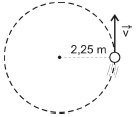
A intensidade da força resultante sobre a partícula, no instante !$ t = 1 \,s !$, em N, vale
Provas
Questão presente nas seguintes provas
Directions: Answer question according to the text.
TEXT
WHY DO SUPERVILLAINS FASCINATE US? A PSYCHOLOGICAL PERSPECTIVE
Why are we fascinated by supervillains? Posing the question is much like asking why evil itself intrigues us, but there's much more to our continued interest in supervillains than meets the eye.
Not only do Lex Luthor, Dracula and the Red Skull run unconstrained by conventional morality, they exist outside the limits of reality itself. Their evil, even at its most realistic, retains a touch of the unreal.
But is our fascination with fantastic fiends !$ ^1 !$ healthy? From a psychological perspective, views vary on what drives our enduring interest in superhuman bad guys.
Shadow confrontation: Psychiatrist Carl Jung believed we need to confront and understand our own hidden nature to grow as human beings. Healthy confrontation with our shadow selves can unearth new strengths (e.g., Bruce Wayne creating his Dark Knight persona to fight crime), whereas unhealthy attempts at confrontation may involve dwelling on or unleashing the worst parts of ourselves.
Wish fulfillment: Sigmund Freud viewed human nature as inherently antisocial, biologically driven by the undisciplined id's pleasure principle to get what we want when we want it – born to be bad but held back by society. Even if the psyche fully develops its ego (source of self-control) and superego (conscience), Freudians say the id still dwells !$ ^2 !$ underneath, and it wishes for many selfish things – so it would love to be supervillainous.
Hierarchy of needs: Humanistic psychologist Abraham Maslow held that people who haven't met their most basic needs will have difficulty maturing. If starved for food, you're unlikely to feel secure. If starved for love and companionship, you'll have trouble building self-esteem. People who dwell on their deficits may envy and resent others who have more than they do. Some people who are unable to overcome social shortcomings fantasize about obtaining any means, good or bad, to satisfy every need and greed.
Conditioning: Ivan Pavlov would say we can learn to associate supervillains with other things we value – like entertainment, strength, freedom or the heroes themselves. Behaviorist B.F. Skinner would likely argue that we can find it reinforcing to watch or read about supervillains, but without knowing what's reinforcing about them, that's a bit like saying it's rewarding because it's rewarding.
Our Motivations for Seeking Out Supervillains
Throughout history, humans have been captivated by stories of heroes facing off against superhuman foes !$ ^3 !$. But what specific rewards, needs, wishes and dark dreams do supervillains satisfy?
Freedom: Superpowered characters enjoy freedoms the rest of us don't. Nobody can arrest Superman unless he lets them (at least not without kryptonite handcuffs). As much time as supervillains spend locked up, they seem to escape as often as they please, to run unconstrained by rules and regulations. Cosplayers who dress like Wonder Woman and Captain America can't do any crazy thing that crosses their minds without seeming to mock and insult our heroes, whereas those dressed as villains get to go wild. Supervillainy feels liberating.
Power: Maybe you envy the power these evil characters wield !$ ^4 !$. While that's also a reason to adore superheroes, good guys don't ache to dominate. Stories like Watchmen and Kingdom Come show how heroes become menaces !$ ^5 !$ when they try to take over.
So when dreaming of superpowers, maybe you relate to characters who dream of power as well, from the Scarecrow (who controls individuals' fears) to Doctor Doom (who's perpetually out to dominate the world).
Better villain than victim: Physiologically, anger activates us and feels better than anxiety or fear. One who feels victimized and cannot figure out constructive ways to stand up, be strong or become heroic might twist the need for self-assertion into destruction. Alternately, a healthy person simply might focus on how all characters assert themselves in any given story.
Better villain equals better hero: A hero only appears as heroic as the challenge he or she must overcome. Great heroes require great villains. Without supercriminals, the world's finest heroes seem like overpowered brutes nabbing thugs !$ ^6 !$ unworthy of them. Through myths, legends and lore across time, we have needed heroes who rise to the occasion, overcome great odds !$ ^7 !$ and take down giants.
Facing our fears: Instead of dreading the darkness, you might reduce that dread by shining a light and seeing what's out there. Fiction can help us feel empowered and enlightened without literally traipsing into mob hangouts !$ ^8 !$ and poorly lit alleyways !$ ^9 !$.
Exploring the unknown: Our need to challenge the unknown has driven the human race to cover the globe. This powerful curiosity makes us wonder about everything that baffles !$ ^{10} !$ us, including the world's worst fiends. Knowledge is power, or at least feels like it. When gritty details repulse us, exploring evil through the filter of fiction can help us contemplate humanity's worst without turning away or dwelling almost voyeuristically on real human tragedy. Even when the fiction is about improbable people doing impossible things, the story's fantastic nature reassures us that this cannot happen – and therefore we don't have to turn away.
Supervillains' Ultimate Purpose
In the end, our interest in supervillains can be healthy or unhealthy. Even the more maladaptive reasons for such fascination tend to arise from motivations that were originally healthy and natural – frustrated drives that went the wrong way.
Remember, though, that superheroic fiction ultimately begins and ends with the heroes. Comic book writers and artists create supervillains, who move in and out as guest stars and supporting cast, first and foremost to reveal how heroic the comics' stars can be.
(Adapted from https://www.wired.com/2012/07/why-do-supervillainsfascinate- us/)
Glossary:
1. fiend – an evil and cruel person
2. to dwell – remain
3. foe – an enemy
4. to wield – influence, use power
5. menace – threat
6. to nab thugs – arrest criminals
7. odds – probability
8. to traipse into mob hangouts – walk among places where gangs, criminals meet
9. poorly lit alleyways – narrow road or path with little light
10. to baffle – confuse somebody completely
In the sentence “ when gritty details repulse us [...]” , the underlined word means
Provas
Questão presente nas seguintes provas
No plano cartesiano, os focos !$ F_1 !$ e!$ F_2 !$ da elipse !$ \alpha: {\large{x^2 \over 36}}+{\large{y^2 \over 32}}=1 !$ são pontos diametralmente opostos da circunferência !$ λ !$ e coincidem com as extremidades do eixo real de uma hipérbole equilátera !$ \beta !$
É INCORRETO afirmar que
Provas
Questão presente nas seguintes provas
Cadernos
Caderno Container