Foram encontradas 80 questões.
Sabe-se que um livro possui 828 páginas, sendo todas numeradas. Quantas vezes o algarismo 2 foi usado?
Provas
Questão presente nas seguintes provas


Provas
Questão presente nas seguintes provas
Se o ano de 2012 começou em um domingo, então o dia 30 de dezembro de 2017 acontecerá em qual dia da semana?
Provas
Questão presente nas seguintes provas
Em um setor de uma determinada empresa trabalham 30 pessoas, sendo 20 mulheres. Uma comissão de 3 funcionários será formada, de forma aleatória, por sorteio. A probabilidade de esta comissão ser formada por pessoas do mesmo sexo é, aproximadamente,
Provas
Questão presente nas seguintes provas
Se é verdade que “alguns candidatos são estudiosos” e que “nenhum aventureiro é estudioso”, então, também é necessariamente verdade que
Provas
Questão presente nas seguintes provas
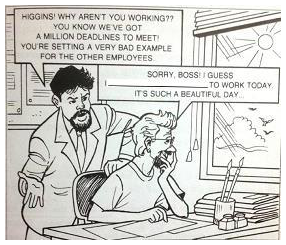
Read the dialogue in the picture. Choose the option to fill in the blank.
Provas
Questão presente nas seguintes provas
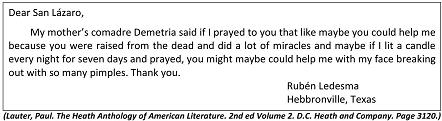
It is true about the message that
Provas
Questão presente nas seguintes provas

The ad contains a/an
Provas
Questão presente nas seguintes provas

Choose the sequence to fill in the blanks
Provas
Questão presente nas seguintes provas
This (Illegal) American Life
By Maria E. Andreu
My parents came to New York City to make their fortune when I was a baby. Irresponsible and dreamy and in their early 20s, they didn't think things through when their visa expired; they decided to stay just a bit longer to build up a nest egg.
But our stay got progressively longer, until, when I was 6, my grandfather died in South America. My father decided my mother and I should go to the funeral and, with assurances that he would handle everything, sat me down and told me I'd have a nice visit in his boyhood home in Argentina, then be back in America in a month.
I didn't see him for two years.
We couldn't get a visa to return. My father sent us money from New Jersey, as the months of our absence stretched into years. Finally, he met someone who knew "coyotes" - people who smuggled others into the U.S. via Mexico. He paid them what they asked for, and we flew to Mexico City.
They drove us to the Mexican side of the border, and left us at a beach. Another from their operation picked us up there and drove us across as his family. We passed Disneyland on our way to the airport, where we boarded the plane to finally rejoin my father.
As a child, I had thought coming back home would be the magical end to our troubles, but in many ways it was the beginning. I chafed at the strictures of undocumented life: no social security number meant no public school (instead I attended a Catholic school my parents could scarcely afford); no driver's license, no after-school job. My parents had made their choices, and I had to live with those, seeing off my classmates as they left on a class trip to Canada, or packing to go off to college, where 1 could not go.
The year before I graduated from high school, Congress passed the amnesty law of 1987. A few months after my 18th birthday, I became legal and what had always seemed a blank future of no hope suddenly turned dazzling with possibility.
When I went for my interview at the Immigration and Naturalization Service, the caseworker looked at me quizzically when he heard me talk in unaccented English and joke about current events. Surely this American teenager did not fit in with the crowd of illegals looking to make things right.
At the time, I was flattered. His confusion meant I could pass as an American.
(Newsweek, October 2f 2008. Page 12.)
Provas
Questão presente nas seguintes provas
Cadernos
Caderno Container