Foram encontradas 259 questões.
Indique se o item é certo ou errado, com base no Texto a que se refere.
PART I
Wage controls during the transition from central planning to a market economy
Freeing prices to alleviate imbalances has been a priority in most emerging market economies. It is therefore paradoxical that wage controls have been a key component of stabilization in many of these countries.
There is considerable skepticism among economist about the effectiveness of wage controls in general: they are intended to suppress market forces, introducing rigidities in the structure of wages and delaying adjustment to changing labor market conditions; they are often circumvented, and they are typically costly to administer. This pessimism is borne out by the experience of many countries with wage controls, as with other centralized means of wage determination. If wage controls are recommended during the transition to a market economy, therefore, their rationale must be predicated on exceptional circumstances.
As a brake on inflationary momentum, wage controls have figured in “heterodox” stabilization programs in Latin America and elsewhere. The object was to reduce the cost of adjusting an economy to lower rate of inflation by controlling a publicly visible price, limiting the extent to which inflationary expectations become sef-perpetuating. Formerly centrally planned economies have had an added and even more pressing reason for integrating incomes policies into their reform programs and maintaining them as an enduring feature of the economic regime: the weakness of governance of state enterprises by their legal owner, the state.
The weakness of governance has been especially serious at the “no-man’s land” stage, when central planning, with its detailed control of prices and wages, has been dismantled but before market forces have become an effective replacement. At this stage enterprise managers often owe their jobs to workers’ councils; the interests of capital, by contrast, have little representation. At the same time, the “soft-budget” problem - the perception that losses will ultimately be underwritten through subsidies and credit and that the firm will not be allowed to fail - is exacerbated when privatization is impending. Workers and managers, realizing that they have limited time to take advantage of their control of the firm, have little incentive to restrain their wage demands, since the benefits of such restraint would be reaped by the future owners and the state. The extent to which this occurs depends on how privatization is implemented - particularly whether existing stakeholders such as workers and managers are given a share of the privatized value of the firm.
(Coricelli, F. and T. Lane, 1993, The World Bank Research Observer, vol. 8, n°2, July: 195-196).
According to the text:
Item 0 - When it is possible for existing stakeholders to become stockholders, it may be advantageous to them to moderate wage demands.
Provas

Suponha que em determinado ano, as seguintes transações com o exterior sejam realizadas:
• Um consórcio de bancos americanos empresta 50 milhões de dólares à Petrobrás.
• O Brasil envia 20 milhões de dólares para a Somália como ajuda humanitária.
• O Banco Central do Brasil autoriza o pagamento de juros a um banco americano no valor de 10 milhões de dólares, ao mesmo tempo em que consegue refinanciar o pagamento de juros vincendos neste ano no montante de 20 milhões de dólares.
• Trabalhadores brasileiros residentes nos Estados Unidos remetem para as suas famílias em Governador Valadares o equivalente a 100 milhões de dólares.
• O Brasil importa petróleo do Irã no valor FOB de 500 milhões de dólares pagos à vista.
• Uma empresa brasileira investe o equivalente a 20 milhões de dólares na construção de uma fábrica na Argentina.
• Uma empresa de turismo espanhola efetua pagamentos a uma rede de hotéis no Brasil por serviços de hospedagem de turistas daquele país no valor de 10 milhões de dólares.
• Uma fábrica de automóveis alemã compra à vista uma partida de aço produzido no Brasil no valor FOB de 200 milhões de dólares.
• Uma subsidiária de uma empresa francesa investe no Brasil o equivalente a 50 milhões de dólares.
Assinale com certo ou errado o item abaixo:
Item 0 - O saldo em transações correntes é negativo e equivalente a 240 milhões de dólares.
Provas
Assinale se o item é certo ou errado:
Item 2 - No espaço bi-dimensional (x,y) a distância entre os pontos (a,b) e (b,a) é !$ [2(b-a)^2]^{1/2} !$.
Provas
Deseja-se investigar a afirmação de que o salário médio anual dos economistas em São Paulo é maior do que o salário médio anual dos economistas no Rio de Janeiro. Pode-se afirmar que:
Item 2 - A hipótese nula deverá ser !$ H_0 : \mu_{RJ} < \mu_{SP} !$ em que !$ \mu_{RJ} !$ é a média populacional dos salários no Rio de Janeiro e !$ \mu_{SP} !$ é a média populacional dos salários em São Paulo.
Provas
Três idivíduos participam de um comitê encarregado de apreciar os projetos A, B e C. Sabe-se que o símbolo < representa a relação “é pior que”, e que as preferências dos indivíduos são as seguintes:
indivíduo 1: A < B < C
indivíduo 2: B < C < A
indivíduo 3: C < A < B
O processo decisório do comitê recomenda considerar as alternativas duas a duas, escolhendo o projeto vencedor por maioria simples. Nestas condições pode-se afirmar que:
Item 2 - O comitê poderia ser considerado um núcleo decisório típico contemplado pela Teoria do Consumidor.
Provas
Responda certo ou errado:
Item 1 - O imposto inflacionário é a habilidade do Governo em aumentar a receita pela criação de moeda, sendo que os economistas admitem que este imposto tem uma relação direta com a inflação.
Provas
Com relação à teoria da Probabilidade pode-se afirmar que:
Item 5 - A definição freqüentista de Probabilidade é fundamentada na idéia de repetição do experimento.
Provas
Um monopolista produz com uma tecnologia que exibe retornos constantes à escala para um mercado cuja função demanda tem elasticidade constante. Então:
Item 1 - A receita marginal se confunde com a função demanda.
Provas
Através da observação direta verificou-se que um consumidor fez as seguintes escolhas:
(i) quando prevaleceram os preços p1 e p2 para os bens 1 e 2, respectivamente, o consumidor escolheu a cesta x1 ;
(ii) quando os preços eram q1 e q2 o consumidor escolheu a cesta x2. As linhas orçamentárias AB e CD embutem os preços que prevaleceram nas situações (i) e (ii) respectivamente. Então:
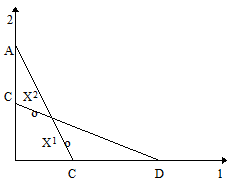
Item 2 - Sabe-se que o custo da cesta x2 aos preços p1 e p2 é maior que o custo da mesma cesta aos preços q1 e q2.
Provas
Indique se o item é certo ou errado, com base no Texto a que se refere.
PART I
Wage controls during the transition from central planning to a market economy
Freeing prices to alleviate imbalances has been a priority in most emerging market economies. It is therefore paradoxical that wage controls have been a key component of stabilization in many of these countries.
There is considerable skepticism among economist about the effectiveness of wage controls in general: they are intended to suppress market forces, introducing rigidities in the structure of wages and delaying adjustment to changing labor market conditions; they are often circumvented, and they are typically costly to administer. This pessimism is borne out by the experience of many countries with wage controls, as with other centralized means of wage determination. If wage controls are recommended during the transition to a market economy, therefore, their rationale must be predicated on exceptional circumstances.
As a brake on inflationary momentum, wage controls have figured in “heterodox” stabilization programs in Latin America and elsewhere. The object was to reduce the cost of adjusting an economy to lower rate of inflation by controlling a publicly visible price, limiting the extent to which inflationary expectations become sef-perpetuating. Formerly centrally planned economies have had an added and even more pressing reason for integrating incomes policies into their reform programs and maintaining them as an enduring feature of the economic regime: the weakness of governance of state enterprises by their legal owner, the state.
The weakness of governance has been especially serious at the “no-man’s land” stage, when central planning, with its detailed control of prices and wages, has been dismantled but before market forces have become an effective replacement. At this stage enterprise managers often owe their jobs to workers’ councils; the interests of capital, by contrast, have little representation. At the same time, the “soft-budget” problem - the perception that losses will ultimately be underwritten through subsidies and credit and that the firm will not be allowed to fail - is exacerbated when privatization is impending. Workers and managers, realizing that they have limited time to take advantage of their control of the firm, have little incentive to restrain their wage demands, since the benefits of such restraint would be reaped by the future owners and the state. The extent to which this occurs depends on how privatization is implemented - particularly whether existing stakeholders such as workers and managers are given a share of the privatized value of the firm.
(Coricelli, F. and T. Lane, 1993, The World Bank Research Observer, vol. 8, n°2, July: 195-196).
According to the text:
Item 2 - When privatization is impending, the belief is widespread that the government will not fail to bail out the firm facing bankruptcy.
Provas
Caderno Container