Foram encontradas 259 questões.
Considere uma firma cuja função custo pode ser representada pela expressão C = wvy, em que w e v são os preços dos dois fatores de produção utilizados e y é o produto. Desta maneira:
Item 1 - As proporções entre as despesas com cada fator dependerão da quantidade produzida.
Provas

Indique se o item abaixo é certo ou errado, com base no texto a que se refere.
PART II
Cambridge versus Cambridge
In most universities today, economics is booming. To undergraduates and businesspersons it spells money-making; to graduate students it offers a lucrative slot in a bank or a confortable billet in a university; to governments it promises technical wheezes for balancing the books and boosting industries. The dismal science, it seems, can do no wrong.
Harvard and Cambridge are ideally placed to exploit this boom. They can both lay claim to some of the most illustrious names in the history of the subject. And they both boast well-connected alumni and high-powered students. But nobody inside the profession doubts that Harvard is having a far better boom than Cambridge. An Oxford professor admits that Harvard has probably the best economics department in the world. A Princeton professor ranks Cambridge along, say, Phennsylvania State University. cambridge graduates frequently go on to Harvard’s graduate school; the compliment is rarely returned. What is wrong with Cambridge?
The decline of its economics department dates from its defeat in one of the noisiest battles in post-war economics - the so-called Cambridge versus Cambridge controversy. In the early 1960s a group of Cambridge economists led by Joan Robinson mounted a furious assault on neoclassical orthodoxy. The Massashusetts Institute of Technology (MIT) took up the case for the defense (Harvard being a gentlemanly backwater).
At stake was nothing less than the soul of the subject. Robinson et al. argued that neoclassical economics was interested in the wrong thing (the optimal allocation of given resources) and based on a false assumption (that man is a rational “utility maximizer.”) In the Cambridge view, the hottest subjects were te accumulation of capital and the distribution of income. To add spice to the debate, the Cambridges disagreed about method and ideology. MIT preferred mathematics and markets; Cambridge favoured elegant prose and state intervention. To the likes of Robinson, the paddy fields of China were far preferable to the skyscrapers of Manhattan.
The world went the Massachusetts way. Neoclassical economics is now international orthodoxy; the Cambridge tradition is taken seriously only in East Anglia and the Italian provinces. Economics is an over more mathematical subject. And state planning is dead.
The Cambridge controbersy did more than marginalise the dominant faction in the Cambridgeshire fens. It also divided the faculty and politicised appointments. Some senior figures, like Frank Hahn and James Meade, did the unpatriotic thing and sided with the other Cambridge. The result was civil war. It was impossible to change the syllabus or appoint a lecturer without an ideological feud. The divided faculty made a number of light-weight appointments. It also lost a generation of stars. Just three of the dozen or so who fled - Amartya Sen, Christopher Bliss and Jim Mirrlees - would make the nucleus of a world-class department.
That was almost two decades ago. Why has Cambridge taken so long to repair the damage? Partly because the place is so enthralled by its glorious past. Naming a road ofter Sidgwick, a building after Marshall and a seminar room after Keynes is dangerously close to ancestor worship. But even more important than its over-developed sense of history is its underdeveloped appetite for competition. While Cambridge sank into faction fighting, Harvard challenged MIT for the position as the best department in the world. To understand their different fates, you need to examine their rival philosophies of academic life.
(The Economist, Dec. 1991 - Jan. 1992, p.43).
According to the text:
Item 3 - Harvard’s appetite for competition is pushing her forward.
Provas
Através da observação direta verificou-se que um consumidor fez as seguintes escolhas:
(i) quando prevaleceram os preços p1 e p2 para os bens 1 e 2, respectivamente, o consumidor escolheu a cesta x1 ;
(ii) quando os preços eram q1 e q2 o consumidor escolheu a cesta x2. As linhas orçamentárias AB e CD embutem os preços que prevaleceram nas situações (i) e (ii) respectivamente. Então:
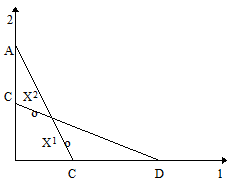
Item 3 - Uma situação como esta não é usada posto que as linhas orçamentárias em geral não se cruzam.
Provas
Responda certo ou errado:
Item 2 - Os economistas que enfatizam o lado da oferta (supply side economics) apoiam-se na conhecida proposição de Laffer que postula uma relação inversa entre receita tributária e a alíquota do imposto.
Provas
Considere as preferências de um consumidor representadas no gráfico abaixo, onde a linha AB representa uma curva de indiferença típica. Então:
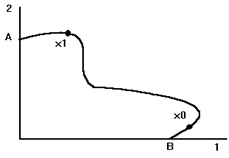
Item 3 - Para a cesta x0 ser demandada é necessário que o preço do bem 1 seja maior que o do bem 2.
Provas
Um comerciante atacadista vende determinado produto em sacas que deveriam conter 16 kg. A pesagem de uma amostra aleatória com 100 sacas revelou os resultados descriminados na tabela a seguir:
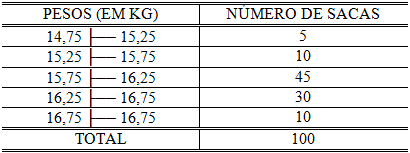
Item 2 -
Um comerciante atacadista vende determinado produto em sacas que deveriam conter 16 kg. A pesagem de uma amostra aleatória com 100 sacas revelou os resultados descriminados na tabela a seguir:
Item 3 - Se o comerciante aumentar em 2,00 kg o conteúdo de cada saca, a média das 100 sacas pesadas não se alterará.
Provas
Seja a função !$ f(x,y)=-x^3+y^3+x^2+y^2 !$. Esta função:
Item 1 - Apresenta um ponto de mínimo em (0, 0).
Provas
Um indivíduo consome apenas os bens 1 e 2. Assumindo que o bem 1 é um bem inferior e o bem 2 é um bem normal e supondo que o preço do bem normal caia,
Item 2 - Nada se pode afirmar sobre o efeito preço, apenas sobre o efeito renda.
Provas
Indique se o item abaixo é certo ou errado, com base no texto a que se refere.
PART II
Cambridge versus Cambridge
In most universities today, economics is booming. To undergraduates and businesspersons it spells money-making; to graduate students it offers a lucrative slot in a bank or a confortable billet in a university; to governments it promises technical wheezes for balancing the books and boosting industries. The dismal science, it seems, can do no wrong.
Harvard and Cambridge are ideally placed to exploit this boom. They can both lay claim to some of the most illustrious names in the history of the subject. And they both boast well-connected alumni and high-powered students. But nobody inside the profession doubts that Harvard is having a far better boom than Cambridge. An Oxford professor admits that Harvard has probably the best economics department in the world. A Princeton professor ranks Cambridge along, say, Phennsylvania State University. cambridge graduates frequently go on to Harvard’s graduate school; the compliment is rarely returned. What is wrong with Cambridge?
The decline of its economics department dates from its defeat in one of the noisiest battles in post-war economics - the so-called Cambridge versus Cambridge controversy. In the early 1960s a group of Cambridge economists led by Joan Robinson mounted a furious assault on neoclassical orthodoxy. The Massashusetts Institute of Technology (MIT) took up the case for the defense (Harvard being a gentlemanly backwater).
At stake was nothing less than the soul of the subject. Robinson et al. argued that neoclassical economics was interested in the wrong thing (the optimal allocation of given resources) and based on a false assumption (that man is a rational “utility maximizer.”) In the Cambridge view, the hottest subjects were te accumulation of capital and the distribution of income. To add spice to the debate, the Cambridges disagreed about method and ideology. MIT preferred mathematics and markets; Cambridge favoured elegant prose and state intervention. To the likes of Robinson, the paddy fields of China were far preferable to the skyscrapers of Manhattan.
The world went the Massachusetts way. Neoclassical economics is now international orthodoxy; the Cambridge tradition is taken seriously only in East Anglia and the Italian provinces. Economics is an over more mathematical subject. And state planning is dead.
The Cambridge controbersy did more than marginalise the dominant faction in the Cambridgeshire fens. It also divided the faculty and politicised appointments. Some senior figures, like Frank Hahn and James Meade, did the unpatriotic thing and sided with the other Cambridge. The result was civil war. It was impossible to change the syllabus or appoint a lecturer without an ideological feud. The divided faculty made a number of light-weight appointments. It also lost a generation of stars. Just three of the dozen or so who fled - Amartya Sen, Christopher Bliss and Jim Mirrlees - would make the nucleus of a world-class department.
That was almost two decades ago. Why has Cambridge taken so long to repair the damage? Partly because the place is so enthralled by its glorious past. Naming a road ofter Sidgwick, a building after Marshall and a seminar room after Keynes is dangerously close to ancestor worship. But even more important than its over-developed sense of history is its underdeveloped appetite for competition. While Cambridge sank into faction fighting, Harvard challenged MIT for the position as the best department in the world. To understand their different fates, you need to examine their rival philosophies of academic life.
(The Economist, Dec. 1991 - Jan. 1992, p.43).
According to the text:
Item 3 - In the wake of the controversies, Cambridge lost three dozen faculty members to American universities.
Provas
Indique se o item abaixo é certo ou errado, com base no texto a que se refere.
PART II
Cambridge versus Cambridge
In most universities today, economics is booming. To undergraduates and businesspersons it spells money-making; to graduate students it offers a lucrative slot in a bank or a confortable billet in a university; to governments it promises technical wheezes for balancing the books and boosting industries. The dismal science, it seems, can do no wrong.
Harvard and Cambridge are ideally placed to exploit this boom. They can both lay claim to some of the most illustrious names in the history of the subject. And they both boast well-connected alumni and high-powered students. But nobody inside the profession doubts that Harvard is having a far better boom than Cambridge. An Oxford professor admits that Harvard has probably the best economics department in the world. A Princeton professor ranks Cambridge along, say, Phennsylvania State University. cambridge graduates frequently go on to Harvard’s graduate school; the compliment is rarely returned. What is wrong with Cambridge?
The decline of its economics department dates from its defeat in one of the noisiest battles in post-war economics - the so-called Cambridge versus Cambridge controversy. In the early 1960s a group of Cambridge economists led by Joan Robinson mounted a furious assault on neoclassical orthodoxy. The Massashusetts Institute of Technology (MIT) took up the case for the defense (Harvard being a gentlemanly backwater).
At stake was nothing less than the soul of the subject. Robinson et al. argued that neoclassical economics was interested in the wrong thing (the optimal allocation of given resources) and based on a false assumption (that man is a rational “utility maximizer.”) In the Cambridge view, the hottest subjects were te accumulation of capital and the distribution of income. To add spice to the debate, the Cambridges disagreed about method and ideology. MIT preferred mathematics and markets; Cambridge favoured elegant prose and state intervention. To the likes of Robinson, the paddy fields of China were far preferable to the skyscrapers of Manhattan.
The world went the Massachusetts way. Neoclassical economics is now international orthodoxy; the Cambridge tradition is taken seriously only in East Anglia and the Italian provinces. Economics is an over more mathematical subject. And state planning is dead.
The Cambridge controbersy did more than marginalise the dominant faction in the Cambridgeshire fens. It also divided the faculty and politicised appointments. Some senior figures, like Frank Hahn and James Meade, did the unpatriotic thing and sided with the other Cambridge. The result was civil war. It was impossible to change the syllabus or appoint a lecturer without an ideological feud. The divided faculty made a number of light-weight appointments. It also lost a generation of stars. Just three of the dozen or so who fled - Amartya Sen, Christopher Bliss and Jim Mirrlees - would make the nucleus of a world-class department.
That was almost two decades ago. Why has Cambridge taken so long to repair the damage? Partly because the place is so enthralled by its glorious past. Naming a road ofter Sidgwick, a building after Marshall and a seminar room after Keynes is dangerously close to ancestor worship. But even more important than its over-developed sense of history is its underdeveloped appetite for competition. While Cambridge sank into faction fighting, Harvard challenged MIT for the position as the best department in the world. To understand their different fates, you need to examine their rival philosophies of academic life.
(The Economist, Dec. 1991 - Jan. 1992, p.43).
According to the text:
Item 4 - Fate is what accounts for the changing fortunes of Harvard and Cambridge.
Provas
Caderno Container