Foram encontradas 312 questões.
"Thorstein Veblen and Post-Darwinian Economics".
By
Geoffrey M. Hodgson. Economics and Evolution. Chapter 9, pp 123-24.
Polity Press,1993.
In a famous article originally published in 1898, Thorstein Veblen (1919, p.56) asked: 'Why is economics not an evolutionary science?' The term 'evolutionary' was subsequently adopted by institutional economists, but often in broad or developmentalist terms, and with only slight attention to the more precise mechanisms of natural selection as developed in biology. Veblen's knowledge of biological science was remarkably up-to-date, yet evolutionary theory has developed enormously since his death, leaving many of his institutionalist followers well behind. Veblen made a direct appeal to biological science for inspiration; but subsequently, and until very recently, this example has rarely been replicated. Accordingly there has been remarkably little detailed exploration, informed by biology, of what Veblen precisely meant by an 'evolutionary' science, and of the character of the 'post-Darwinian' economics that he attempted to build.
Like Alfred Marshall, Thorstein Veblen saw that the appropriate metaphor for economics was to be found in biology. In particular, Veblen saw the evolutionary metaphor as crucial to the understanding of the processes of technological development in a capitalist economy. But unlike his English colleague, he did not care to develop a static, equilibrium analysis as a prelude to the dynamic. He characterized his own economics as post-Darwinian, and argued that economics should embrace the metaphor of evolution and change, rather than the static ideas of equilibrium that had been borrowed by the neoclassical economists from physics.
However, after rebutting a mechanical prelude to economic dynamics, Veblen was faced with a biology at a stage of development at which the mechanisms of evolution were only partly understood. Consequently, and given his own personal aversion to intellectual 'symmetry and system-making' (Veblen, 1919, p. 68), there was little chance that Veblen would be able to build an economic theory on the Marshallian scale.
Instead, he leaves us with plentiful hints and insights, many brilliant, several contradictory. He writes in a style which is often dazzling and illuminating, but also sometimes evasive or unclear. Partly for the latter reason, and partly because he did not provide us with a systematic theoretical legacy, his significance for evolutionary economics in particular, and economics in general, still remains underestimated to this day.
Importantly, Veblen had a keen and perceptive understanding of the relationships and connections between the social and the physical sciences. In this chapter it will be shown that Veblen had two primary reasons for the adoption of a Darwinian and evolutionary metaphor. One relates to the idea of cumulative causation and an opposition to depictions of the economic process that are consummated in equilibrium. The other is based on the formation of analogies to both the gene and the processes of natural selection in the social world.
As noted in chapter 3, Darwinian natural selection involves several component principles. First, there must be sustained variation among the members of a species or population. Without such variation, natural selection cannot operate. Second, there must be some principle of heredity or continuity, through which offspring resemble their parents more than they resemble other members of their species, due to some mechanism by which individual characteristics are passed on from one generation to the next. Third, natural selection operates either because better-adapted organisms leave increased numbers of offspring, or because the genotypes that are preserved bestow advantage in struggling to survive. The latter is the principle of the struggle for existence. The application of the metaphor of natural selection to economics should be on the basis of analogous principles. It is argued here that Veblen was relatively successful in this regard.
According to the author, after Veblen, the institutional economists adopted the term "evolutionary"
Item 1: with only slight attention to the more precise meaning of the term used in biology.
Provas

Considere as informações sobre preços e quantidades consumidas por um conjunto de famílias em dois períodos sucessivos dadas na tabela a seguir:
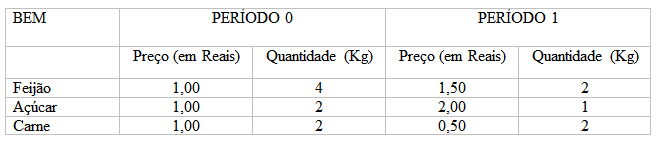
Podemos afirmar que:
Item 1: A variação percentual do nível de preços pelo índice de Laspeyres foi maior que a variação pelo índice de Paasche.
Provas
"Thorstein Veblen and Post-Darwinian Economics".
By
Geoffrey M. Hodgson. Economics and Evolution. Chapter 9, pp 123-24.
Polity Press,1993.
In a famous article originally published in 1898, Thorstein Veblen (1919, p.56) asked: 'Why is economics not an evolutionary science?' The term 'evolutionary' was subsequently adopted by institutional economists, but often in broad or developmentalist terms, and with only slight attention to the more precise mechanisms of natural selection as developed in biology. Veblen's knowledge of biological science was remarkably up-to-date, yet evolutionary theory has developed enormously since his death, leaving many of his institutionalist followers well behind. Veblen made a direct appeal to biological science for inspiration; but subsequently, and until very recently, this example has rarely been replicated. Accordingly there has been remarkably little detailed exploration, informed by biology, of what Veblen precisely meant by an 'evolutionary' science, and of the character of the 'post-Darwinian' economics that he attempted to build.
Like Alfred Marshall, Thorstein Veblen saw that the appropriate metaphor for economics was to be found in biology. In particular, Veblen saw the evolutionary metaphor as crucial to the understanding of the processes of technological development in a capitalist economy. But unlike his English colleague, he did not care to develop a static, equilibrium analysis as a prelude to the dynamic. He characterized his own economics as post-Darwinian, and argued that economics should embrace the metaphor of evolution and change, rather than the static ideas of equilibrium that had been borrowed by the neoclassical economists from physics.
However, after rebutting a mechanical prelude to economic dynamics, Veblen was faced with a biology at a stage of development at which the mechanisms of evolution were only partly understood. Consequently, and given his own personal aversion to intellectual 'symmetry and system-making' (Veblen, 1919, p. 68), there was little chance that Veblen would be able to build an economic theory on the Marshallian scale.
Instead, he leaves us with plentiful hints and insights, many brilliant, several contradictory. He writes in a style which is often dazzling and illuminating, but also sometimes evasive or unclear. Partly for the latter reason, and partly because he did not provide us with a systematic theoretical legacy, his significance for evolutionary economics in particular, and economics in general, still remains underestimated to this day.
Importantly, Veblen had a keen and perceptive understanding of the relationships and connections between the social and the physical sciences. In this chapter it will be shown that Veblen had two primary reasons for the adoption of a Darwinian and evolutionary metaphor. One relates to the idea of cumulative causation and an opposition to depictions of the economic process that are consummated in equilibrium. The other is based on the formation of analogies to both the gene and the processes of natural selection in the social world.
As noted in chapter 3, Darwinian natural selection involves several component principles. First, there must be sustained variation among the members of a species or population. Without such variation, natural selection cannot operate. Second, there must be some principle of heredity or continuity, through which offspring resemble their parents more than they resemble other members of their species, due to some mechanism by which individual characteristics are passed on from one generation to the next. Third, natural selection operates either because better-adapted organisms leave increased numbers of offspring, or because the genotypes that are preserved bestow advantage in struggling to survive. The latter is the principle of the struggle for existence. The application of the metaphor of natural selection to economics should be on the basis of analogous principles. It is argued here that Veblen was relatively successful in this regard.
According to the author,
Item 3: institutional economists did not follow the development of evolutionary theory.
Provas
É correto afirmar que:
Item 1: Se a economia está em uma alocação eficiente no sentido de Pareto, ninguém pode conseguir uma utilidade maior.
Provas
Seja X ~ Normal (!$ μ, σ^2 !$). Considere o problema de estimação de !$ μ !$ a partir de uma amostra aleatória !$ X_1 !$, ...., !$ X_n !$ e considere os três estimadores abaixo:
!$ M_1 = { \large 1 \over n} \sum_{k-1}^n Xk !$
!$ M_2 = { \large 1 \over n + 1} \sum_{k-1}^n Xk !$
!$ M_3 = { \large 1 \over 2} X_1 + { \large 1 \over 2n} \sum_{k-2}^n Xk !$
Podemos afirmar que:
Item 2: M2 é o melhor estimador linear não-tendencioso.
Provas
Em relação à teoria de produção das firmas, pode-se afirmar que:
Item 2: A função de produção !$ f(x_1,x_2) = min [ax_1, bx_2] !$ combina os insumos na proporção !$ { \large x_1 \over x_2} = { \large a \over b} !$.
Provas
Provas
Provas
Provas
Identifique a afirmativa verdadeira e falsa.
Seja:
I = conjunto de todas as pessoas inteligentes.
R = conjunto de todas as pessoas ricas.
RJ = conjunto das pessoas que moram no Rio de Janeiro.
Então:
Item 2: !$ RJ \cup R = !$ Conjunto das pessoas ricas ou das pessoas que moram no Rio de Janeiro ou das pessoas ricas que moram no Rio de Janeiro.
Provas
Caderno Container