Foram encontradas 384 questões.
A respeito dos limites abaixo, responda V (verdadeiro) ou F (falso).
Item 0: !$ lim_{x \rightarrow + \infty} (1 + { \large 3 \over x})^{ \large x \over 5} = e^{5 / 3} !$;
Provas
Questão presente nas seguintes provas

FIRST TEXT
Sympathetic writers talk of Marx’s passionate empathy toward the working class, his demands for a decent wage and improved working conditions, and his great feeling for his family’s welfare. In this respect, Marx is an enigma. In the classroom’s most popular book on the history of economics, Robert L. Heilbroner writes that, despite his reputation as a contentious and vengeful man who feuded constantly with his contemporaries, Marx was a devoted husband and father. In a sympathetic biography, Saul K. Padover notes, “Marx, the harsh critic and angry radical in his public life and writings, was a different man in private. In his personal life, he was extraordinarily kind and generous and, when not tormented by illnesses, gay. . . . [As a] self-assured male, Marx has a genuine affection and esteem for women. . . . [And] Jenny was the only woman in his life.”
Apologists for Marx are almost always blind to the darker side of the creator of communism. They write of his devotion to his family and his love letters to his wife but ignore or condone his illicit affair with the family’s household servant, Lenchen, which produced an illegitimate son whom Marx would have nothing to do with. Interestingly, Marx also never paid this servant a penny for her housework.
Karl and Jenny Marx were poverty-stricken but not for want of money. They received large sums over the years from Engels, other supporters, and from Marx’s writings. One estimate is that Marx was poor only 15 years of his 65-year career, and that his income placed him in the top 5 percent of London residents in the 1860s. But the Marxes were financially incompetent and could not control their spending habits. Marx entertained lavishly, speculated on the stock market, and spent large sums on liquor, books, travel, and other consumer goods until he had to beg for more or borrow from pawnshops at usury rates. Such irresponsible spending habits often left his family starving, destitute, and in ill health. Marx’s family life was often a nightmare, resulting in the early death or eventual suicide of most of his children. Historian Robert Payne, in his biography of Marx, concludes, “He exploited everyone around him – his wife, his children, his mistress and his friends – with a ruthlessness which was all the more terrible because it was deliberate and calculating.” (“Was Marx a Good Family Man?” Skousen, Marx, Economics on Trial: Lies, Myths, and Realities. Business One Irwin, Homewood, Ill, 1991: 212-213).
According to the text:
Item 4: Marx had an out-of-the-wedlock son.
Provas
Questão presente nas seguintes provas
FIRST TEXT
Sympathetic writers talk of Marx’s passionate empathy toward the working class, his demands for a decent wage and improved working conditions, and his great feeling for his family’s welfare. In this respect, Marx is an enigma. In the classroom’s most popular book on the history of economics, Robert L. Heilbroner writes that, despite his reputation as a contentious and vengeful man who feuded constantly with his contemporaries, Marx was a devoted husband and father. In a sympathetic biography, Saul K. Padover notes, “Marx, the harsh critic and angry radical in his public life and writings, was a different man in private. In his personal life, he was extraordinarily kind and generous and, when not tormented by illnesses, gay. . . . [As a] self-assured male, Marx has a genuine affection and esteem for women. . . . [And] Jenny was the only woman in his life.”
Apologists for Marx are almost always blind to the darker side of the creator of communism. They write of his devotion to his family and his love letters to his wife but ignore or condone his illicit affair with the family’s household servant, Lenchen, which produced an illegitimate son whom Marx would have nothing to do with. Interestingly, Marx also never paid this servant a penny for her housework.
Karl and Jenny Marx were poverty-stricken but not for want of money. They received large sums over the years from Engels, other supporters, and from Marx’s writings. One estimate is that Marx was poor only 15 years of his 65-year career, and that his income placed him in the top 5 percent of London residents in the 1860s. But the Marxes were financially incompetent and could not control their spending habits. Marx entertained lavishly, speculated on the stock market, and spent large sums on liquor, books, travel, and other consumer goods until he had to beg for more or borrow from pawnshops at usury rates. Such irresponsible spending habits often left his family starving, destitute, and in ill health. Marx’s family life was often a nightmare, resulting in the early death or eventual suicide of most of his children. Historian Robert Payne, in his biography of Marx, concludes, “He exploited everyone around him – his wife, his children, his mistress and his friends – with a ruthlessness which was all the more terrible because it was deliberate and calculating.” (“Was Marx a Good Family Man?” Skousen, Marx, Economics on Trial: Lies, Myths, and Realities. Business One Irwin, Homewood, Ill, 1991: 212-213).
According to the text:
Item 0: Marx’s apologists often fail to realize his darker side.
Provas
Questão presente nas seguintes provas
Considere o jogo na forma extensiva apresentada a seguir.
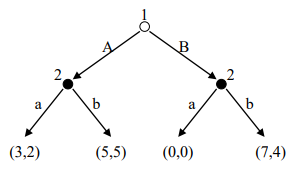
Item 4: Todo equilíbrio de Nash em estratégias puras do jogo é eficiente no sentido de Pareto.
Provas
Questão presente nas seguintes provas
FIRST TEXT
Sympathetic writers talk of Marx’s passionate empathy toward the working class, his demands for a decent wage and improved working conditions, and his great feeling for his family’s welfare. In this respect, Marx is an enigma. In the classroom’s most popular book on the history of economics, Robert L. Heilbroner writes that, despite his reputation as a contentious and vengeful man who feuded constantly with his contemporaries, Marx was a devoted husband and father. In a sympathetic biography, Saul K. Padover notes, “Marx, the harsh critic and angry radical in his public life and writings, was a different man in private. In his personal life, he was extraordinarily kind and generous and, when not tormented by illnesses, gay. . . . [As a] self-assured male, Marx has a genuine affection and esteem for women. . . . [And] Jenny was the only woman in his life.”
Apologists for Marx are almost always blind to the darker side of the creator of communism. They write of his devotion to his family and his love letters to his wife but ignore or condone his illicit affair with the family’s household servant, Lenchen, which produced an illegitimate son whom Marx would have nothing to do with. Interestingly, Marx also never paid this servant a penny for her housework.
Karl and Jenny Marx were poverty-stricken but not for want of money. They received large sums over the years from Engels, other supporters, and from Marx’s writings. One estimate is that Marx was poor only 15 years of his 65-year career, and that his income placed him in the top 5 percent of London residents in the 1860s. But the Marxes were financially incompetent and could not control their spending habits. Marx entertained lavishly, speculated on the stock market, and spent large sums on liquor, books, travel, and other consumer goods until he had to beg for more or borrow from pawnshops at usury rates. Such irresponsible spending habits often left his family starving, destitute, and in ill health. Marx’s family life was often a nightmare, resulting in the early death or eventual suicide of most of his children. Historian Robert Payne, in his biography of Marx, concludes, “He exploited everyone around him – his wife, his children, his mistress and his friends – with a ruthlessness which was all the more terrible because it was deliberate and calculating.” (“Was Marx a Good Family Man?” Skousen, Marx, Economics on Trial: Lies, Myths, and Realities. Business One Irwin, Homewood, Ill, 1991: 212-213).
According to the text, Marx:
Item 0: was a congenial man who got along well with his family and contemporaries alike.
Provas
Questão presente nas seguintes provas
FIRST TEXT
Sympathetic writers talk of Marx’s passionate empathy toward the working class, his demands for a decent wage and improved working conditions, and his great feeling for his family’s welfare. In this respect, Marx is an enigma. In the classroom’s most popular book on the history of economics, Robert L. Heilbroner writes that, despite his reputation as a contentious and vengeful man who feuded constantly with his contemporaries, Marx was a devoted husband and father. In a sympathetic biography, Saul K. Padover notes, “Marx, the harsh critic and angry radical in his public life and writings, was a different man in private. In his personal life, he was extraordinarily kind and generous and, when not tormented by illnesses, gay. . . . [As a] self-assured male, Marx has a genuine affection and esteem for women. . . . [And] Jenny was the only woman in his life.”
Apologists for Marx are almost always blind to the darker side of the creator of communism. They write of his devotion to his family and his love letters to his wife but ignore or condone his illicit affair with the family’s household servant, Lenchen, which produced an illegitimate son whom Marx would have nothing to do with. Interestingly, Marx also never paid this servant a penny for her housework.
Karl and Jenny Marx were poverty-stricken but not for want of money. They received large sums over the years from Engels, other supporters, and from Marx’s writings. One estimate is that Marx was poor only 15 years of his 65-year career, and that his income placed him in the top 5 percent of London residents in the 1860s. But the Marxes were financially incompetent and could not control their spending habits. Marx entertained lavishly, speculated on the stock market, and spent large sums on liquor, books, travel, and other consumer goods until he had to beg for more or borrow from pawnshops at usury rates. Such irresponsible spending habits often left his family starving, destitute, and in ill health. Marx’s family life was often a nightmare, resulting in the early death or eventual suicide of most of his children. Historian Robert Payne, in his biography of Marx, concludes, “He exploited everyone around him – his wife, his children, his mistress and his friends – with a ruthlessness which was all the more terrible because it was deliberate and calculating.” (“Was Marx a Good Family Man?” Skousen, Marx, Economics on Trial: Lies, Myths, and Realities. Business One Irwin, Homewood, Ill, 1991: 212-213).
According to the text:
Item 3: Marx was a beggar.
Provas
Questão presente nas seguintes provas
Entre os fatores que contribuíram para a apreciação do câmbio (valorização da moeda nacional) no período 1899-1905, devem ser mencionados:
Item 2: a redução do papel-moeda em circulação no período 1899-1905;
Provas
Questão presente nas seguintes provas
A respeito da integra abaixo, assinale V (verdadeiro) ou F (falso):
Item 4: !$ \int\limits^{\pi / 2}_{ 0} !$ x sen(x) dx = 1.
Provas
Questão presente nas seguintes provas
Dada a função !$ f : R^2 \rightarrow R !$ definida por !$ f (x, y) = x y !$, assinale V (verdadeiro) ou F (falso):
Item 0: O valor máximo de !$ f !$ sujeito à restrição !$ |x| + |y| \le 2 !$ é igual a 1 (um);
Provas
Questão presente nas seguintes provas
Um pequeno produtor utiliza implementos agrícolas e trabalho para produzir mudas de plantas ornamentais. Este produtor deseja maximizar seu lucro, que depende do esforço E de um trabalhador assim como de condições climáticas aleatórias. O esforço máximo do trabalhador é dado por E = 1 e o esforço nulo por E = 0. Há um custo para o trabalhador esforçar-se, dado por C ( E ) = 0, se E = 0 e C( E ) = 5.000, se E =1. A probabilidade do clima ser favorável é de p = 0,5 e a matriz de lucros possíveis é dada por:
| Clima Favorável (p=0,5) R$ | Clima desfavorável (p=0,5) R$ | |
| E=0 | 10.000,00 | 5.000,00 |
| E=1 | 20.000,00 | 10.000,00 |
Analise a assertiva abaixo, supondo que o objetivo do trabalhador seja maximizar sua remuneração esperada líquida, e que o objetivo do produtor seja maximizar o lucro.
Item 4: A falta de informação a respeito do esforço realizado pelo trabalhador pode levar à ineficiência já que diminui simultaneamente a remuneração do trabalhador e o lucro do produtor.
Provas
Questão presente nas seguintes provas
Cadernos
Caderno Container