Foram encontradas 384 questões.
No modelo clássico de regressão linear: !$ Y_i= β_1 + β_2 X_i + u_i !$
Item 2: As hipóteses de que o erro é normalmente distribuído e de que cov!$ (u_i, u_j | X_i, X_j)= 0, \ i !$  !$ j !$ asseguram que !$ u_i !$ e !$ u_j !$ se distribuem independentemente.
!$ j !$ asseguram que !$ u_i !$ e !$ u_j !$ se distribuem independentemente.Provas
Questão presente nas seguintes provas

Em relação ao intervalo de confiança estatístico pode-se afirmar:
Item 2: Para aumentar a precisão de uma estimativa por intervalo, o pesquisador deve aumentar o intervalo de confiança de 95% para 99%, por exemplo.
Provas
Questão presente nas seguintes provas
Sobre testes de hipóteses, pode-se afirmar que:
Item 2: Por potência do teste entende-se a probabilidade de se rejeitar a hipótese nula quando esta for falsa.
Provas
Questão presente nas seguintes provas
A política antiinflacionária do período 1964/67 alcançou sucesso em reverter a tendência ascendente da inflação do período anterior. Entre os principais componentes dessa política podemos mencionar:
Item 0: o congelamento temporário de preços e salários, tendo o controle de preços posterior constituído-se num expediente secundário para o sucesso da política de estabilização;
Provas
Questão presente nas seguintes provas
SECOND TEXT
All things considered, it must have been a crummy week to be the king of the software world. If you are Bill Gates, you’re used to being cursed by competitors, hounded by regulators and lampooned by late-night comics as the perfect – albeit perfect rich – geek. But no one, not even Gates, could be comfortable with the idea that one’s masterpiece – which happens to the biggest and most powerful software company on earth – could be taken and sliced in two.
But that’s precisely what state and federal trustbusters demanded last week. In a filing submitted to federal Judge Thomas Penfield Jackson, the Justice Department and 17 of 19 states that have brought suits against Microsoft finally agreed: Microsoft should be chopped into two companies. One would develop and sell the Windows operating system that runs 85% of the world’s desktop computers. The other business would handle everything else – most notably, the universally used “applications” software, such as Microsoft Office, which includes its dominant word processing and spreadsheet programs, and its Web-browsing Internet Explorer.
The two companies could not collude or cooperate in any way for 10 years. During that time, they would be required to strive ceaselessly against each other. Gates would have to choose which company to run and hold stock in – while competing with the other.
To antitrust chief Joel Klein, the plan strikes a perfect balance: “Neither the heavy hand of ongoing government regulation nor the self-interest of an entrenched monopolist will decide what is in the best interest of consumers,” he says. “Rather, consumers will be able to choose for themselves the products they want in a free and competitive marketplace.” Counters Gates: “We don’t believe the courts are going to uphold this kind of unprecedented and radical regulation of our activities.”
But beyond the angry words and legal documents, the proposed remedy marked the culmination of 23 months of state and federal pursuit of Microsoft and represents a clear watershed for the computer and software industries. The ruling that emerges from Judge Jackson’s court, and from an appeals process that could last two more years, will do much to determine the course of software development for decades to come – and with it the programs that countless companies and consumers use.
For now, Microsoft attorney William Neukom plans to push for an extension of the company’s May 10 deadline for responding to last Friday’s Justice Department proposal. Microsoft will want “months and months” of additional hearings in front of Jackson, who ruled on April 3 that the company had illegally and repeatedly used its monopoly power to stifle innovation. A final decision by Jackson might not come until the end of summer. Even then, any breakup that the judge might call for would be on hold until the appeals process is done. That’s why Klein and the states want Jackson’s ruling to include immediate restrictions on Microsoft’s conduct, including a measure that would bar it from retaliating against computer makers that load rivals’ software on their machines. In addition, prosecutors want Microsoft to publish a price list that would apply to all its largest customers. (“Carving up Gates,” Time magazine, May 8, 2000: 28-31).
According to the text:
Item 1: The attorney for Microsoft is seeking a postponement of the company’s deadline to respond to the Justice Department’s proposal.
Provas
Questão presente nas seguintes provas
Quanto ao dilema de política econômica expresso pela curva de Philips, indique se a afirmação é falsa ou verdadeira:
Item 0: O custo da redução do desemprego, medido em aumento de taxa de inflação, será tanto maior quanto maior for a capacidade ociosa da economia.
Provas
Questão presente nas seguintes provas
A respeito da integra abaixo, assinale V (verdadeiro) ou F (falso):
Item 0: !$ \int\limits^{+ \infty}_{ - \infty} !$ max !$ \{0 , x e^{x^2} dx = 0,5 !$;
Provas
Questão presente nas seguintes provas
Analise a assertiva abaixo, supondo uma indústria composta por n firmas, n > 2, cada uma atuando segundo as hipóteses do modelo de Cournot.
Item 0: Como o número de firmas da indústria é superior a 2, a condição necessária à maximização do lucro de cada uma deixa de ser a igualdade entre receita marginal e custo marginal.
Provas
Questão presente nas seguintes provas
Considere o jogo na forma extensiva apresentada a seguir.
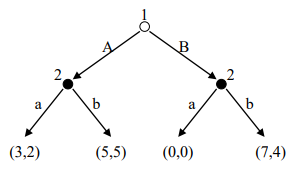
Item 2: Não existe equilíbrio de Nash que resulte nos ganhos (7, 4).
Provas
Questão presente nas seguintes provas
Sobre as demandas de consumo e de investimento, indique se a afirmação é falsa ou verdadeira:
Item 4: Se a taxa de juros é de 10% a.a., valerá a pena realizar um investimento de $100, do qual se esperam retornos líquidos de $ 44 ao final do primeiro ano e $ 60,5 ao final do segundo.
Provas
Questão presente nas seguintes provas
Cadernos
Caderno Container