Foram encontradas 395 questões.
O Plano Real alcançou seu objetivo de manter a inflação sob controle, mas contribuiu para agravar alguns problemas macroeconômicos no Brasil. Isto aconteceu porque:
Item 4 - a conjunção de taxas de juros elevadas com a necessidade de geração de superávits primários nas contas públicas, a partir de 1999, deprimiu a taxa de crescimento do PIB.
Provas
Questão presente nas seguintes provas

Avalie o item:
Item 0 - Uma condição necessária a que valha a pena comprar um equipamento é que o valor presente dos lucros esperados gerados pelo seu uso seja inferior ao preço de mercado do equipamento.
Provas
Questão presente nas seguintes provas
Rising real rates of interest, transmitted to LDCs and to their DRAs, are likely to cause rising rates of resource degradation, via private incentives and public capacities.
Suppose a farmer is choosing between a “sustainable” way to manage land, which generates a net return of y1 each year forever, and “exhaustive” way, which generates a higher return, y2 each year for n years, after which the land has been destroyed and yields nothing. It can easily be shown that the “sustainable” path yields a higher present value if, and only if
(y2/y1) < 1 – 1/ (1 – r)n+1
Where r is the real interest rate for a n-year loan. For example, if r = 10 percent and n = 15 years, the sustainable path is chosen only if it produces at least 78 percent as much, forever, as the exhaustive path produces for 15 years before destroying the land. If r = 5 percent, the sustainable path needs to produce less, namely, 54 percent of “exhaustive” net returns, to be preferred. Clearly, the rise in real long-term rates of interest, if transmitted to DRAs, must have had enormous incentive effects on resource management, shifting it away from sustainability.
If risk is allowed for, the interest rate incentive to deplete is probably sharpened. Higher interest rates reduce the present-value burden of long-term-future downside risks, relative to that of near-term risks (and costs). The land use patterns are therefore shifted toward activities with long-term risks, such as possible long-term resource degradation.
In the analysis of the effects of risk on resource depletion, the text allows one to conclude that:
Item 1 - higher interest rates reduces the cost effect of long-term risks as compared to that of short-term risks;
Provas
Questão presente nas seguintes provas
Com base no modelo Mundell-Fleming, avalie o item. Em economias pequenas:
Item 0 - Sob o regime de câmbio fixo, o multiplicador de gasto autônomo será tanto menor quanto maior for a mobilidade de capital.
Provas
Questão presente nas seguintes provas
Considere um jogo na forma normal resumido em termos da seguinte matriz de ganhos
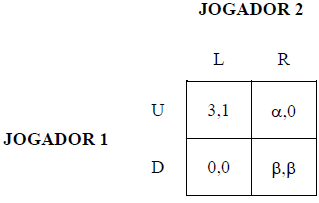
Item 1 - Para !$ \alpha !$ = 2 e !$ \beta !$ = 1, existe um único equilíbrio de Nash em estratégias puras.
Provas
Questão presente nas seguintes provas
Rising real rates of interest, transmitted to LDCs and to their DRAs, are likely to cause rising rates of resource degradation, via private incentives and public capacities.
Suppose a farmer is choosing between a “sustainable” way to manage land, which generates a net return of y1 each year forever, and “exhaustive” way, which generates a higher return, y2 each year for n years, after which the land has been destroyed and yields nothing. It can easily be shown that the “sustainable” path yields a higher present value if, and only if
(y2/y1) < 1 – 1/ (1 – r)n+1
Where r is the real interest rate for a n-year loan. For example, if r = 10 percent and n = 15 years, the sustainable path is chosen only if it produces at least 78 percent as much, forever, as the exhaustive path produces for 15 years before destroying the land. If r = 5 percent, the sustainable path needs to produce less, namely, 54 percent of “exhaustive” net returns, to be preferred. Clearly, the rise in real long-term rates of interest, if transmitted to DRAs, must have had enormous incentive effects on resource management, shifting it away from sustainability.
If risk is allowed for, the interest rate incentive to deplete is probably sharpened. Higher interest rates reduce the present-value burden of long-term-future downside risks, relative to that of near-term risks (and costs). The land use patterns are therefore shifted toward activities with long-term risks, such as possible long-term resource degradation.
In the analysis of the relationship between rising interest rates and rising rates of resource degradation, the text leads to the conclusion that:
Item 4 - the exhaustible path produces nothing after 15 years.
Provas
Questão presente nas seguintes provas
Para mercados em concorrência monopolística, é correto o item:
Item 4 - No equilíbrio de longo prazo do mercado, o preço é maior do que o custo médio.
Provas
Questão presente nas seguintes provas
It is policies in developed countries that have produced the bigger, more pervasive, more durable, and worsening “price twists” against developing countries’ farm prices, thereby encouraging developing country farmers to discount the future capacity of their resources to sustain output. Farm policy in the European Community, and for some products in the United States (sugar, tobacco, cotton) and Japan (rice), lowers the trend line of world farm output prices by (1) stimulating overproduction; (2) subsidizing huge stock overhangs that depress prices further, and arguably by subsidizing exports as well; and (3) greatly stimulating developed country farmers’ demand for research, which generates a pipeline of technical progress that leads to further incentives to overproduce. Finally, developing country governments have often ill-advisedly intensified this price decline via trade regimes, parastatal monopolies of farm inputs or monopsonies of farm outputs, and so forth.
In its evaluation of the impact of developed country policies on resource degradation in developing country rural areas, the text
Item 3 - singles out Japan as the chief culprit (because of its support to rice prices);
Provas
Questão presente nas seguintes provas
Avalie o item que segue, relativa ao comportamento da oferta agregada:
Item 2 - Quanto mais horizontal for a curva de Phillips, menor será o sacrifício decorrente do processo de estabilização.
Provas
Questão presente nas seguintes provas
Rising real rates of interest, transmitted to LDCs and to their DRAs, are likely to cause rising rates of resource degradation, via private incentives and public capacities.
Suppose a farmer is choosing between a “sustainable” way to manage land, which generates a net return of y1 each year forever, and “exhaustive” way, which generates a higher return, y2 each year for n years, after which the land has been destroyed and yields nothing. It can easily be shown that the “sustainable” path yields a higher present value if, and only if
(y2/y1) < 1 – 1/ (1 – r)n+1
Where r is the real interest rate for a n-year loan. For example, if r = 10 percent and n = 15 years, the sustainable path is chosen only if it produces at least 78 percent as much, forever, as the exhaustive path produces for 15 years before destroying the land. If r = 5 percent, the sustainable path needs to produce less, namely, 54 percent of “exhaustive” net returns, to be preferred. Clearly, the rise in real long-term rates of interest, if transmitted to DRAs, must have had enormous incentive effects on resource management, shifting it away from sustainability.
If risk is allowed for, the interest rate incentive to deplete is probably sharpened. Higher interest rates reduce the present-value burden of long-term-future downside risks, relative to that of near-term risks (and costs). The land use patterns are therefore shifted toward activities with long-term risks, such as possible long-term resource degradation.
According to the text, the halving of the interest rate, everything else remaining the same, produces the following effects:
Item 1 - reduces production of the sustainable path;
Provas
Questão presente nas seguintes provas
Cadernos
Caderno Container