Foram encontradas 371 questões.
O gráfico abaixo mostra a curva de renda-consumo (ou caminho de expansão da renda) de um consumidor. A respeito do bem x1, é correto afirmar:
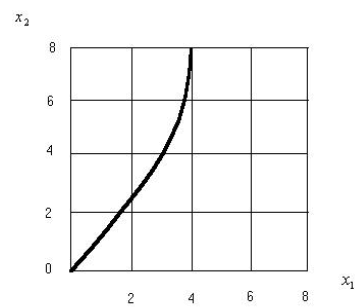
Item 2 - x1 é um bem normal.
Provas

Responda V (verdadeiro) ou F (falso):
Item 1 - Os vetores (1,3,4), (3,-1,1), (4,6,-1) e (0,1,2) são linearmente independentes.
Provas
Responda V (verdadeiro) ou F (falso):
Item 3 - A interseção do plano !$ z-x-y=3 !$ com o plano !$ z+x+y=4 !$ é uma reta em !$ \mathbb{R}^3 !$.
Provas
Considere o modelo de regressão linear múltipla para dados seccionais:
!$ y_i=\beta_0+\beta_1x_{1i}+\beta_2x_{2i}+L + \beta_k x_{ki}+u_i, \,\,\,\, i=1,K,n !$
É correto afirmar que:
Item 4 - Se !$ Cov(x_{1i}, x_{3i}=0,\,\,\, i=1,K, n !$ os estimadores de mínimos quadrados ordinários da regressão !$ y_1=\beta_0+\beta_1x_{1i}+\beta_2x_{2i}+\beta_4x_{4i}+L+\beta_k x_{ki}+u_i,\,\,\,\,\, i=1, K, n !$, serão consistentes.
Provas
Considere a seguinte regressão entre!$ y_t !$ e !$ z_t !$:
!$ y_t=\alpha z_t + u_t !$,
em que !$ u_t !$ é o erro. É correto afirmar:
Item 0 - Se !$ y_t !$ for I(1) e !$ z_t !$ for I(0), então !$ y_t !$ e !$ z_t !$ são co-integradas.
Provas
Provas
A figura abaixo mostra as curvas de indiferença de um consumidor e a direção na qual a utilidade deste consumidor aumenta.
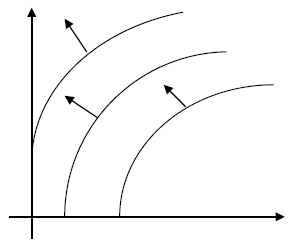
É correto afirmar:
Item 1 - O indivíduo gosta da diversificação.
Provas
Considere um modelo de Agente-Principal em que o último contrata um vendedor para seu produto. Se o vendedor esforçar-se muito, a receita das vendas será R$ 100, com probabilidade 0,8; R$ 50, com probabilidade 0,2; e a utilidade do vendedor será !$ \sqrt{w}-4 !$. Caso o vendedor se esforce pouco, a receita de vendas será R$ 100, com probabilidade 0,4; R$ 50, com probabilidade 0,6; e a utilidade do vendedor será !$ \sqrt{w} !$ (w é o salário). O vendedor sempre pode ter a utilidade !$ u_0=1 !$ se for trabalhar numa outra profissão que não seja a de vendas. O Principal preocupa-se em maximizar seu lucro esperado, dado pela receita de vendas menos o custo. Assuma que o Principal não consiga observar o nível de esforço do vendedor, mas apenas as vendas. É correto afirmar:
Item 3 - A receita total esperada correspondente à ação de maior esforço do vendedor é maior que a correspondente à ação de menor esforço.
Provas
The Origins of Structuralism
H.W. Arndt. Modern Political Economy and Latin America. Eds. Jeffry Frieden,
Manuel Pastor Jr., and Michael Tomz. Westview Press, 2000: 5-9.
Introduction
In his recent book on economic development, I.M.D. Little distinguishes two broad categories of development economics. He calls them ‘neoclassical economics’ and ‘structuralism’.
“The structuralist sees the world as inflexible. Change is inhibited by obstacles, bottlenecks and constraints. People find it hard to move or adapt, and resources tend to be stuck. In economic terms, the supply of most things is inelastic. Such general inflexibility was thought to apply particularly to LDC’s.... Entrepreneurs were lacking; and communications were poor.... This alleged inflexibility was married to the evident fact that the production structure of developing countries was very different from that of developed countries. To achieve development, it had to be changed rapidly.... The structuralist view of the world provides a reason for distrusting the price mechanism and for trying to bring about change in other ways. If supplies and demands are very inelastic large price changes are needed to achieve small quantitative adjustments. Large price changes are disturbing, both directly and also because they result in changes in income distribution.... If the losers are powerful, they may... be able to resist the change through organized industrial or political action... Structuralism primarily seeks to provide a reason for managing change by administrative action.”
The purpose of this article is to explore further the origins of structuralism, both in the broader sense and the more specific context of Latin American structuralist theories of inflation, and the links between them.
According to the same author, structuralism rests on the following assumptions:
Item 2 - inelastic supply of goods and services,
Provas
Provas
Caderno Container