Foram encontradas 280 questões.
Uma empresa estava patrocinando um evento musical e resolveu presentear alguns de seus melhores clientes com ingressos para o evento. Para cada um dos 30 clientes solteiros, foi enviado um envelope com apenas um ingresso, e, para cada um dos 40 clientes casados, foi enviado um envelope com dois ingressos. Antes de serem enviados por correio, o conjunto de envelopes com dois ingressos foi pesado, dando uma massa total de 5720g, ao passo que a pesagem do conjunto de envelopes com apenas um ingresso indicou uma massa total de 3090g.
Sabendo-se que os cônjuges dos clientes não eram clientes da empresa e que os envelopes, assim como os ingressos, eram idênticos, qual é a massa, em gramas, de cada ingresso?
Provas

Em uma plataforma de xadrez on-line, as estatísticas de um certo jogador são dadas na Tabela abaixo, em que se mostra a porcentagem de vitórias, empates e derrotas quando ele joga de brancas e quando ele joga de pretas.
| Vitória | Empate | Derrota | |
| Pretas | 50% | 10% | 40% |
| Brancas | 60% | 5% | 35% |
Sabe-se, também, que o número de vezes em que esse jogador empatou de brancas foi duas vezes maior que de pretas.
Qual a razão entre o número de vitórias de pretas e o número total de vitórias?
Provas
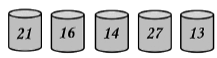
Em cada uma das latas da Figura acima há apenas lápis e borrachas. O número escrito em cada uma dessas latas indica a quantidade total desses objetos nela contidos.
Uma dessas latas foi retirada e, considerando-se apenas as quatro latas restantes, o número total de lápis passou a ser o triplo do número total de borrachas.
Considerando-se apenas as quatro latas restantes, o número total de lápis existente nelas é igual a
Provas
Em uma cidade, as empresas tendem a se tornar clientes de três grandes bancos (1, 2 e 3). Na matriz A, apresentada a seguir, o elemento da linha i e da coluna j representa o número de empresas que deixaram de ser clientes do banco i e se tornaram clientes do banco j no último triênio.
!$ A \, = \, \begin {pmatrix} 0 \,\, 5 \,\, 3 \\ 4 \,\, 0 \,\, 2 \\ 1 \,\, 6 \,\, 0 \end {pmatrix} !$
Com base apenas na matriz A, no último triênio, o banco 2 teve um aumento de quantas empresas clientes?
Provas
Em 2021, uma empresa lançou o produto P, até então o único de sua categoria no mercado. No início do ano seguinte, uma outra empresa lançou um forte concorrente desse produto. O lançamento desse produto concorrente implicou, em 2022, uma redução de 4% nas vendas do produto P, em comparação com 2021.
Supondo-se que essa taxa de redução anual nas vendas se mantenha, o número aproximado de anos, depois de 2021, em que as vendas do produto P serão apenas 30% das vendas alcançadas no ano do seu lançamento é dado por
Provas
How To Teach Your Kids Good Money Habits
As a parent, you want the best for your children.
This doesn’t necessarily mean you want them to have the best clothes, the latest toys or coolest gadgets.
Most likely, it means you want to lay a foundation that they can build upon to do well in life. “Without a working knowledge of money, it is extraordinarily difficult to do well in life,” says Sam X. Renick, cocreator of Sammy Rabbit, a children’s character and financial literacy initiative. “Money is central to managing life, day-in and day-out. Where we live, what we eat, the clothes we wear, the car we drive, health care, education, child-raising, gift giving, vacations, entertainment, heat, air-conditioning, insurance—you name it, money is involved.” If you want to play a key role in shaping your children’s feelings, thinking and values about money, you need to give them the gift of financial literacy from an early age. Lessons should begin before age seven, Renick says, because research shows that money habits and attitudes are already formed by then. Actually, showing them how money works is more effective, so let them see you buying things with cash.
Your kids’ early interactions with money will likely involve spending. They see you using it to buy things, including things for them. So it’s important to teach them from a young age that money isn’t just for spending— they should be saving money regularly, too. “Saving teaches discipline and delayed gratification,” Renick says. “Saving teaches goal-setting and planning. It emphasizes being prepared, and it builds security and independence.” Help your kids get in the habit of saving by giving them a piggy bank or savings jar where they can deposit coins or cash.
Kids need to have money of their own so they can learn how to make decisions about using it. An allowance can accomplish that. However, you should consider requiring your kids to do certain tasks to earn their allowance. “Just about everyone values money they earn differently than money they receive,” Renick says. There are some kinds of housework the kids have to do without pay because they’re expected to help out as part of a family. But they can have specific activities they need to complete if they want to get paid.
In addition to wanting his kids to understand that money is earned, it is important that they can learn to live within a budget. “My two youngest children would constantly ask for money and spend like drunken sailors,” says Tim Sheehan, co-founder and CEO of Greenlight, a debit card for kids with parental controls. “When I started paying them an allowance, I told them that was all the money they would get and that it was up to them to manage it. Amazingly, it worked,” he says. They track how much they have coming in and going out and how much they’re saving using the Greenlight app. Learning how to budget now will help them when they enter the real world, Sheehan says.
A key reason that it is important for you, as a parent, to teach your kids financial lessons is because you can share your money values through those lessons. If you value giving to others, you can introduce that value to your children by helping make it a habit for them from an early age. You could do as Chase Peckham – from the San Diego Financial Literacy Center – did with his kids, when they were little, and create spending, saving and giving jars.
Then help your children plan their giving by discussing what groups or causes they want to support.
Just as important as the lessons you teach your kids about money are the ways you discuss and handle money when you’re around them. For example, if you complain about having to spend too much on certain things and then take your kids out for compulsive shopping, you’re sending mixed messages. If you want your children to develop good spending and saving habits, they need to see you making smart spending and saving choices. In short, practice what you preach. And preach with consistency. Educating your children about personal finance is a process that can take time. But if you put in the effort and continuously communicate a clear message about money, you will instill good habits that will serve your children well.
Available at: https://www.forbes.com/advisor/personal-finance/how-to- teach -
your-kids-good-money-habits/ Retrieved on: Jan. 2, 2023. Adapted.
In the passage of paragraph, “An allowance can accomplish that. However, you should consider requiring your kids to do certain tasks to earn their allowance”, the term “however” establishes the idea of
Provas
How To Teach Your Kids Good Money Habits
As a parent, you want the best for your children.
This doesn’t necessarily mean you want them to have the best clothes, the latest toys or coolest gadgets.
Most likely, it means you want to lay a foundation that they can build upon to do well in life. “Without a working knowledge of money, it is extraordinarily difficult to do well in life,” says Sam X. Renick, cocreator of Sammy Rabbit, a children’s character and financial literacy initiative. “Money is central to managing life, day-in and day-out. Where we live, what we eat, the clothes we wear, the car we drive, health care, education, child-raising, gift giving, vacations, entertainment, heat, air-conditioning, insurance—you name it, money is involved.” If you want to play a key role in shaping your children’s feelings, thinking and values about money, you need to give them the gift of financial literacy from an early age. Lessons should begin before age seven, Renick says, because research shows that money habits and attitudes are already formed by then. Actually, showing them how money works is more effective, so let them see you buying things with cash.
Your kids’ early interactions with money will likely involve spending. They see you using it to buy things, including things for them. So it’s important to teach them from a young age that money isn’t just for spending— they should be saving money regularly, too. “Saving teaches discipline and delayed gratification,” Renick says. “Saving teaches goal-setting and planning. It emphasizes being prepared, and it builds security and independence.” Help your kids get in the habit of saving by giving them a piggy bank or savings jar where they can deposit coins or cash.
Kids need to have money of their own so they can learn how to make decisions about using it. An allowance can accomplish that. However, you should consider requiring your kids to do certain tasks to earn their allowance. “Just about everyone values money they earn differently than money they receive,” Renick says. There are some kinds of housework the kids have to do without pay because they’re expected to help out as part of a family. But they can have specific activities they need to complete if they want to get paid.
In addition to wanting his kids to understand that money is earned, it is important that they can learn to live within a budget. “My two youngest children would constantly ask for money and spend like drunken sailors,” says Tim Sheehan, co-founder and CEO of Greenlight, a debit card for kids with parental controls. “When I started paying them an allowance, I told them that was all the money they would get and that it was up to them to manage it. Amazingly, it worked,” he says. They track how much they have coming in and going out and how much they’re saving using the Greenlight app. Learning how to budget now will help them when they enter the real world, Sheehan says.
A key reason that it is important for you, as a parent, to teach your kids financial lessons is because you can share your money values through those lessons. If you value giving to others, you can introduce that value to your children by helping make it a habit for them from an early age. You could do as Chase Peckham – from the San Diego Financial Literacy Center – did with his kids, when they were little, and create spending, saving and giving jars.
Then help your children plan their giving by discussing what groups or causes they want to support.
Just as important as the lessons you teach your kids about money are the ways you discuss and handle money when you’re around them. For example, if you complain about having to spend too much on certain things and then take your kids out for compulsive shopping, you’re sending mixed messages. If you want your children to develop good spending and saving habits, they need to see you making smart spending and saving choices. In short, practice what you preach. And preach with consistency. Educating your children about personal finance is a process that can take time. But if you put in the effort and continuously communicate a clear message about money, you will instill good habits that will serve your children well.
Available at: https://www.forbes.com/advisor/personal-finance/how-to- teach -
your-kids-good-money-habits/ Retrieved on: Jan. 2, 2023. Adapted.
In the segment of paragraph, “Saving teaches goalsetting and planning. It emphasizes being prepared, and it builds security and independence.” the word “it” is a reference to
Provas
How To Teach Your Kids Good Money Habits
As a parent, you want the best for your children.
This doesn’t necessarily mean you want them to have the best clothes, the latest toys or coolest gadgets.
Most likely, it means you want to lay a foundation that they can build upon to do well in life. “Without a working knowledge of money, it is extraordinarily difficult to do well in life,” says Sam X. Renick, cocreator of Sammy Rabbit, a children’s character and financial literacy initiative. “Money is central to managing life, day-in and day-out. Where we live, what we eat, the clothes we wear, the car we drive, health care, education, child-raising, gift giving, vacations, entertainment, heat, air-conditioning, insurance—you name it, money is involved.” If you want to play a key role in shaping your children’s feelings, thinking and values about money, you need to give them the gift of financial literacy from an early age. Lessons should begin before age seven, Renick says, because research shows that money habits and attitudes are already formed by then. Actually, showing them how money works is more effective, so let them see you buying things with cash.
Your kids’ early interactions with money will likely involve spending. They see you using it to buy things, including things for them. So it’s important to teach them from a young age that money isn’t just for spending— they should be saving money regularly, too. “Saving teaches discipline and delayed gratification,” Renick says. “Saving teaches goal-setting and planning. It emphasizes being prepared, and it builds security and independence.” Help your kids get in the habit of saving by giving them a piggy bank or savings jar where they can deposit coins or cash.
Kids need to have money of their own so they can learn how to make decisions about using it. An allowance can accomplish that. However, you should consider requiring your kids to do certain tasks to earn their allowance. “Just about everyone values money they earn differently than money they receive,” Renick says. There are some kinds of housework the kids have to do without pay because they’re expected to help out as part of a family. But they can have specific activities they need to complete if they want to get paid.
In addition to wanting his kids to understand that money is earned, it is important that they can learn to live within a budget. “My two youngest children would constantly ask for money and spend like drunken sailors,” says Tim Sheehan, co-founder and CEO of Greenlight, a debit card for kids with parental controls. “When I started paying them an allowance, I told them that was all the money they would get and that it was up to them to manage it. Amazingly, it worked,” he says. They track how much they have coming in and going out and how much they’re saving using the Greenlight app. Learning how to budget now will help them when they enter the real world, Sheehan says.
A key reason that it is important for you, as a parent, to teach your kids financial lessons is because you can share your money values through those lessons. If you value giving to others, you can introduce that value to your children by helping make it a habit for them from an early age. You could do as Chase Peckham – from the San Diego Financial Literacy Center – did with his kids, when they were little, and create spending, saving and giving jars.
Then help your children plan their giving by discussing what groups or causes they want to support.
Just as important as the lessons you teach your kids about money are the ways you discuss and handle money when you’re around them. For example, if you complain about having to spend too much on certain things and then take your kids out for compulsive shopping, you’re sending mixed messages. If you want your children to develop good spending and saving habits, they need to see you making smart spending and saving choices. In short, practice what you preach. And preach with consistency. Educating your children about personal finance is a process that can take time. But if you put in the effort and continuously communicate a clear message about money, you will instill good habits that will serve your children well.
Available at: https://www.forbes.com/advisor/personal-finance/how-to- teach -
your-kids-good-money-habits/ Retrieved on: Jan. 2, 2023. Adapted.
In the sentence of paragraph, “Your kids’ early interactions with money will likely involve spending”, the word “likely” can be replaced, with no change in meaning, by
Provas
How To Teach Your Kids Good Money Habits
As a parent, you want the best for your children.
This doesn’t necessarily mean you want them to have the best clothes, the latest toys or coolest gadgets.
Most likely, it means you want to lay a foundation that they can build upon to do well in life. “Without a working knowledge of money, it is extraordinarily difficult to do well in life,” says Sam X. Renick, cocreator of Sammy Rabbit, a children’s character and financial literacy initiative. “Money is central to managing life, day-in and day-out. Where we live, what we eat, the clothes we wear, the car we drive, health care, education, child-raising, gift giving, vacations, entertainment, heat, air-conditioning, insurance—you name it, money is involved.” If you want to play a key role in shaping your children’s feelings, thinking and values about money, you need to give them the gift of financial literacy from an early age. Lessons should begin before age seven, Renick says, because research shows that money habits and attitudes are already formed by then. Actually, showing them how money works is more effective, so let them see you buying things with cash.
Your kids’ early interactions with money will likely involve spending. They see you using it to buy things, including things for them. So it’s important to teach them from a young age that money isn’t just for spending— they should be saving money regularly, too. “Saving teaches discipline and delayed gratification,” Renick says. “Saving teaches goal-setting and planning. It emphasizes being prepared, and it builds security and independence.” Help your kids get in the habit of saving by giving them a piggy bank or savings jar where they can deposit coins or cash.
Kids need to have money of their own so they can learn how to make decisions about using it. An allowance can accomplish that. However, you should consider requiring your kids to do certain tasks to earn their allowance. “Just about everyone values money they earn differently than money they receive,” Renick says. There are some kinds of housework the kids have to do without pay because they’re expected to help out as part of a family. But they can have specific activities they need to complete if they want to get paid.
In addition to wanting his kids to understand that money is earned, it is important that they can learn to live within a budget. “My two youngest children would constantly ask for money and spend like drunken sailors,” says Tim Sheehan, co-founder and CEO of Greenlight, a debit card for kids with parental controls. “When I started paying them an allowance, I told them that was all the money they would get and that it was up to them to manage it. Amazingly, it worked,” he says. They track how much they have coming in and going out and how much they’re saving using the Greenlight app. Learning how to budget now will help them when they enter the real world, Sheehan says.
A key reason that it is important for you, as a parent, to teach your kids financial lessons is because you can share your money values through those lessons. If you value giving to others, you can introduce that value to your children by helping make it a habit for them from an early age. You could do as Chase Peckham – from the San Diego Financial Literacy Center – did with his kids, when they were little, and create spending, saving and giving jars.
Then help your children plan their giving by discussing what groups or causes they want to support.
Just as important as the lessons you teach your kids about money are the ways you discuss and handle money when you’re around them. For example, if you complain about having to spend too much on certain things and then take your kids out for compulsive shopping, you’re sending mixed messages. If you want your children to develop good spending and saving habits, they need to see you making smart spending and saving choices. In short, practice what you preach. And preach with consistency. Educating your children about personal finance is a process that can take time. But if you put in the effort and continuously communicate a clear message about money, you will instill good habits that will serve your children well.
Available at: https://www.forbes.com/advisor/personal-finance/how-to- teach -
your-kids-good-money-habits/ Retrieved on: Jan. 2, 2023. Adapted.
In the sentence of paragraph, “Money is central to managing life, day-in and day-out.” the expression “day-in and day-out” means
Provas
How To Teach Your Kids Good Money Habits
As a parent, you want the best for your children.
This doesn’t necessarily mean you want them to have the best clothes, the latest toys or coolest gadgets.
Most likely, it means you want to lay a foundation that they can build upon to do well in life. “Without a working knowledge of money, it is extraordinarily difficult to do well in life,” says Sam X. Renick, cocreator of Sammy Rabbit, a children’s character and financial literacy initiative. “Money is central to managing life, day-in and day-out. Where we live, what we eat, the clothes we wear, the car we drive, health care, education, child-raising, gift giving, vacations, entertainment, heat, air-conditioning, insurance—you name it, money is involved.” If you want to play a key role in shaping your children’s feelings, thinking and values about money, you need to give them the gift of financial literacy from an early age. Lessons should begin before age seven, Renick says, because research shows that money habits and attitudes are already formed by then. Actually, showing them how money works is more effective, so let them see you buying things with cash.
Your kids’ early interactions with money will likely involve spending. They see you using it to buy things, including things for them. So it’s important to teach them from a young age that money isn’t just for spending— they should be saving money regularly, too. “Saving teaches discipline and delayed gratification,” Renick says. “Saving teaches goal-setting and planning. It emphasizes being prepared, and it builds security and independence.” Help your kids get in the habit of saving by giving them a piggy bank or savings jar where they can deposit coins or cash.
Kids need to have money of their own so they can learn how to make decisions about using it. An allowance can accomplish that. However, you should consider requiring your kids to do certain tasks to earn their allowance. “Just about everyone values money they earn differently than money they receive,” Renick says. There are some kinds of housework the kids have to do without pay because they’re expected to help out as part of a family. But they can have specific activities they need to complete if they want to get paid.
In addition to wanting his kids to understand that money is earned, it is important that they can learn to live within a budget. “My two youngest children would constantly ask for money and spend like drunken sailors,” says Tim Sheehan, co-founder and CEO of Greenlight, a debit card for kids with parental controls. “When I started paying them an allowance, I told them that was all the money they would get and that it was up to them to manage it. Amazingly, it worked,” he says. They track how much they have coming in and going out and how much they’re saving using the Greenlight app. Learning how to budget now will help them when they enter the real world, Sheehan says.
A key reason that it is important for you, as a parent, to teach your kids financial lessons is because you can share your money values through those lessons. If you value giving to others, you can introduce that value to your children by helping make it a habit for them from an early age. You could do as Chase Peckham – from the San Diego Financial Literacy Center – did with his kids, when they were little, and create spending, saving and giving jars.
Then help your children plan their giving by discussing what groups or causes they want to support.
Just as important as the lessons you teach your kids about money are the ways you discuss and handle money when you’re around them. For example, if you complain about having to spend too much on certain things and then take your kids out for compulsive shopping, you’re sending mixed messages. If you want your children to develop good spending and saving habits, they need to see you making smart spending and saving choices. In short, practice what you preach. And preach with consistency. Educating your children about personal finance is a process that can take time. But if you put in the effort and continuously communicate a clear message about money, you will instill good habits that will serve your children well.
Available at: https://www.forbes.com/advisor/personal-finance/how-to- teach -
your-kids-good-money-habits/ Retrieved on: Jan. 2, 2023. Adapted.
The main purpose of the text is to
Provas
Caderno Container