Foram encontradas 196 questões.
Text VII – questions 38 through 40
World Bank Brazil – country brief
1 With an estimated 167 million inhabitants, Brazil has the
largest population in Latin America and ranks sixth in the world. The
majority live in the south-central area, which includes industrial cities
4 such as São Paulo, Rio de Janeiro and Belo Horizonte. 80% of the
population now lives in urban areas. Rapid growth in the urban
population has aided economic development but also created serious
7 problems for major cities.
Brazil’s “miracle years” were in the late 1960s and early 1970s
when double digit-annual growth rates were recorded and the structure
10 of the economy underwent rapid change.
In the 1980s, however, Brazil’s economic performance was
poor in comparison with its potential. Annual Gross Domestic Product
13 (GDP) growth only averaged 1.5 percent over the period from 1980
to 1993. This reflected the economy’s inability to respond to
international events in the late 1970s and the 1980s: the second oil
16 shock; increase in international real interest rates; the Latin American
external debt crisis and the ensuing cutoff of foreign credit and foreign
direct investment. This lack of responsiveness reflected the largely
19 inward-looking policy orientation that had been in place since the
1960s.
Economic flexibility was further impaired by provisions of the
22 1988 Constitution, which introduced significant rigidities in budgeting
and public expenditure. An outcome of these pressures was a steady
rise in the rate of inflation, which reached monthly rates of 50% by the
25 middle of 1994.
Internet: <http://lnweb18.worldbank.org/Exter…/
abe36259ca656c4985256914005207e3?OpenDocumen> (with adaptations).
With the help of text VII, judge the following items.
The 1988 Constitution helped Brazilian economic flexibility as regard
public expenditure.World Bank Brazil – country brief
1 With an estimated 167 million inhabitants, Brazil has the
largest population in Latin America and ranks sixth in the world. The
majority live in the south-central area, which includes industrial cities
4 such as São Paulo, Rio de Janeiro and Belo Horizonte. 80% of the
population now lives in urban areas. Rapid growth in the urban
population has aided economic development but also created serious
7 problems for major cities.
Brazil’s “miracle years” were in the late 1960s and early 1970s
when double digit-annual growth rates were recorded and the structure
10 of the economy underwent rapid change.
In the 1980s, however, Brazil’s economic performance was
poor in comparison with its potential. Annual Gross Domestic Product
13 (GDP) growth only averaged 1.5 percent over the period from 1980
to 1993. This reflected the economy’s inability to respond to
international events in the late 1970s and the 1980s: the second oil
16 shock; increase in international real interest rates; the Latin American
external debt crisis and the ensuing cutoff of foreign credit and foreign
direct investment. This lack of responsiveness reflected the largely
19 inward-looking policy orientation that had been in place since the
1960s.
Economic flexibility was further impaired by provisions of the
22 1988 Constitution, which introduced significant rigidities in budgeting
and public expenditure. An outcome of these pressures was a steady
rise in the rate of inflation, which reached monthly rates of 50% by the
25 middle of 1994.
Internet: <http://lnweb18.worldbank.org/Exter…/
abe36259ca656c4985256914005207e3?OpenDocumen> (with adaptations).
With the help of text VII, judge the following items.
Provas
Questão presente nas seguintes provas

Text VII – questions 38 through 40
World Bank Brazil – country brief
1 With an estimated 167 million inhabitants, Brazil has the
largest population in Latin America and ranks sixth in the world. The
majority live in the south-central area, which includes industrial cities
4 such as São Paulo, Rio de Janeiro and Belo Horizonte. 80% of the
population now lives in urban areas. Rapid growth in the urban
population has aided economic development but also created serious
7 problems for major cities.
Brazil’s “miracle years” were in the late 1960s and early 1970s
when double digit-annual growth rates were recorded and the structure
10 of the economy underwent rapid change.
In the 1980s, however, Brazil’s economic performance was
poor in comparison with its potential. Annual Gross Domestic Product
13 (GDP) growth only averaged 1.5 percent over the period from 1980
to 1993. This reflected the economy’s inability to respond to
international events in the late 1970s and the 1980s: the second oil
16 shock; increase in international real interest rates; the Latin American
external debt crisis and the ensuing cutoff of foreign credit and foreign
direct investment. This lack of responsiveness reflected the largely
19 inward-looking policy orientation that had been in place since the
1960s.
Economic flexibility was further impaired by provisions of the
22 1988 Constitution, which introduced significant rigidities in budgeting
and public expenditure. An outcome of these pressures was a steady
rise in the rate of inflation, which reached monthly rates of 50% by the
25 middle of 1994.
Internet: <http://lnweb18.worldbank.org/Exter…/
abe36259ca656c4985256914005207e3?OpenDocumen> (with adaptations).
Considering text VII, judge the items below.
More than 20% of Brazilian population lives in the rural area.World Bank Brazil – country brief
1 With an estimated 167 million inhabitants, Brazil has the
largest population in Latin America and ranks sixth in the world. The
majority live in the south-central area, which includes industrial cities
4 such as São Paulo, Rio de Janeiro and Belo Horizonte. 80% of the
population now lives in urban areas. Rapid growth in the urban
population has aided economic development but also created serious
7 problems for major cities.
Brazil’s “miracle years” were in the late 1960s and early 1970s
when double digit-annual growth rates were recorded and the structure
10 of the economy underwent rapid change.
In the 1980s, however, Brazil’s economic performance was
poor in comparison with its potential. Annual Gross Domestic Product
13 (GDP) growth only averaged 1.5 percent over the period from 1980
to 1993. This reflected the economy’s inability to respond to
international events in the late 1970s and the 1980s: the second oil
16 shock; increase in international real interest rates; the Latin American
external debt crisis and the ensuing cutoff of foreign credit and foreign
direct investment. This lack of responsiveness reflected the largely
19 inward-looking policy orientation that had been in place since the
1960s.
Economic flexibility was further impaired by provisions of the
22 1988 Constitution, which introduced significant rigidities in budgeting
and public expenditure. An outcome of these pressures was a steady
rise in the rate of inflation, which reached monthly rates of 50% by the
25 middle of 1994.
Internet: <http://lnweb18.worldbank.org/Exter…/
abe36259ca656c4985256914005207e3?OpenDocumen> (with adaptations).
Considering text VII, judge the items below.
Provas
Questão presente nas seguintes provas
Text VII – questions 38 through 40
World Bank Brazil – country brief
1 With an estimated 167 million inhabitants, Brazil has the
largest population in Latin America and ranks sixth in the world. The
majority live in the south-central area, which includes industrial cities
4 such as São Paulo, Rio de Janeiro and Belo Horizonte. 80% of the
population now lives in urban areas. Rapid growth in the urban
population has aided economic development but also created serious
7 problems for major cities.
Brazil’s “miracle years” were in the late 1960s and early 1970s
when double digit-annual growth rates were recorded and the structure
10 of the economy underwent rapid change.
In the 1980s, however, Brazil’s economic performance was
poor in comparison with its potential. Annual Gross Domestic Product
13 (GDP) growth only averaged 1.5 percent over the period from 1980
to 1993. This reflected the economy’s inability to respond to
international events in the late 1970s and the 1980s: the second oil
16 shock; increase in international real interest rates; the Latin American
external debt crisis and the ensuing cutoff of foreign credit and foreign
direct investment. This lack of responsiveness reflected the largely
19 inward-looking policy orientation that had been in place since the
1960s.
Economic flexibility was further impaired by provisions of the
22 1988 Constitution, which introduced significant rigidities in budgeting
and public expenditure. An outcome of these pressures was a steady
rise in the rate of inflation, which reached monthly rates of 50% by the
25 middle of 1994.
Internet: <http://lnweb18.worldbank.org/Exter…/
abe36259ca656c4985256914005207e3?OpenDocumen> (with adaptations).
Considering text VII, judge the items below.
Five countries in the world have a larger population than Brazil.World Bank Brazil – country brief
1 With an estimated 167 million inhabitants, Brazil has the
largest population in Latin America and ranks sixth in the world. The
majority live in the south-central area, which includes industrial cities
4 such as São Paulo, Rio de Janeiro and Belo Horizonte. 80% of the
population now lives in urban areas. Rapid growth in the urban
population has aided economic development but also created serious
7 problems for major cities.
Brazil’s “miracle years” were in the late 1960s and early 1970s
when double digit-annual growth rates were recorded and the structure
10 of the economy underwent rapid change.
In the 1980s, however, Brazil’s economic performance was
poor in comparison with its potential. Annual Gross Domestic Product
13 (GDP) growth only averaged 1.5 percent over the period from 1980
to 1993. This reflected the economy’s inability to respond to
international events in the late 1970s and the 1980s: the second oil
16 shock; increase in international real interest rates; the Latin American
external debt crisis and the ensuing cutoff of foreign credit and foreign
direct investment. This lack of responsiveness reflected the largely
19 inward-looking policy orientation that had been in place since the
1960s.
Economic flexibility was further impaired by provisions of the
22 1988 Constitution, which introduced significant rigidities in budgeting
and public expenditure. An outcome of these pressures was a steady
rise in the rate of inflation, which reached monthly rates of 50% by the
25 middle of 1994.
Internet: <http://lnweb18.worldbank.org/Exter…/
abe36259ca656c4985256914005207e3?OpenDocumen> (with adaptations).
Considering text VII, judge the items below.
Provas
Questão presente nas seguintes provas
Text VII – questions 38 through 40
World Bank Brazil – country brief
1 With an estimated 167 million inhabitants, Brazil has the
largest population in Latin America and ranks sixth in the world. The
majority live in the south-central area, which includes industrial cities
4 such as São Paulo, Rio de Janeiro and Belo Horizonte. 80% of the
population now lives in urban areas. Rapid growth in the urban
population has aided economic development but also created serious
7 problems for major cities.
Brazil’s “miracle years” were in the late 1960s and early 1970s
when double digit-annual growth rates were recorded and the structure
10 of the economy underwent rapid change.
In the 1980s, however, Brazil’s economic performance was
poor in comparison with its potential. Annual Gross Domestic Product
13 (GDP) growth only averaged 1.5 percent over the period from 1980
to 1993. This reflected the economy’s inability to respond to
international events in the late 1970s and the 1980s: the second oil
16 shock; increase in international real interest rates; the Latin American
external debt crisis and the ensuing cutoff of foreign credit and foreign
direct investment. This lack of responsiveness reflected the largely
19 inward-looking policy orientation that had been in place since the
1960s.
Economic flexibility was further impaired by provisions of the
22 1988 Constitution, which introduced significant rigidities in budgeting
and public expenditure. An outcome of these pressures was a steady
rise in the rate of inflation, which reached monthly rates of 50% by the
25 middle of 1994.
Internet: <http://lnweb18.worldbank.org/Exter…/
abe36259ca656c4985256914005207e3?OpenDocumen> (with adaptations).
The sentence "Rapid growth in the urban population has aided economic development but also created serious problems for major cities" (R.5-7) means the same as
Fast increase in the city populations not only has helped economic
progress, but also brought about serious problems for bigger
urban areas.World Bank Brazil – country brief
1 With an estimated 167 million inhabitants, Brazil has the
largest population in Latin America and ranks sixth in the world. The
majority live in the south-central area, which includes industrial cities
4 such as São Paulo, Rio de Janeiro and Belo Horizonte. 80% of the
population now lives in urban areas. Rapid growth in the urban
population has aided economic development but also created serious
7 problems for major cities.
Brazil’s “miracle years” were in the late 1960s and early 1970s
when double digit-annual growth rates were recorded and the structure
10 of the economy underwent rapid change.
In the 1980s, however, Brazil’s economic performance was
poor in comparison with its potential. Annual Gross Domestic Product
13 (GDP) growth only averaged 1.5 percent over the period from 1980
to 1993. This reflected the economy’s inability to respond to
international events in the late 1970s and the 1980s: the second oil
16 shock; increase in international real interest rates; the Latin American
external debt crisis and the ensuing cutoff of foreign credit and foreign
direct investment. This lack of responsiveness reflected the largely
19 inward-looking policy orientation that had been in place since the
1960s.
Economic flexibility was further impaired by provisions of the
22 1988 Constitution, which introduced significant rigidities in budgeting
and public expenditure. An outcome of these pressures was a steady
rise in the rate of inflation, which reached monthly rates of 50% by the
25 middle of 1994.
Internet: <http://lnweb18.worldbank.org/Exter…/
abe36259ca656c4985256914005207e3?OpenDocumen> (with adaptations).
The sentence "Rapid growth in the urban population has aided economic development but also created serious problems for major cities" (R.5-7) means the same as
Provas
Questão presente nas seguintes provas
Text VII – questions 38 through 40
World Bank Brazil – country brief
1 With an estimated 167 million inhabitants, Brazil has the
largest population in Latin America and ranks sixth in the world. The
majority live in the south-central area, which includes industrial cities
4 such as São Paulo, Rio de Janeiro and Belo Horizonte. 80% of the
population now lives in urban areas. Rapid growth in the urban
population has aided economic development but also created serious
7 problems for major cities.
Brazil’s “miracle years” were in the late 1960s and early 1970s
when double digit-annual growth rates were recorded and the structure
10 of the economy underwent rapid change.
In the 1980s, however, Brazil’s economic performance was
poor in comparison with its potential. Annual Gross Domestic Product
13 (GDP) growth only averaged 1.5 percent over the period from 1980
to 1993. This reflected the economy’s inability to respond to
international events in the late 1970s and the 1980s: the second oil
16 shock; increase in international real interest rates; the Latin American
external debt crisis and the ensuing cutoff of foreign credit and foreign
direct investment. This lack of responsiveness reflected the largely
19 inward-looking policy orientation that had been in place since the
1960s.
Economic flexibility was further impaired by provisions of the
22 1988 Constitution, which introduced significant rigidities in budgeting
and public expenditure. An outcome of these pressures was a steady
rise in the rate of inflation, which reached monthly rates of 50% by the
25 middle of 1994.
Internet: <http://lnweb18.worldbank.org/Exter…/
abe36259ca656c4985256914005207e3?OpenDocumen> (with adaptations).
The sentence "Rapid growth in the urban population has aided economic development but also created serious problems for major cities" (R.5-7) means the same as
Serious problems have been caused by rapid growth of the urban
population in major cities, which on the other hand also brought
about economic improvement.World Bank Brazil – country brief
1 With an estimated 167 million inhabitants, Brazil has the
largest population in Latin America and ranks sixth in the world. The
majority live in the south-central area, which includes industrial cities
4 such as São Paulo, Rio de Janeiro and Belo Horizonte. 80% of the
population now lives in urban areas. Rapid growth in the urban
population has aided economic development but also created serious
7 problems for major cities.
Brazil’s “miracle years” were in the late 1960s and early 1970s
when double digit-annual growth rates were recorded and the structure
10 of the economy underwent rapid change.
In the 1980s, however, Brazil’s economic performance was
poor in comparison with its potential. Annual Gross Domestic Product
13 (GDP) growth only averaged 1.5 percent over the period from 1980
to 1993. This reflected the economy’s inability to respond to
international events in the late 1970s and the 1980s: the second oil
16 shock; increase in international real interest rates; the Latin American
external debt crisis and the ensuing cutoff of foreign credit and foreign
direct investment. This lack of responsiveness reflected the largely
19 inward-looking policy orientation that had been in place since the
1960s.
Economic flexibility was further impaired by provisions of the
22 1988 Constitution, which introduced significant rigidities in budgeting
and public expenditure. An outcome of these pressures was a steady
rise in the rate of inflation, which reached monthly rates of 50% by the
25 middle of 1994.
Internet: <http://lnweb18.worldbank.org/Exter…/
abe36259ca656c4985256914005207e3?OpenDocumen> (with adaptations).
The sentence "Rapid growth in the urban population has aided economic development but also created serious problems for major cities" (R.5-7) means the same as
Provas
Questão presente nas seguintes provas
Text VII – questions 38 through 40
World Bank Brazil – country brief
1 With an estimated 167 million inhabitants, Brazil has the
largest population in Latin America and ranks sixth in the world. The
majority live in the south-central area, which includes industrial cities
4 such as São Paulo, Rio de Janeiro and Belo Horizonte. 80% of the
population now lives in urban areas. Rapid growth in the urban
population has aided economic development but also created serious
7 problems for major cities.
Brazil’s “miracle years” were in the late 1960s and early 1970s
when double digit-annual growth rates were recorded and the structure
10 of the economy underwent rapid change.
In the 1980s, however, Brazil’s economic performance was
poor in comparison with its potential. Annual Gross Domestic Product
13 (GDP) growth only averaged 1.5 percent over the period from 1980
to 1993. This reflected the economy’s inability to respond to
international events in the late 1970s and the 1980s: the second oil
16 shock; increase in international real interest rates; the Latin American
external debt crisis and the ensuing cutoff of foreign credit and foreign
direct investment. This lack of responsiveness reflected the largely
19 inward-looking policy orientation that had been in place since the
1960s.
Economic flexibility was further impaired by provisions of the
22 1988 Constitution, which introduced significant rigidities in budgeting
and public expenditure. An outcome of these pressures was a steady
rise in the rate of inflation, which reached monthly rates of 50% by the
25 middle of 1994.
Internet: <http://lnweb18.worldbank.org/Exter…/
abe36259ca656c4985256914005207e3?OpenDocumen> (with adaptations).
The sentence "Rapid growth in the urban population has aided economic development but also created serious problems for major cities" (R.5-7) means the same as
Rapid increase in the population of bigger cities brought about
economical development together with minor problems.World Bank Brazil – country brief
1 With an estimated 167 million inhabitants, Brazil has the
largest population in Latin America and ranks sixth in the world. The
majority live in the south-central area, which includes industrial cities
4 such as São Paulo, Rio de Janeiro and Belo Horizonte. 80% of the
population now lives in urban areas. Rapid growth in the urban
population has aided economic development but also created serious
7 problems for major cities.
Brazil’s “miracle years” were in the late 1960s and early 1970s
when double digit-annual growth rates were recorded and the structure
10 of the economy underwent rapid change.
In the 1980s, however, Brazil’s economic performance was
poor in comparison with its potential. Annual Gross Domestic Product
13 (GDP) growth only averaged 1.5 percent over the period from 1980
to 1993. This reflected the economy’s inability to respond to
international events in the late 1970s and the 1980s: the second oil
16 shock; increase in international real interest rates; the Latin American
external debt crisis and the ensuing cutoff of foreign credit and foreign
direct investment. This lack of responsiveness reflected the largely
19 inward-looking policy orientation that had been in place since the
1960s.
Economic flexibility was further impaired by provisions of the
22 1988 Constitution, which introduced significant rigidities in budgeting
and public expenditure. An outcome of these pressures was a steady
rise in the rate of inflation, which reached monthly rates of 50% by the
25 middle of 1994.
Internet: <http://lnweb18.worldbank.org/Exter…/
abe36259ca656c4985256914005207e3?OpenDocumen> (with adaptations).
The sentence "Rapid growth in the urban population has aided economic development but also created serious problems for major cities" (R.5-7) means the same as
Provas
Questão presente nas seguintes provas
Text VII – questions 38 through 40
World Bank Brazil – country brief
1 With an estimated 167 million inhabitants, Brazil has the
largest population in Latin America and ranks sixth in the world. The
majority live in the south-central area, which includes industrial cities
4 such as São Paulo, Rio de Janeiro and Belo Horizonte. 80% of the
population now lives in urban areas. Rapid growth in the urban
population has aided economic development but also created serious
7 problems for major cities.
Brazil’s “miracle years” were in the late 1960s and early 1970s
when double digit-annual growth rates were recorded and the structure
10 of the economy underwent rapid change.
In the 1980s, however, Brazil’s economic performance was
poor in comparison with its potential. Annual Gross Domestic Product
13 (GDP) growth only averaged 1.5 percent over the period from 1980
to 1993. This reflected the economy’s inability to respond to
international events in the late 1970s and the 1980s: the second oil
16 shock; increase in international real interest rates; the Latin American
external debt crisis and the ensuing cutoff of foreign credit and foreign
direct investment. This lack of responsiveness reflected the largely
19 inward-looking policy orientation that had been in place since the
1960s.
Economic flexibility was further impaired by provisions of the
22 1988 Constitution, which introduced significant rigidities in budgeting
and public expenditure. An outcome of these pressures was a steady
rise in the rate of inflation, which reached monthly rates of 50% by the
25 middle of 1994.
Internet: <http://lnweb18.worldbank.org/Exter…/
abe36259ca656c4985256914005207e3?OpenDocumen> (with adaptations).
With the help of text VII, judge the following items.
Last century, Brazilian economy was affected by international factors.World Bank Brazil – country brief
1 With an estimated 167 million inhabitants, Brazil has the
largest population in Latin America and ranks sixth in the world. The
majority live in the south-central area, which includes industrial cities
4 such as São Paulo, Rio de Janeiro and Belo Horizonte. 80% of the
population now lives in urban areas. Rapid growth in the urban
population has aided economic development but also created serious
7 problems for major cities.
Brazil’s “miracle years” were in the late 1960s and early 1970s
when double digit-annual growth rates were recorded and the structure
10 of the economy underwent rapid change.
In the 1980s, however, Brazil’s economic performance was
poor in comparison with its potential. Annual Gross Domestic Product
13 (GDP) growth only averaged 1.5 percent over the period from 1980
to 1993. This reflected the economy’s inability to respond to
international events in the late 1970s and the 1980s: the second oil
16 shock; increase in international real interest rates; the Latin American
external debt crisis and the ensuing cutoff of foreign credit and foreign
direct investment. This lack of responsiveness reflected the largely
19 inward-looking policy orientation that had been in place since the
1960s.
Economic flexibility was further impaired by provisions of the
22 1988 Constitution, which introduced significant rigidities in budgeting
and public expenditure. An outcome of these pressures was a steady
rise in the rate of inflation, which reached monthly rates of 50% by the
25 middle of 1994.
Internet: <http://lnweb18.worldbank.org/Exter…/
abe36259ca656c4985256914005207e3?OpenDocumen> (with adaptations).
With the help of text VII, judge the following items.
Provas
Questão presente nas seguintes provas
Texto VI –
A figura abaixo é parte da fatura de um cartão de crédito de um cliente do BB.
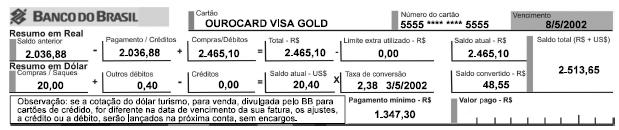
Com base nas informações do texto VI e considerando que a taxa de juros para pagamento parcelado seja de 6,0% ao mês, julgue os itens seguintes.
O valor constante do campo "Outros débitos" está para
o do campo "Compras/Saques" assim como R$ 170,00
está para R$ 3,40.A figura abaixo é parte da fatura de um cartão de crédito de um cliente do BB.
Com base nas informações do texto VI e considerando que a taxa de juros para pagamento parcelado seja de 6,0% ao mês, julgue os itens seguintes.
Provas
Questão presente nas seguintes provas
Texto VI –
A figura abaixo é parte da fatura de um cartão de crédito de um cliente do BB.
Com base nas informações do texto VI e considerando que a taxa de juros para pagamento parcelado seja de 6,0% ao mês, julgue os itens seguintes.
Se o cliente tiver pago em 8/5/2002 o valor de
R$ 2.000,00, serão cobrados, pelo débito restante,
juros inferiores a R$ 30,00.A figura abaixo é parte da fatura de um cartão de crédito de um cliente do BB.
Com base nas informações do texto VI e considerando que a taxa de juros para pagamento parcelado seja de 6,0% ao mês, julgue os itens seguintes.
Provas
Questão presente nas seguintes provas
Texto IV – questões de 18 a 20
BB Crédito Informática
1 Se você deseja adquirir equipamentos de microinformática,
computadores de mão e aparelhos celulares com a tecnologia WAP,
o BB oferece o BB Crédito Informática.
4 Equipamentos de microinformática: microcomputador,
impressora, escâner, Web cam, computadores de mão, notebook,
equipamentos multifuncionais, gravadores de CD e kit DVD
7 (exclusivamente para instalação em microcomputador), monitores,
equipamentos easy box, cable modem e telefones celulares com
tecnologia WAP.
10 Limites de financiamento:
< até o limite de crédito/prestação informado no seu extrato
e(ou) na sua agenda financeira.
13 < o valor do crédito poderá variar entre R$ 200,00 e
R$ 5.000,00.
Prazos: de 2 a 24 meses.
16 Tarifas:
< tarifa de abertura de crédito correspondente a 3% do valor
solicitado, limitado ao mínimo de R$ 9,50 e ao máximo de
19 R$ 40,00, cobrada na data da liberação do crédito.
< taxa de juros de 3,70% ao mês, equivalente a 54,65% ao ano.
Internet: <http://www.bb.com.br>. Acesso em 28/4/2002 (com adaptações).
A partir do texto IV, julgue os itens subseqüentes.
No texto, o pronome possessivo "seu" (L.11) refere-se ao leitor, por causa do emprego de "você" (L.1).BB Crédito Informática
1 Se você deseja adquirir equipamentos de microinformática,
computadores de mão e aparelhos celulares com a tecnologia WAP,
o BB oferece o BB Crédito Informática.
4 Equipamentos de microinformática: microcomputador,
impressora, escâner, Web cam, computadores de mão, notebook,
equipamentos multifuncionais, gravadores de CD e kit DVD
7 (exclusivamente para instalação em microcomputador), monitores,
equipamentos easy box, cable modem e telefones celulares com
tecnologia WAP.
10 Limites de financiamento:
< até o limite de crédito/prestação informado no seu extrato
e(ou) na sua agenda financeira.
13 < o valor do crédito poderá variar entre R$ 200,00 e
R$ 5.000,00.
Prazos: de 2 a 24 meses.
16 Tarifas:
< tarifa de abertura de crédito correspondente a 3% do valor
solicitado, limitado ao mínimo de R$ 9,50 e ao máximo de
19 R$ 40,00, cobrada na data da liberação do crédito.
< taxa de juros de 3,70% ao mês, equivalente a 54,65% ao ano.
Internet: <http://www.bb.com.br>. Acesso em 28/4/2002 (com adaptações).
A partir do texto IV, julgue os itens subseqüentes.
Provas
Questão presente nas seguintes provas
Cadernos
Caderno Container