Foram encontradas 70 questões.
Considere o seguinte planejamento referente a determinado projeto:
• A atividade T1 inicia o projeto e tem duração de 10 (dez) horas.
• A atividade T2 deve começar imediatamente após o término da atividade T1 e tem duração de 12 (doze) horas.
• A atividade T3 deve começar imediatamente após o término da atividade T1 e tem duração de 16 (dezesseis) horas.
• A atividade T4 só pode começar após o término das atividades T2 e T3 e tem duração de 08 (oito) horas.
• A atividade T5 é a última atividade a ser executada, começa imediatamente após o término da atividade T4 e tem duração de 12 (doze) horas.
Considerando-se que o gerente de projetos queira comprimir o cronograma do projeto utilizando a técnica de crashing, qual é a atividade menos indicada para a alocação adicional de recursos?
Provas
Questão presente nas seguintes provas

1635346
Ano: 2011
Disciplina: Inglês (Língua Inglesa)
Banca: CESGRANRIO
Orgão: BR Distribuidora
Disciplina: Inglês (Língua Inglesa)
Banca: CESGRANRIO
Orgão: BR Distribuidora
Provas:
Skillset vs. Mindset: Which Will Get You the Job?
By Heather Huhman
There’s a debate going on among career experts about which is more important: skillset or mindset. While skills are certainly desirable for many positions, does having the right ones guarantee you’ll get the job?
What if you have the mindset to get the work accomplished, but currently lack certain skills requested by the employer? Jennifer Fremont-Smith, CEO of Smarterer, and Paul G. Stoltz, PhD, coauthor of Put Your Mindset to Work: The One Asset You Really Need to Win and Keep the Job You Love, recently sat down with U.S. News to sound off on this issue.
Heather: What is more important to today’s employers: skillset or mindset? Why?
Jennifer: For many jobs, skillset needs to come first. The employer absolutely must find people who have the hard skills to do whatever it is they are being hired to do. Programmers have to know how to program. Data analysts need to know how to crunch numbers in Excel. Marketers must know their marketing tools and software. Social media managers must know the tools of their trade like Twitter, Facebook, WordPress, and have writing and communication skills.
After the employers have identified candidates with these hard skills, they can shift their focus to their candidates’ mindsets - attitude, integrity, work ethic, personality, etc.
Paul: Mindset utterly trumps skillset.
Heather: Do you have any data or statistics to back up your argument?
Jennifer: Despite record high unemployment, many jobs sit empty because employers can’t find candidates with the right skills. In a recent survey cited in the Wall Street Journal, over 50 percent of companies reported difficulty finding applicants with the right skills. Companies are running lean and mean in this economy – they don’t have the time to train for those key skills.
Paul: [Co-author James Reed and I] asked tens of thousands of top employers worldwide this question: If you were hiring someone today, which would you pick, B) the person with the perfect skills and qualifications, but lacking the desired mindset, or A) the person with the desired mindset, but lacking the rest? Ninety-eight percent pick A. Add to this that 97 percent said it is more likely that a person with the right mindset will develop the right skillset, rather than the other way around.
Heather: How do you define skillset?
Jennifer: At Smarterer, we define skillset as the set of digital, social, and technical tools professionals use to be effective in the workforce. Professionals are rapidly accumulating these skills, and the tools themselves are proliferating and evolving – we’re giving people a simple, smart way for people to validate their skillset and articulate it to the world.
Heather: How do you define mindset?
Paul: We define mindset as “the lens through which you see and navigate life.” It undergirds and affects all that you think, see, believe, say, and do.
Heather: How can job seekers show they have the skillset employers are seeking throughout the entire hiring process?
Jennifer: At the beginning of the process, seekers can showcase the skills they have by incorporating them, such as their Smarterer scores, throughout their professional and personal brand materials. They should be articulating their skills in their resume, cover letter, LinkedIn profile, blog, website - everywhere they express their professional identity.
Heather: How can job seekers show they have the mindset employers are seeking throughout the entire hiring process?
Paul: One of the most head-spinning studies we did, which was conducted by an independent statistician showed that, out of 30,000 CVs/resumes, when you look at who gets the job and who does not:
A. The conventional wisdom fails (at best). None of the classic, accepted advice, like using action verbs or including hobbies/interests actually made any difference.
B. The only factor that made the difference was that those who had one of the 72 mindset qualities from our master model, articulated in their CV/resume, in a specific way, were three times as likely to get the job. Furthermore, those who had two or more of these statements, were seven times more likely to get the job, often over other more qualified candidates.
Available at: <http://money.usnews.com/money/blogs/outside-voices- -
careers/2011/08/26/skillset-vs-mindset-which-will-get-you-the-job>. Retrieved on: 17 Sept. 2011. Adapted.
Based on the meanings in the text, the two items are synonymous in
Provas
Questão presente nas seguintes provas
- Equipamentos de RedeHub
- Equipamentos de RedeRepetidor
- Modelo OSIModelo OSI: Camada Física
- Transmissão de DadosDomínios de Colisão e Broadcast
Hubs são dispositivos utilizados, em uma rede de computadores, tanto como concentradores quanto como repetidores que trabalham com quadros, sendo que esses quadros, quando enviados para uma porta de um hub básico, são
Provas
Questão presente nas seguintes provas
Seja o esquema abaixo:
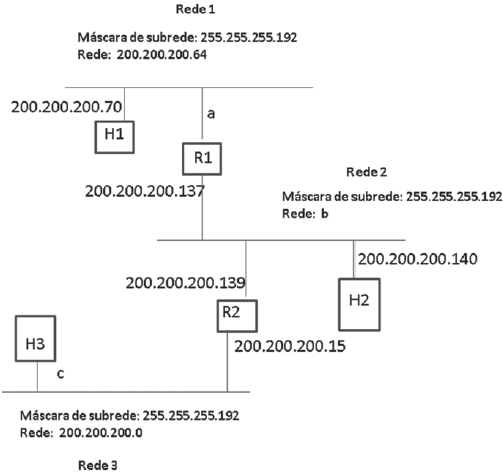
Considere que
• H1 é um host da Rede 1, H2, um host da Rede 2, e H3, um Host da Rede 3;
• R1 é um roteador que liga a Rede 1 com a Rede 2;
• R2 é um roteador que une a Rede 2 com a Rede 3.
• H1 é um host da Rede 1, H2, um host da Rede 2, e H3, um Host da Rede 3;
• R1 é um roteador que liga a Rede 1 com a Rede 2;
• R2 é um roteador que une a Rede 2 com a Rede 3.
Nesse esquema, os valores de IP para a, b e c, respectivamente, são:
Provas
Questão presente nas seguintes provas
Um circo e um antipalhaço
Em 1954, numa cidadezinha universitária dos Estados Unidos, vi “o maior circo do mundo”, que continua a ser o sucessor do velho Barnum & Bailey, velho conhecido dos meus primeiros dias de estudante nos Estados Unidos. Vi então, com olhos de adolescente ainda um tanto menino, maravilhas que só para os meninos têm plenitude de encanto. Em 1954, revendo “o maior circo do mundo”, confesso que, diante de certas façanhas de acrobatas e domadores, senti-me outra vez menino.
O monstro – porque é um circo-monstro, que viaja em três vastos trens – chegou de manhã a Charlottesville e partiu à noite. Ao som das últimas palmas dos espectadores juntou-se o ruído metálico do desmonte da tenda capaz de abrigar milhares de pessoas, acomodadas em cadeiras em forma de x, quase iguais às dos teatros e que, como por mágica, foram se fechando e formando grupos exatos, tantas cadeiras em cada grupo logo transportadas para outros vagões de um dos trens. E com as cadeiras, foram sendo transportadas para outros vagões jaulas com tigres; e também girafas e elefantes que ainda há pouco pareciam enraizados ao solo como se estivessem num jardim zoológico. A verdade é que quem demorasse uns minutos mais a sair veria esta mágica também de circo: a do próprio circo gigante desaparecer sob seus olhos, sob a forma de pacotes prontos a seguirem de trem para a próxima cidade.
O gênio de organização dos anglo-americanos é qualquer coisa de assombrar um latino. Arma e desarma um circo gigante como se armasse ou desarmasse um brinquedo de criança. E o que o faz com os circos, faz com os edifícios, as pontes, as usinas, as fábricas: uma vez planejadas, erguem-se em pouco tempo do solo e tomam como por mágica relevos monumentais.
Talvez a maior originalidade do circo esteja no seu palhaço principal. Circo norte-americano? Pensa-se logo num palhaço para fazer rir meninos de dez anos e meninões de quarenta com suas piruetas e suas infantilidades.
O desse circo – hoje o mais célebre dos palhaços de circo – é uma espécie de antipalhaço. Não ri nem sequer sorri. Não faz uma pirueta. Não dá um salto. Não escorrega uma única vez. Não cai esparramado no chão como os clowns convencionais. Não tem um ás de copas nos fundos de suas vestes de palhaço.
O que faz quase do princípio ao fim das funções do circo é olhar para a multidão com uns olhos, uma expressão, uns modos tão tristes que ninguém lhe esquece a tristeza do clown diferente de todos os outros clowns. Trata-se na verdade de uma audaciosa recriação da figura de palhaço de circo. E o curioso é que, impressionando os adultos, impressiona também os meninos que talvez continuem os melhores juízes de circos de cavalinhos.
Audaciosa e triunfante essa recriação. Pois não há quem saia do supercirco, juntando às suas impressões das maravilhas de acrobacia, de trabalhos de domadores de feras, de equilibristas, de bailarinas, de cantores, de cômicos, a impressão inesperada da tristeza desse antipalhaço que quase se limita a olhar para a multidão com os olhos mais magoados deste mundo.
FREYRE, Gilberto. In: Pessoas, Coisas & Animais. São Paulo: Círculo do Livro.
Edição Especial para MPM Propaganda, 1979. p. 221-222. (Publicado originalmente em O Cruzeiro, Rio de Janeiro, seção Pessoas, coisas e animais, em 8 jul. 1956). Adaptado.
A partir do conhecimento do que é um palhaço, infere-se que um antipalhaço age da seguinte maneira:
Provas
Questão presente nas seguintes provas
1628203
Ano: 2011
Disciplina: Inglês (Língua Inglesa)
Banca: CESGRANRIO
Orgão: BR Distribuidora
Disciplina: Inglês (Língua Inglesa)
Banca: CESGRANRIO
Orgão: BR Distribuidora
Provas:
Skillset vs. Mindset: Which Will Get You the Job?
By Heather Huhman
There’s a debate going on among career experts about which is more important: skillset or mindset. While skills are certainly desirable for many positions, does having the right ones guarantee you’ll get the job?
What if you have the mindset to get the work accomplished, but currently lack certain skills requested by the employer? Jennifer Fremont-Smith, CEO of Smarterer, and Paul G. Stoltz, PhD, coauthor of Put Your Mindset to Work: The One Asset You Really Need to Win and Keep the Job You Love, recently sat down with U.S. News to sound off on this issue.
Heather: What is more important to today’s employers: skillset or mindset? Why?
Jennifer: For many jobs, skillset needs to come first. The employer absolutely must find people who have the hard skills to do whatever it is they are being hired to do. Programmers have to know how to program. Data analysts need to know how to crunch numbers in Excel. Marketers must know their marketing tools and software. Social media managers must know the tools of their trade like Twitter, Facebook, WordPress, and have writing and communication skills.
After the employers have identified candidates with these hard skills, they can shift their focus to their candidates’ mindsets - attitude, integrity, work ethic, personality, etc.
Paul: Mindset utterly trumps skillset.
Heather: Do you have any data or statistics to back up your argument?
Jennifer: Despite record high unemployment, many jobs sit empty because employers can’t find candidates with the right skills. In a recent survey cited in the Wall Street Journal, over 50 percent of companies reported difficulty finding applicants with the right skills. Companies are running lean and mean in this economy – they don’t have the time to train for those key skills.
Paul: [Co-author James Reed and I] asked tens of thousands of top employers worldwide this question: If you were hiring someone today, which would you pick, B) the person with the perfect skills and qualifications, but lacking the desired mindset, or A) the person with the desired mindset, but lacking the rest? Ninety-eight percent pick A. Add to this that 97 percent said it is more likely that a person with the right mindset will develop the right skillset, rather than the other way around.
Heather: How do you define skillset?
Jennifer: At Smarterer, we define skillset as the set of digital, social, and technical tools professionals use to be effective in the workforce. Professionals are rapidly accumulating these skills, and the tools themselves are proliferating and evolving – we’re giving people a simple, smart way for people to validate their skillset and articulate it to the world.
Heather: How do you define mindset?
Paul: We define mindset as “the lens through which you see and navigate life.” It undergirds and affects all that you think, see, believe, say, and do.
Heather: How can job seekers show they have the skillset employers are seeking throughout the entire hiring process?
Jennifer: At the beginning of the process, seekers can showcase the skills they have by incorporating them, such as their Smarterer scores, throughout their professional and personal brand materials. They should be articulating their skills in their resume, cover letter, LinkedIn profile, blog, website - everywhere they express their professional identity.
Heather: How can job seekers show they have the mindset employers are seeking throughout the entire hiring process?
Paul: One of the most head-spinning studies we did, which was conducted by an independent statistician showed that, out of 30,000 CVs/resumes, when you look at who gets the job and who does not:
A. The conventional wisdom fails (at best). None of the classic, accepted advice, like using action verbs or including hobbies/interests actually made any difference.
B. The only factor that made the difference was that those who had one of the 72 mindset qualities from our master model, articulated in their CV/resume, in a specific way, were three times as likely to get the job. Furthermore, those who had two or more of these statements, were seven times more likely to get the job, often over other more qualified candidates.
Available at: <http://money.usnews.com/money/blogs/outside-voices- -
careers/2011/08/26/skillset-vs-mindset-which-will-get-you-the-job>. Retrieved on: 17 Sept. 2011. Adapted.
The pronoun they in “they don’t have time to train for those key skills.” refers to
Provas
Questão presente nas seguintes provas
O recurso denominado NAT (Network Address Translation) permite que sejam utilizados endereços IP virtuais em redes locais para contornar a escassez de endereços IP reais na Internet. Para auxiliar nessa tarefa, três faixas de endereços IP foram separadas como endereços privados, que não podem ser usados para Internet, mas podem ser usados em hosts internos de uma rede.
Uma dessas faixas de endereços IP internos válidas para uso em NAT é
Provas
Questão presente nas seguintes provas
Considere as seguintes premissas:
1 - Código legível é de fácil manutenção.
2 - Código legível é comentado.
3 - Código identado é legível.
2 - Código legível é comentado.
3 - Código identado é legível.
De acordo com o raciocínio lógico clássico, a partir das três premissas acima, conclui-se que o código
Provas
Questão presente nas seguintes provas
1627952
Ano: 2011
Disciplina: TI - Gestão e Governança de TI
Banca: CESGRANRIO
Orgão: BR Distribuidora
Disciplina: TI - Gestão e Governança de TI
Banca: CESGRANRIO
Orgão: BR Distribuidora
Após um upgrade realizado para melhorias da rede de uma empresa, os usuários de determinada filial estão reclamando de lentidão nessa rede. Os técnicos da área de TI comentam que esse é um problema de capacidade.
De acordo com o ITIL, esse fato deve ser reportado por esses usuários à(ao)
Provas
Questão presente nas seguintes provas
1627814
Ano: 2011
Disciplina: TI - Organização e Arquitetura dos Computadores
Banca: CESGRANRIO
Orgão: BR Distribuidora
Disciplina: TI - Organização e Arquitetura dos Computadores
Banca: CESGRANRIO
Orgão: BR Distribuidora
Sobre os modos de endereçamento de uma instrução, uma desvantagem do modo de endereçamento direto é a
Provas
Questão presente nas seguintes provas
Cadernos
Caderno Container