Foram encontradas 783 questões.
Disciplina: Administração Financeira e Orçamentária
Banca: AOCP
Orgão: CASAN-SC
- Ciclo ou Processo Orçamentário
- Orçamento PúblicoTécnicas Orçamentárias
- Orçamento PúblicoTipos de Orçamento
Provas

Provas
Provas
Words that went extinct
By Kimberly Joki
Dictionaries incorporate new words every year. Some are pop culture inventions like jeggings, photobomb, and meme. Other words, like emoji and upvote, spring up from technology and social media. Dictionaries respond by creating definitions for anyone who cares to know what a twitterer is. And thank goodness they do; you can learn what an eggcorn is simply by turning a few pages in your trusty updated dictionary.
Interestingly, not all newly added words are recent developments. The Oxford English Dictionary June 2015 new words list included autotune, birdhouse, North Korean, and shizzle! North Korea was founded in 1948. The initial release of the autotuner audio processor was in 1997. Before adding a slang term like shizzle, dictionary publishers weigh the current popularity, predicted longevity, and other factors. Just this year alone, the Merriam-Webster Dictionary welcomed about 1,700 new arrivals.
With more and more words coined every year, dictionaries couldn’t possibly add them all to their existing word banks. Can you imagine a dictionary containing all the words ever used in English? It would be impossible to lift! With each yearly edit, dictionary editors must discard some words to make room for new ones.
(…)
The Sami languages, spoken in Finland, Norway, and Sweden, reportedly include more than 150 words related to snow and ice. In the 1590s, the English language had a word for recently melted snow—snowbroth. Now, English speakers simply call it water or melted snow. In fact, words that are markedly specific seem more vulnerable to extinction. A 19th-century dictionary included Englishable, a term to describe how appropriate a word is for the English language. However, English is a dynamic language, always accepting and abandoning words. Apparently, Englishable itself isn’t Englishable; it’s now obsolete.
Do you favor any infrequently used words? If so, use them now and often. . . A word’s best defense against extinction is regular use.
(Source: http://www.grammarly.com/blog/2015/words-that-went-extinct/)
Provas
Words that went extinct
By Kimberly Joki
Dictionaries incorporate new words every year. Some are pop culture inventions like jeggings, photobomb, and meme. Other words, like emoji and upvote, spring up from technology and social media. Dictionaries respond by creating definitions for anyone who cares to know what a twitterer is. And thank goodness they do; you can learn what an eggcorn is simply by turning a few pages in your trusty updated dictionary.
Interestingly, not all newly added words are recent developments. The Oxford English Dictionary June 2015 new words list included autotune, birdhouse, North Korean, and shizzle! North Korea was founded in 1948. The initial release of the autotuner audio processor was in 1997. Before adding a slang term like shizzle, dictionary publishers weigh the current popularity, predicted longevity, and other factors. Just this year alone, the Merriam-Webster Dictionary welcomed about 1,700 new arrivals.
With more and more words coined every year, dictionaries couldn’t possibly add them all to their existing word banks. Can you imagine a dictionary containing all the words ever used in English? It would be impossible to lift! With each yearly edit, dictionary editors must discard some words to make room for new ones.
(…)
The Sami languages, spoken in Finland, Norway, and Sweden, reportedly include more than 150 words related to snow and ice. In the 1590s, the English language had a word for recently melted snow—snowbroth. Now, English speakers simply call it water or melted snow. In fact, words that are markedly specific seem more vulnerable to extinction. A 19th-century dictionary included Englishable, a term to describe how appropriate a word is for the English language. However, English is a dynamic language, always accepting and abandoning words. Apparently, Englishable itself isn’t Englishable; it’s now obsolete.
Do you favor any infrequently used words? If so, use them now and often. . . A word’s best defense against extinction is regular use.
(Source: http://www.grammarly.com/blog/2015/words-that-went-extinct/)
Provas
Words that went extinct
By Kimberly Joki
Dictionaries incorporate new words every year. Some are pop culture inventions like jeggings, photobomb, and meme. Other words, like emoji and upvote, spring up from technology and social media. Dictionaries respond by creating definitions for anyone who cares to know what a twitterer is. And thank goodness they do; you can learn what an eggcorn is simply by turning a few pages in your trusty updated dictionary.
Interestingly, not all newly added words are recent developments. The Oxford English Dictionary June 2015 new words list included autotune, birdhouse, North Korean, and shizzle! North Korea was founded in 1948. The initial release of the autotuner audio processor was in 1997. Before adding a slang term like shizzle, dictionary publishers weigh the current popularity, predicted longevity, and other factors. Just this year alone, the Merriam-Webster Dictionary welcomed about 1,700 new arrivals.
With more and more words coined every year, dictionaries couldn’t possibly add them all to their existing word banks. Can you imagine a dictionary containing all the words ever used in English? It would be impossible to lift! With each yearly edit, dictionary editors must discard some words to make room for new ones.
(…)
The Sami languages, spoken in Finland, Norway, and Sweden, reportedly include more than 150 words related to snow and ice. In the 1590s, the English language had a word for recently melted snow—snowbroth. Now, English speakers simply call it water or melted snow. In fact, words that are markedly specific seem more vulnerable to extinction. A 19th-century dictionary included Englishable, a term to describe how appropriate a word is for the English language. However, English is a dynamic language, always accepting and abandoning words. Apparently, Englishable itself isn’t Englishable; it’s now obsolete.
Do you favor any infrequently used words? If so, use them now and often. . . A word’s best defense against extinction is regular use.
(Source: http://www.grammarly.com/blog/2015/words-that-went-extinct/)
Provas
Words that went extinct
By Kimberly Joki
Dictionaries incorporate new words every year. Some are pop culture inventions like jeggings, photobomb, and meme. Other words, like emoji and upvote, spring up from technology and social media. Dictionaries respond by creating definitions for anyone who cares to know what a twitterer is. And thank goodness they do; you can learn what an eggcorn is simply by turning a few pages in your trusty updated dictionary.
Interestingly, not all newly added words are recent developments. The Oxford English Dictionary June 2015 new words list included autotune, birdhouse, North Korean, and shizzle! North Korea was founded in 1948. The initial release of the autotuner audio processor was in 1997. Before adding a slang term like shizzle, dictionary publishers weigh the current popularity, predicted longevity, and other factors. Just this year alone, the Merriam-Webster Dictionary welcomed about 1,700 new arrivals.
With more and more words coined every year, dictionaries couldn’t possibly add them all to their existing word banks. Can you imagine a dictionary containing all the words ever used in English? It would be impossible to lift! With each yearly edit, dictionary editors must discard some words to make room for new ones.
(…)
The Sami languages, spoken in Finland, Norway, and Sweden, reportedly include more than 150 words related to snow and ice. In the 1590s, the English language had a word for recently melted snow—snowbroth. Now, English speakers simply call it water or melted snow. In fact, words that are markedly specific seem more vulnerable to extinction. A 19th-century dictionary included Englishable, a term to describe how appropriate a word is for the English language. However, English is a dynamic language, always accepting and abandoning words. Apparently, Englishable itself isn’t Englishable; it’s now obsolete.
Do you favor any infrequently used words? If so, use them now and often. . . A word’s best defense against extinction is regular use.
(Source: http://www.grammarly.com/blog/2015/words-that-went-extinct/)
Provas
Words that went extinct
By Kimberly Joki
Dictionaries incorporate new words every year. Some are pop culture inventions like jeggings, photobomb, and meme. Other words, like emoji and upvote, spring up from technology and social media. Dictionaries respond by creating definitions for anyone who cares to know what a twitterer is. And thank goodness they do; you can learn what an eggcorn is simply by turning a few pages in your trusty updated dictionary.
Interestingly, not all newly added words are recent developments. The Oxford English Dictionary June 2015 new words list included autotune, birdhouse, North Korean, and shizzle! North Korea was founded in 1948. The initial release of the autotuner audio processor was in 1997. Before adding a slang term like shizzle, dictionary publishers weigh the current popularity, predicted longevity, and other factors. Just this year alone, the Merriam-Webster Dictionary welcomed about 1,700 new arrivals.
With more and more words coined every year, dictionaries couldn’t possibly add them all to their existing word banks. Can you imagine a dictionary containing all the words ever used in English? It would be impossible to lift! With each yearly edit, dictionary editors must discard some words to make room for new ones.
(…)
The Sami languages, spoken in Finland, Norway, and Sweden, reportedly include more than 150 words related to snow and ice. In the 1590s, the English language had a word for recently melted snow—snowbroth. Now, English speakers simply call it water or melted snow. In fact, words that are markedly specific seem more vulnerable to extinction. A 19th-century dictionary included Englishable, a term to describe how appropriate a word is for the English language. However, English is a dynamic language, always accepting and abandoning words. Apparently, Englishable itself isn’t Englishable; it’s now obsolete.
Do you favor any infrequently used words? If so, use them now and often. . . A word’s best defense against extinction is regular use.
(Source: http://www.grammarly.com/blog/2015/words-that-went-extinct/)
Provas
A tabela a seguir mostra a estrutura tarifária da CASAN para residências. Use-a para responder a seguinte questão.
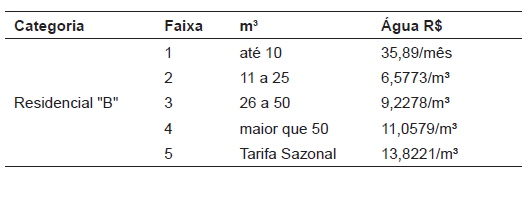
Considere uma residência que se enquadre na categoria apresentada na tabela e que consumiu 20.000 litros de água em um determinado mês. Qual é o valor da tarifa neste mês?
Provas
Provas
Caderno Container