Foram encontradas 55 questões.
O gás mostarda é uma substância conhecida pela sua aplicabilidade como arma química. Acredita-se que essa substância foi utilizada durante a Primeira Guerra Mundial e que seus efeitos causavam queimaduras com formação de bolhas na pele e nas mucosas do trato respiratório, levando à cegueira e à morte por asfixia. A produção do gás mostarda ocorre mediante a reação química do dicloreto de enxofre !$ (SCl_2) !$ com o eteno !$ (C_2H_4) !$, conforme a equação química a seguir.

Sobre a equação de produção do gás mostarda, foram feitas a seguintes afirmações:
I. O eteno é um composto isomérico trans.
II. O gás mostarda tem fórmula molecular !$ C_4H_8SCl_2 !$.
III. A reação orgânica de produção do gás mostarda é de substituição.
São incorretas as afirmações
Provas
Questão presente nas seguintes provas

Quando ocorrem variações exageradas de temperatura, um fenômeno comum que se pode observar é a dilatação dos corpos. Tal fenômeno é observado, por exemplo, em um local em que ocorre um incêndio.
Analisando a dilatação de dois objetos distintos, essa dilatação dependerá apenas da(o)
Provas
Questão presente nas seguintes provas
Analise o mapa a seguir.
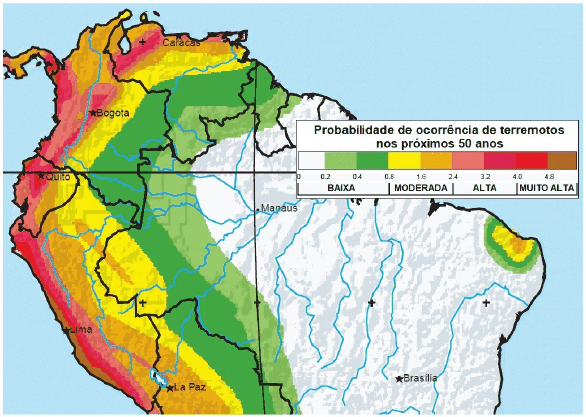
Disponível em: <https://www.thoughtco.com/seismic-hazard-maps-of-the-world-1441205>. Acesso em: 9 abr. 2018 (Adaptação).
No espaço sul americano retratado no mapa, a probabilidade de ocorrência de terremotos nos próximos 50 anos não
Provas
Questão presente nas seguintes provas
“O legado da Guerra Civil acabou sendo a transmissão para o negro de uma condição ambígua: a de não ser nem escravo nem cidadão. O negro passaria ainda muitos anos como um membro de um sistema de castas e viveria como um cidadão de segunda classe numa sociedade que, desde o século XVIII, tinha se manifestado a favor da proposta de que ‘todos os homens eram criados iguais’.”
NARO, Nancy Priscilla S. A formação dos Estados Unidos. São Paulo: Atual editora, 1994. p. 44.
A condição ambígua do negro na sociedade estadunidense após o término da Guerra Civil, de não ser nem escravo e nem cidadão, era explicada legalmente porque
Provas
Questão presente nas seguintes provas
Leia o trecho a seguir.
“Existem inúmeras medidas de combate às enchentes.”
Considerando a análise sintática desse período, é correto afirmar que o
Provas
Questão presente nas seguintes provas
O problema das enchentes
O problema das enchentes passou a ser algo comum na vida das populações de algumas cidades. Infelizmente, todo o ano é a mesma coisa: entre os meses de dezembro e fevereiro, os noticiários são tomados por problemas relacionados com a elevação dos cursos d'água e a inundação de casas e ruas, desencadeando uma série de tragédias que, quase sempre, poderia ser evitada. Mas por que as enchentes ocorrem? É possível combatê-las?
Em geral, os rios perenes costumam ter dois tipos de leito: um menor e principal, por onde a água corre durante a maior parte do tempo, e um maior e complementar, que é inundado apenas em períodos de cheias. [...] Eventualmente, dependendo do curso d’água e das condições meteorológicas e locais, o leito maior é inundado, provocando as cheias em sua área. [...] Casas, vilas e até cidades são surpreendidas pelas cheias naturais eventuais. Em alguns casos, cidades inteiras ficam embaixo d'água. Além dessas causas das enchentes, há as antrópicas.
A interferência humana sobre os cursos d’água ocorre das mais diversas formas. Em casos extremos, porém menos comuns, tais situações podem estar relacionadas com rompimentos de diques e barragens, o que pode causar sérios danos à sociedade. Mas, quase sempre, essa questão está ligada ao mau uso do espaço urbano.
Um problema que parece não ter uma solução rápida é o elevado índice de poluição, causado tanto pela ausência de consciência por parte da população quanto por sistemas ineficientes de coleta de lixo ou de distribuição de lixeiras pela cidade. Além do mais, há problemas causados pela poluição gerada por empresas e outros órgãos. Com isso, ocorre o entupimento dos bueiros que seriam responsáveis por conter parte da água que eleva o nível dos rios. Além disso, o lixo gerado é levado pelas enxurradas e contribui ainda mais para elevar o volume das águas. [...]
Outra questão é a ocupação irregular ou desordenada do espaço geográfico. Como explicamos, algumas áreas correspondem ao leito maior de um rio que, esporadicamente, inunda. Com a ocupação irregular dessas áreas – muitas vezes causada pela ausência de planejamento adequado –, as pessoas estão sujeitas à ocorrência de inundações. Além disso, a remoção da vegetação que compõe o entorno do rio pode intensificar o processo, pois ela teria a função de reter parte dos sedimentos que vão para o leito e aumentam o nível das águas.
Apesar de todos os problemas mencionados, a causa considerada principal para as enchentes é, sem dúvida, a impermeabilização do solo. Com a pavimentação das ruas e a cimentação de quintais e calçadas, a maior parte da água, que deveria infiltrar no solo, escorre na superfície, provocando o aumento das enxurradas e a elevação dos rios. Além disso, a impermeabilização contribui para a elevação da velocidade desse escoamento, provocando erosões e causando outros tipos de desastres ambientais urbanos.
Existem inúmeras medidas de combate às enchentes. A cidade de Belo Horizonte, por exemplo, contratou em outubro de 2013 alguns “olheiros”, que são funcionários encarregados de detectar o início de inundações em áreas de risco. Eles teriam a função de minimizar os efeitos da “inundação relâmpago”, aquela que ocorre em um curtíssimo período de tempo. Outras ações envolvem a construção de barragens e o desassoreamento do leito dos rios, em que todos os sedimentos existentes no fundo dos cursos d’água são removidos, aumentando a sua profundidade.
Mas todas essas medidas são paliativas. [...] A melhor forma de lidar com esse problema é realizar uma devida prevenção, através da construção de sistemas eficientes de drenagem, a desocupação de áreas de risco, criação de reservas florestais nas margens dos rios, diminuição dos índices de poluição e geração de lixo, além de um planejamento urbano mais consistente.
PENA, Rodolfo F. Alves. O problema das enchentes. Brasil Escola. Disponível em <https://brasilescola.uol.com.br/geografia/enchentes.htm>. Acesso em: 14 mar. 2018 [Fragmento].
De acordo com o texto, uma das medidas preventivas de enchentes é
Provas
Questão presente nas seguintes provas
INSTRUCTIONS: Read the following text carefully and mark the correct alternative that completes the sentences presented after it.
International Civil Defence Organisation
1. Introduction
Fires are the accidents which occur most frequently, whose causes are the most diverse and which require intervention methods and techniques adapted to the conditions and needs of each incident. Depending on the type of fire (nature of the material ablaze), meteorological conditions (wind) and the effectiveness of the intervention, material damage can be limited (a single car, building or production or storage warehouse installation), or affect wide areas (forest or agricultural fires, hydrocarbons, gas or other highly flammable products, storage or piping installations, harbour installations and rail or marine transport equipment). […]
2. Preventive and protective measures
Fires can spread more or less rapidly depending on their causes, the nature of the material and goods alight, the fire prevention installations (automatic sprinklers), meteorological conditions, the ways the population is informed and the initiative it shows, as well as the speed and efficiency of the intervening services and of their fire-fighting equipment. In the light of experience, prevention is seen to be most important and consists of two distinct components. On the one hand, the primary responsibility falling upon the political authorities empowered to implement the legal prescriptions concerning fire protection, to forecast accidents and to inform the population, as well as to set up measures and means for fighting fires and explosions. On the other hand, the responsible behaviour of each individual based upon an education geared towards caution and the respect of instructions in case of fire. Defining, and controlling the implementation of, the particular rules of protection against fires, specific to each enterprise presenting a potential danger, including the training of security personnel, is also relevant in this context. The many types of fire and the preventive and protective measures which relate to them, make it advisable to limit the present study to the specific measures falling to the political authorities in one area only, namely that of “forest fires”. This type of fire is of particular interest to developing countries and the preventive measures to be applied have a general representative value, that is:
– organising an observation service, prevention and alarm (security) service at local and regional levels;
– implementing legislation regulating the use of fire by all the population present in or at the edge of forests, and more particularly by owners and individuals exercising a professional activity in sensitive areas;
– planning and concrete preparation (periodic maintenance) for fire-fighting through adequate landscaping of the territory and appropriate forest cultivation limiting fire propagation (alternating vegetation, clearance, trimming), creating and maintaining access paths (extinction) and fire-break areas as well as fire-fighting equipment such as water supplies (conduits, cisterns), watch towers and meteorological posts, and the construction of helicopter landing pads;
– surveillance and detection of fires as soon as the danger of fires is forecast by the ad hoc meteorological service (which comprises automatic or mobile statistics posts observing the winds and the vegetation: dryness, force, direction, evolution);
– as soon as the danger of fire increases, activating an alarm plan (basic intervention plan) requiring the engagement of preventive intervention squads (firemen), and their wide positioning as near as possible to the threatened zones, and making available water bombers and specialised aerial machines ready for action;
– preparation and concretisation (organisation) of an intervention mechanism: this requires the setting up of specialised management programmes ensuring the coordination of powerful and efficient equipment and means for fighting forest fires (instruction);
– preparedness management and the coordination of the use of the means of intervention of the authorities and the information and alarm services for the population require a secure transmission network (radio network);
– planning the evacuation of the population possibly under threat in the various sensitive areas, particularly if there are risks of explosion (reservoirs and gas conduits explosives or ammunition dumps, hydrocarbon production, handling or transport installations, other dangerous material, etc.).
[...]
Available at: <http://www.icdo.org/en/disasters/man-made-disasters/industrial-accidents/fire>. Accessed on: April 6th, 2018 (Fragment).
According to the text, in a fire incident
According to the text, organising an intervention mechanism demands at least that
Provas
Questão presente nas seguintes provas
Analise o gráfico a seguir.
Brasil: distribuição atual da População Economicamente Ativa (PEA), por setores de atividades
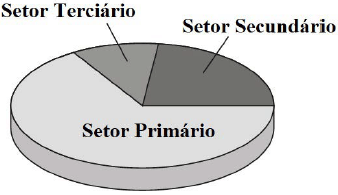
A distribuição atual da PEA no Brasil representada no gráfico está
Provas
Questão presente nas seguintes provas
Nas últimas décadas, a histórica desigualdade socioespacial vigente no interior das cidades brasileiras adquiriu características mais acentuadas.
Essa desigualdade socioespacial não se explica
Provas
Questão presente nas seguintes provas
INSTRUCTIONS: Read the following text carefully and mark the correct alternative that completes the sentences presented after it.
International Civil Defence Organisation
1. Introduction
Fires are the accidents which occur most frequently, whose causes are the most diverse and which require intervention methods and techniques adapted to the conditions and needs of each incident. Depending on the type of fire (nature of the material ablaze), meteorological conditions (wind) and the effectiveness of the intervention, material damage can be limited (a single car, building or production or storage warehouse installation), or affect wide areas (forest or agricultural fires, hydrocarbons, gas or other highly flammable products, storage or piping installations, harbour installations and rail or marine transport equipment). […]
2. Preventive and protective measures
Fires can spread more or less rapidly depending on their causes, the nature of the material and goods alight, the fire prevention installations (automatic sprinklers), meteorological conditions, the ways the population is informed and the initiative it shows, as well as the speed and efficiency of the intervening services and of their fire-fighting equipment. In the light of experience, prevention is seen to be most important and consists of two distinct components. On the one hand, the primary responsibility falling upon the political authorities empowered to implement the legal prescriptions concerning fire protection, to forecast accidents and to inform the population, as well as to set up measures and means for fighting fires and explosions. On the other hand, the responsible behaviour of each individual based upon an education geared towards caution and the respect of instructions in case of fire. Defining, and controlling the implementation of, the particular rules of protection against fires, specific to each enterprise presenting a potential danger, including the training of security personnel, is also relevant in this context. The many types of fire and the preventive and protective measures which relate to them, make it advisable to limit the present study to the specific measures falling to the political authorities in one area only, namely that of “forest fires”. This type of fire is of particular interest to developing countries and the preventive measures to be applied have a general representative value, that is:
– organising an observation service, prevention and alarm (security) service at local and regional levels;
– implementing legislation regulating the use of fire by all the population present in or at the edge of forests, and more particularly by owners and individuals exercising a professional activity in sensitive areas;
– planning and concrete preparation (periodic maintenance) for fire-fighting through adequate landscaping of the territory and appropriate forest cultivation limiting fire propagation (alternating vegetation, clearance, trimming), creating and maintaining access paths (extinction) and fire-break areas as well as fire-fighting equipment such as water supplies (conduits, cisterns), watch towers and meteorological posts, and the construction of helicopter landing pads;
– surveillance and detection of fires as soon as the danger of fires is forecast by the ad hoc meteorological service (which comprises automatic or mobile statistics posts observing the winds and the vegetation: dryness, force, direction, evolution);
– as soon as the danger of fire increases, activating an alarm plan (basic intervention plan) requiring the engagement of preventive intervention squads (firemen), and their wide positioning as near as possible to the threatened zones, and making available water bombers and specialised aerial machines ready for action;
– preparation and concretisation (organisation) of an intervention mechanism: this requires the setting up of specialised management programmes ensuring the coordination of powerful and efficient equipment and means for fighting forest fires (instruction);
– preparedness management and the coordination of the use of the means of intervention of the authorities and the information and alarm services for the population require a secure transmission network (radio network);
– planning the evacuation of the population possibly under threat in the various sensitive areas, particularly if there are risks of explosion (reservoirs and gas conduits explosives or ammunition dumps, hydrocarbon production, handling or transport installations, other dangerous material, etc.).
[...]
Available at: <http://www.icdo.org/en/disasters/man-made-disasters/industrial-accidents/fire>. Accessed on: April 6th, 2018 (Fragment).
According to the text, in a fire incident
Provas
Questão presente nas seguintes provas
Cadernos
Caderno Container