Foram encontradas 72 questões.
Redefining the Kilogram
The kilogram is shrinking.
The official object that defines the mass of a kilogram is a tiny, 139-year-old cylinder of platinum and iridium that resides in a triple-locked vault near Paris. Because it is so important, scientists almost never take it out; instead they use copies called working standards. But the last time they did inspect the real kilogram, they found it is roughly five parts in 100 million heavier than all the working standards, which have been leaving behind a few atoms of metal every time they are put on scales. This is one of the reasons the kilogram may soon be redefined not by a physical object but through calculations based on fundamental constants.
“This [shrinking] is the kind of thing that happens when you have an object that needs to be conserved in order to have a standard,” says Peter Mohr, a physicist at the National Institute of Standards and Technology (NIST), who serves on the committee that oversees the International System of Units (SI). “Fundamental constants, on the other hand, are not going to change over time.”
The redefinition of the kilogram will be part of a planned larger overhaul to make SI units fully dependent on constants of nature. Representatives from 57 countries will vote on the proposed change this month at a conference in Versailles, France, and the new rules are expected to pass.
What will happen to the old kilogram artifacts after the redefinition? Rather than packing them off to museums, scientists plan to keep studying how they fare over time. “There is so much measurement history on these,” says physicist Stephan Schlamminger of NIST. “It would be irresponsible to not continue to measure them.”
Adaptado de:
<https://www.scientificamerican.com/article/redefining-thekilogram/>
Acessado em 10 de outubro de 2018.
The Kilogram as we know it
Provas
Questão presente nas seguintes provas

A tabela periódica é um arranjo tabular dos elementos químicos, disposta de acordo com o seu número atômico e suas configurações eletrônicas, ordenando as propriedades químicas recorrentes. Esta ordenação mostra as tendências periódicas, onde os elementos presentes na mesma coluna apresentam propriedades semelhantes.
Com relação a essa descrição, três afirmações foram feitas:
1) Be, Mg, Ca e Sr fazem parte do grupo dos metais alcalino-terrosos, grupo que apresenta facilidade em perder 2 elétrons, formando cátions bivalentes.
2) He, Ne, Ar e Kr são chamados de gases inertes, por possuírem a última camada de elétrons completa, dificultando assim a formação de ligações e a associação com outros átomos.
3) N, S, Se e Te fazem parte do grupo dos calcogênios, que apresentam a propriedade de formar duas ligações.
Está(ão) correta(s) a(s) afirmativa(s):
Provas
Questão presente nas seguintes provas
Se a Sociologia é uma disciplina cujo estudo ajuda a melhor compreender a sociabilidade, enquanto exigência natural do ser humano, conclui-se que essa ciência:
Provas
Questão presente nas seguintes provas
Redefining the Kilogram
The kilogram is shrinking.
The official object that defines the mass of a kilogram is a tiny, 139-year-old cylinder of platinum and iridium that resides in a triple-locked vault near Paris. Because it is so important, scientists almost never take it out; instead they use copies called working standards. But the last time they did inspect the real kilogram, they found it is roughly five parts in 100 million heavier than all the working standards, which have been leaving behind a few atoms of metal every time they are put on scales. This is one of the reasons the kilogram may soon be redefined not by a physical object but through calculations based on fundamental constants.
“This [shrinking] is the kind of thing that happens when you have an object that needs to be conserved in order to have a standard,” says Peter Mohr, a physicist at the National Institute of Standards and Technology (NIST), who serves on the committee that oversees the International System of Units (SI). “Fundamental constants, on the other hand, are not going to change over time.”
The redefinition of the kilogram will be part of a planned larger overhaul to make SI units fully dependent on constants of nature. Representatives from 57 countries will vote on the proposed change this month at a conference in Versailles, France, and the new rules are expected to pass.
What will happen to the old kilogram artifacts after the redefinition? Rather than packing them off to museums, scientists plan to keep studying how they fare over time. “There is so much measurement history on these,” says physicist Stephan Schlamminger of NIST. “It would be irresponsible to not continue to measure them.”
Adaptado de:
<https://www.scientificamerican.com/article/redefining-thekilogram/>
Acessado em 10 de outubro de 2018.
All of the following are a synonym of shrink except for
Provas
Questão presente nas seguintes provas
1314696
Ano: 2018
Disciplina: Literatura Brasileira e Estrangeira
Banca: FADURPE
Orgão: CESMAC
Disciplina: Literatura Brasileira e Estrangeira
Banca: FADURPE
Orgão: CESMAC
Provas:
Ao lado de Cláudio Manoel da Costa, Silva Alvarenga e Alvarenga Peixoto, Tomás Antônio Gonzaga é um dos nomes mais representativos do arcadismo brasileiro. No entanto, além de poeta, Gonzaga escreveu um conjunto de sátiras ao Governador de Minas Gerais, Luís da Cunha Menezes. Como se chamam essas sátiras?
Provas
Questão presente nas seguintes provas
Do tweens and teens believe “fake news”?
Let's be clear: "Fake news" has always existed. From P.T. Barnum to Ripley's Believe It or Not to supermarket tabloids, selling outrageous ideas has long been a part of our culture. Most kids can tell the difference between the shocking stories they see in the checkout line and the more evenhanded reporting they see on the local TV news.
But today's fake online news sources so closely mimic real news that it's challenging even for adults to discern what's real and what's fake. Also, kids have less experience in and context for evaluating news sources, so certain words or images that might immediately tell an adult that something is fake or biased might not have the same effect on kids.
According to Common Sense Media's report, News and America's Kids: How Young People Perceive and Are Impacted by the News, less than half of kids agree that they know how to tell fake news stories from real ones. When it comes to online news, the stats reveal a serious lack of faith:
Only about one in four kids who gets news online think that news posted online is "very accurate."
Only seven percent think news by people they don't know well is "very accurate."
Tweens are more likely than teens to think that news posted online is "very accurate."
The good news is that kids who get news from social media sites are trying to be careful readers. Most kids who get their news from social media say they pay "a lot" or "some" attention to the source the link on social media takes them to. And the majority who get news online say that when they come across information in a news story that they think is wrong, they "sometimes" or "often" try to figure out whether or not it's true.
Adaptado de: < https://www.commonsensemedia.org/news-and-media-literacy/do-tweens-and-teens-believe-fake-news> Acessado em 19 de outubro de 2018.
Fake news
Provas
Questão presente nas seguintes provas
La grandeza de la soledad
A medida que compruebo que mi vida depende cada día más de los otros, sean los desconocidos miembros del Banco Mundial o el fontanero, crece una cierta misantropía en mi interior que me incita a admirar aquellos trabajos cuyos resultados son frutos estrictamente individuales. Mi fe en el corredor de los 100 metros es infinitamente superior a la que pueda sentir por el afamado presidente ejecutivo de una inmensa compañía, llena de asesores, técnicos y consejeros. La autenticidad de la valía del saltador de pértiga me parece mucho más fácil de comprobar que la habilidad de un ministro, a quien presumo rodeado de funcionarios, expertos y auxiliares de toda índole. Ese tipo que se dispone a lanzar la pesa lo más lejos posible, aunque haya tenido a su disposición entrenadores, dietistas e incluso esos médicos que con los fármacos lo pueden poner a pie de la descalificación, está solo y lo que haga, bien o mal, será de su estricta responsabilidad. En una sociedad donde nadie se siente responsable de los desastres que ocasiona, porque siempre hay factores e interacciones exculpatorias, el trabajo solitario adquiere una noble grandeza, una referencia necesaria. Quien falla en el salto de longitud no puede aducir que sus padres se divorciaron, que el capitalismo le oprime o que está triste por el empobrecimiento de la biodiversidad. Un atleta es un ciudadano que se presenta ligero de equipaje y que no tiene preparado un rosario de excusas si no sale bien su ejercicio.
La asunción de la responsabilidad individual es una tarea pendiente de esta sociedad. El día que salga alguien y diga "señoras, señores, les pido disculpas porque me he equivocado; ha sido un error; es culpa mía", a lo peor avisan al personal del frenopático porque se dudará de la salud mental del sincero. Rodeados de soberbios, trepas, simuladores, mediocres y maniobreros, la figura del atleta en la pista casi resulta extravagante. Está solo. Con su responsabilidad y sus fuerzas. Con sus temores y sus glorias. Solo en su grandeza.
Luis del Val, El País
Según el texto, el trabajo de un ministro es menos admirable que el de un atleta porque:
1) el ministro está rodeado de asesores y especialistas.
2) el atleta está rodeado a veces por médicos que no le aconsejan bien.
3) el atleta, siempre solo, está a merced de sus resultados.
4) en los resultados del trabajo de un ministro, se pueden aducir factores externos.
5) los ministros siempre piden disculpas en público.
2) el atleta está rodeado a veces por médicos que no le aconsejan bien.
3) el atleta, siempre solo, está a merced de sus resultados.
4) en los resultados del trabajo de un ministro, se pueden aducir factores externos.
5) los ministros siempre piden disculpas en público.
Son correctas:
Provas
Questão presente nas seguintes provas
Read the graph below and answer the following question.
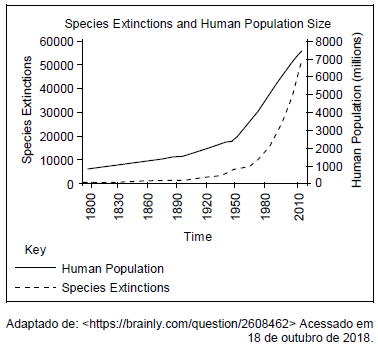
According to the graph above it is true to assert that
Provas
Questão presente nas seguintes provas
A ararinha-azul (Cyanopsitta spixii), protagonista do filme “Rio”, e outras sete espécies de aves foram recentemente consideradas extintas na natureza ou com extinção altamente provável. A extinção de espécies:
1) pode ser intensificada pela introdução de espécies exóticas.
2) ocorre pela destruição dos hábitats, além da caça e da pesca predatória.
3) não é um processo natural, já que necessita da ação humana.
4) não altera a cadeia alimentar, pois outros animais poderão ocupar a função da espécie extinta.
Estão corretas as afirmativas apenas:
Provas
Questão presente nas seguintes provas
Os governos de Getúlio Vargas procuraram modernizar o Brasil e reconheceram os direitos sociais da população. Nesse sentido, com relação ao nacionalismo:
Provas
Questão presente nas seguintes provas
Cadernos
Caderno Container