Foram encontradas 50 questões.
"Grow or die." This dictum is not new to manufacturing, and although it can be over dramatized, there is a stark truth here that companies must accept, especially in the context of today's global economy. Take a close look at the world's major manufacturing corporations whose annual revenues exceed $1 billion, and you will see that they have risen above the competition because they have learned how to respond to the pressures of conducting business in a world where suppliers, competitors, and markets can be located on any continent. Those companies whose annual revenues fall between $50 million and $1 billion-call them Mid- Market manufacturers or Strategic Growth Enterprises-face the same challenges and must also learn to master the global game. There are solutions. Information is the lifeblood of effective planning, which in turn is the foundation for creating a tight, demand-driven supply chain. Establishing enterprise information flows is paramount, but it is a daunting task that is much more complicated than shipping parts or finished goods around the world. The right tools are needed to transform the growth strategy from theory into reality.
Source: http://www.knowledgestorm.com/ Published on: September 2008.
Select the best title for the text:
Provas
Questão presente nas seguintes provas

Observe as declarações a seguir:
//COMP JOB
//COMPILE EXEC IGYWC
//SYSIN DD *
IDENTIFICATION DIVISION (source program)
.
/*
//
//COMPILE EXEC IGYWC
//SYSIN DD *
IDENTIFICATION DIVISION (source program)
.
/*
//
------------------------------------------------------------------
//IGYWC PROC
LNGPRFX='IGY.V3R2M0',SYSLBLK=3200
//*
//* COMPILE A COBOL PROGRAM
//*
//* PARAMETER DEFAULT VALUE
//* SYSLBLK 3200
//* LNGPRFX IGY.V3R2M0
//*
//* CALLER MUST SUPPLY //COBOL.SYSIN DD . . .
//*
//COBOL EXEC PGM=IGYCRCTL,REGION=2048K
//STEPLIB DD DSNAME=&LNGPRFX..SIGYCOMP,
// DISP=SHR
//SYSPRINT DD SYSOUT=*
//SYSLIN DD DSNAME=&&LOADSET,UNIT=SYSDA,
// DISP=(MOD,PASS),SPACE=(TRK,(3,3)),
// DCB=(BLKSIZE=&SYSLBLK)
//SYSUT1 DD UNIT=SYSDA,SPACE=(CYL,(1,1))
//SYSUT2 DD UNIT=SYSDA,SPACE=(CYL,(1,1))
//SYSUT3 DD UNIT=SYSDA,SPACE=(CYL,(1,1))
//SYSUT4 DD UNIT=SYSDA,SPACE=(CYL,(1,1))
//SYSUT5 DD UNIT=SYSDA,SPACE=(CYL,(1,1))
//SYSUT6 DD UNIT=SYSDA,SPACE=(CYL,(1,1))
//SYSUT7 DD UNIT=SYSDA,SPACE=(CYL,(1,1))
------------------------------------------------------------------
//IGYWC PROC
LNGPRFX='IGY.V3R2M0',SYSLBLK=3200
//*
//* COMPILE A COBOL PROGRAM
//*
//* PARAMETER DEFAULT VALUE
//* SYSLBLK 3200
//* LNGPRFX IGY.V3R2M0
//*
//* CALLER MUST SUPPLY //COBOL.SYSIN DD . . .
//*
//COBOL EXEC PGM=IGYCRCTL,REGION=2048K
//STEPLIB DD DSNAME=&LNGPRFX..SIGYCOMP,
// DISP=SHR
//SYSPRINT DD SYSOUT=*
//SYSLIN DD DSNAME=&&LOADSET,UNIT=SYSDA,
// DISP=(MOD,PASS),SPACE=(TRK,(3,3)),
// DCB=(BLKSIZE=&SYSLBLK)
//SYSUT1 DD UNIT=SYSDA,SPACE=(CYL,(1,1))
//SYSUT2 DD UNIT=SYSDA,SPACE=(CYL,(1,1))
//SYSUT3 DD UNIT=SYSDA,SPACE=(CYL,(1,1))
//SYSUT4 DD UNIT=SYSDA,SPACE=(CYL,(1,1))
//SYSUT5 DD UNIT=SYSDA,SPACE=(CYL,(1,1))
//SYSUT6 DD UNIT=SYSDA,SPACE=(CYL,(1,1))
//SYSUT7 DD UNIT=SYSDA,SPACE=(CYL,(1,1))
------------------------------------------------------------------
Qual será o resultado a ser armazenado no cartão: //SYSLIN?
Provas
Questão presente nas seguintes provas
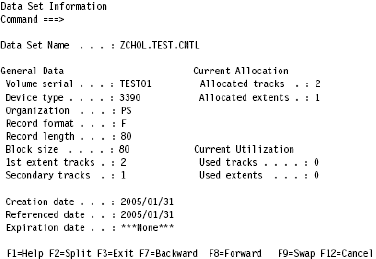
Atente para os cinco formatos tradicionais de registros no z/OS e suas respectivas definições:
I. Fixed.
II. Fixed Blocked.
III. Variable Organization.
IV. Variable Blocked.
V. Undefined.
II. Fixed Blocked.
III. Variable Organization.
IV. Variable Blocked.
V. Undefined.
( ).Significa que diversos registros lógicos de tamanhos distintos estão combinados em um bloco físico. Isso pode prover melhor utilização do espaço e de operação.
( ).Esse formato apresenta diversos registros de tamanhos distintos em um bloco físico.
( ).Significa que um bloco físico no disco é um registro lógico e todos os blocos/registros possuem o mesmo tamanho.
( ).Esse formato apresenta diversos registros/ blocos físicos de tamanhos diferentes sem uma estrutura pré-definida.
( ).Esse formato apresenta um registro lógico como um bloco físico.
Escolha a alternativa que relaciona CORRETAMENTE os termos listados acima e as definições correspondentes.
Provas
Questão presente nas seguintes provas
Qual é o tipo de objeto do natural onde se definem os elementos de dados que podem ser referenciados por múltiplos programas ou sub-rotinas da mesma biblioteca?
Provas
Questão presente nas seguintes provas
- Fundamentos de ProgramaçãoEstruturas de Seleção
- Fundamentos de ProgramaçãoLógica de Programação
- LinguagensJCL: Job Control Language
Ordene CORRETAMENTE os seguintes parâmetros condicionais:
I. // ENDIF
II. //COND IF ABC > 5 THEN
III. //STEP2 EXEC PGM=DELFILE
IV. // ELSE
V. //STEP1 EXEC PROC=PRINT
II. //COND IF ABC > 5 THEN
III. //STEP2 EXEC PGM=DELFILE
IV. // ELSE
V. //STEP1 EXEC PROC=PRINT
Provas
Questão presente nas seguintes provas
Qual seria o melhor critério de busca a ser utilizado para achar as linhas no arquivo BRIO.TXT que contenham a palavra "disks"?
Provas
Questão presente nas seguintes provas
DESKTOP HARD DRIVES SHRINK
When you say "3.5-inch hard drive," most people think of desktop PCs. But that presumption is changing as 2.5-inch hard drives find their way into desktop PCs and servers.
The trend first took hold with servers and enterprise hard drives, as 2.5-inch drives achieved high rotations per minute— 10,000 or 15,000 rpm-and better performance while generating less heat than 3.5-inch drives.
Now, consumer PCs are moving to 2.5-inch drives as well. A push toward smaller, design- and energy-conscious systems underlies manufacturers' inclusion of 2.5-inch drives in desktops. Mainstream desktop manufacturers use laptop components to build the compact PCs of the future, so it makes sense that some compact PCs have 2.5-inch hard drives inside. Even power desktops can get into the 2.5-inch game with Western Digital/s VelociRaptor hard drive, which zips at 10,000 rpm. Capacity is no longer an issue: 250GB to 320GB 2.5-inch drives are commonplace, and 500GB drives have begun shipping. But 2.5-inch drives won't take over on the desktop: Since 3.5-inch drives offer a better price/capacity ratio, 3.5-inch drives will continue to prevail.
Source: PERENSON, Melissa J. www.pcworld.com, July 2008.
What does the title of the article mean?
Provas
Questão presente nas seguintes provas
Considere o programa NATURAL abaixo. Em quais linhas o comando CHECK apontaria problemas?
0110 DEFINE DATA
0120 LOCAL
0130 01 #NAME-START (A20)
0140 01 #NAME-END (A20)
0150 01 #MARK (A1)
0160 01 EMPLOYEES-VIEW VIEW OF EMPLOYEES
0170 02 PERSONNEL-ID (A8)
0180 02 NAME (A20)
0190 02 DEPT (A6)
0200 02 LEAVE-DUE (N2)
0210 END-DEFINE
0220 *
0230 *
0240 REPEAT
0250 *
0260 INPUT USING MAP ’MAP01’
0270 IF #NAME-START = ’.’
0280 ESCAPE BOTTOM
0290 END-IF
0300 MOVE #NAME-START TO #NAME-END
0310
0320 RD1. READ EMPLOYEES-VIEW BY NAME
0330 STARTING FROM #NAME-START
0340 THRU #NAME-END
0350 IF LEAVE-DUE >= 20
0360 PERFORM MARK-SPECIAL-EMPLOYEES
0370 ELSE
0380 RESET #MARK
0390 END-IF
0400 DISPLAY NAME 3X DEPT 3X LEAVE-DUE 3X ’>=20
#MARK
0450 END-READ
0460 *
0470 IF *COUNTER (RD1.) = ' '
0480 REINPUT ’PLEASE TRY ANOTHER NAME’
0490 END-IF
0500 *
0600 END-REPEAT
0610 *
0620 DEFINE SUBROUTINE MARK-SPECIAL EMPLOYEES
0630 MOVE ’*’ TO #MARK
0640 END-SUBROUTINE
0650 END
0120 LOCAL
0130 01 #NAME-START (A20)
0140 01 #NAME-END (A20)
0150 01 #MARK (A1)
0160 01 EMPLOYEES-VIEW VIEW OF EMPLOYEES
0170 02 PERSONNEL-ID (A8)
0180 02 NAME (A20)
0190 02 DEPT (A6)
0200 02 LEAVE-DUE (N2)
0210 END-DEFINE
0220 *
0230 *
0240 REPEAT
0250 *
0260 INPUT USING MAP ’MAP01’
0270 IF #NAME-START = ’.’
0280 ESCAPE BOTTOM
0290 END-IF
0300 MOVE #NAME-START TO #NAME-END
0310
0320 RD1. READ EMPLOYEES-VIEW BY NAME
0330 STARTING FROM #NAME-START
0340 THRU #NAME-END
0350 IF LEAVE-DUE >= 20
0360 PERFORM MARK-SPECIAL-EMPLOYEES
0370 ELSE
0380 RESET #MARK
0390 END-IF
0400 DISPLAY NAME 3X DEPT 3X LEAVE-DUE 3X ’>=20
#MARK
0450 END-READ
0460 *
0470 IF *COUNTER (RD1.) = ' '
0480 REINPUT ’PLEASE TRY ANOTHER NAME’
0490 END-IF
0500 *
0600 END-REPEAT
0610 *
0620 DEFINE SUBROUTINE MARK-SPECIAL EMPLOYEES
0630 MOVE ’*’ TO #MARK
0640 END-SUBROUTINE
0650 END
Provas
Questão presente nas seguintes provas
Utilize o modelo a seguir cuja janela tem como posição inicial e responda à questão:
DEFINE WINDOW TEST
SIZE 5*25
BASE 5/40
TITLE ’Sample Window’
SIZE 5*25
BASE 5/40
TITLE ’Sample Window’
CONTROL WINDOW
FRAMED POSITION SYMBOL BOT LEFT
FRAMED POSITION SYMBOL BOT LEFT
Quais das opções abaixo alterariam a Janela para sétima linha e diminuiriam sua largura em três colunas?
Provas
Questão presente nas seguintes provas
Observe um exemplo de uma procedure JCL abaixo:
//MYPROC PROC
//MYSORT EXEC PGM=SORT
//SORTIN DD DISP=SHR,DSN=&SORTDSN
//SORTOUT DD SYSOUT=*
//SYSOUT DD SYSOUT=*
// PEND
//MYSORT EXEC PGM=SORT
//SORTIN DD DISP=SHR,DSN=&SORTDSN
//SORTOUT DD SYSOUT=*
//SYSOUT DD SYSOUT=*
// PEND
Acrescentam-se os cartões em negrito:
//MYJOB JOB 1
//*---------------------------------*
//MYPROC PROC
//MYSORT EXEC PGM=SORT
//SORTIN DD DISP=SHR,DSN=&SORTDSN
//SORTOUT DD SYSOUT=*
//SYSOUT DD SYSOUT=*
// PEND
//*---------------------------------*
//STEP1 EXEC
YPROC,SORTDSN=ZPROF.AREA.CODES
//SYSIN DD *
SORT FIELDS=(1,3,CH,A)
//*---------------------------------*
//MYPROC PROC
//MYSORT EXEC PGM=SORT
//SORTIN DD DISP=SHR,DSN=&SORTDSN
//SORTOUT DD SYSOUT=*
//SYSOUT DD SYSOUT=*
// PEND
//*---------------------------------*
//STEP1 EXEC
YPROC,SORTDSN=ZPROF.AREA.CODES
//SYSIN DD *
SORT FIELDS=(1,3,CH,A)
Esses cartões permitem a execução da procedure JCL. Eles são conhecidos como:
Provas
Questão presente nas seguintes provas
Cadernos
Caderno Container