Foram encontradas 59 questões.
Check the correct pair of opposites
Provas

In "It helps a pilot that is in a very stressful situation to have a calm voice on the other end of the radio." (lines 9-10), "have" could be replaced by:
Provas
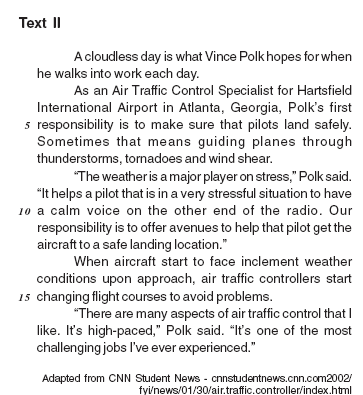
How does Polk feel about his job as an air controller?
Provas
airports do not need air traffic controllers if the skies are clear.
Provas
According to the last paragraph of Text I, a radar controller
Provas
Mark the only option in which the word(s) in bold type express(es) an idea of hypothesis/condition.
Provas
The only word(s) that could NOT replace "nears" in "As the plane nears the runway" (line 30) is(are):
Provas
The phenomenon of wind shear (lines 17-21):
Provas
In "…airport tower controllers (or terminal controllers) watch over all planes traveling through the airport's airspace," (lines 10 - 12 ), "watch over" means:
Provas
Text I
The air traffic control system is a vast network of
people and equipment that ensures the safe operation of
commercial and private aircraft. Air traffic controllers
coordinate the movement of air traffic to make certain that
5 planes stay a safe distance apart. Their immediate concern
is safety, but controllers also must direct planes efficiently
to minimize delays. Some regulate airport traffic through
designated airspaces; others regulate airport arrivals and
departures.
10 Although airport tower controllers (or terminal
controllers) watch over all planes traveling through the
airport’s airspace, their main responsibility is to organize
the flow of aircraft into and out of the airport. Relying on
radar and visual observation, they closely monitor each
15 plane to ensure a safe distance between all aircraft and to
guide pilots between the hangar or ramp and the end of
the airport’s airspace. In addition, controllers keep pilots
informed about changes in weather conditions such as
wind shear, a sudden change in the velocity or direction of
20 the wind that can cause the pilot to lose control of the
aircraft.
During arrival or departure, several controllers direct
each plane. As a plane approaches an airport, the pilot
radios ahead to inform the terminal of the plane’s presence.
25 The controller in the radar room, just beneath the control
tower, has a copy of the plane’s flight plan and already
has observed the plane on radar. If the path is clear, the
controller directs the pilot to a runway; if the airport is
busy, the plane is fitted into a traffic pattern with other
30 aircraft waiting to land. As the plane nears the runway,
the pilot is asked to contact the tower. There, another
controller, who also is watching the plane on radar,
monitors the aircraft the last mile or so to the runway,
delaying any departures that would interfere with the plane’s
35 landing. Once the plane has landed, a ground controller
in the tower directs it along the taxiways to its assigned
gate. The ground controller usually works entirely by sight,
but may use radar if visibility is very poor.
The radar controller, who is the senior team member,
40 observes the planes in the team’s airspace on radar and
communicates with the pilots when necessary. Radar
controllers warn pilots about nearby planes, bad weather
conditions, and other potential hazards. As the flight
progresses, the team responsible for the aircraft notifies
45 the next team in charge of the airspace ahead. Through
team coordination, the plane arrives safely at its
destination.
Adapted from http://stats.bls.gov/oco/ocos108.htm
The pronoun “others” (line 8) refers to:
Provas
Caderno Container