Foram encontradas 50 questões.
Os neurônios se comunicam uns com os outros e com as células-alvo nas sinapses. O tipo mais comum de sinapse no sistema nervoso é a sinapse química – na qual a mensagem química da célula pré-sináptica induz mudanças na célula pós-sináptica. Nas sinapses elétricas, o potencial de ação se espalha diretamente do terminal pré-sináptico para a célula pós-sináptica.
SADAVA, David et al. Vida: a ciência da Biologia. Porto Alegre:
Artmed, 2009. V. 3. P. 1091.
Apesar das sinapses químicas e elétricas apresentarem a mesma função de propagação do impulso nervoso entre a célula pré-sináptica e a pós-sináptica, elas possuem especificidades funcionais que as diferenciam amplamente.
Pode-se afirmar que uma dessas especificidades funcionais é a
Provas

O fato de a humanidade ter passado por importantes gargalos populacionais e ter sido palco de repetidos efeitos fundadores, certamente, tornou-a vulnerável às sequelas da deriva genética. [...] Com isso, a probabilidade média de identidade por descendência aumenta em uma população. Em outras palavras, a deriva cria homogeneidade genética.
Porém a expansão populacional, as migrações humanas e, principalmente, as mutações do DNA têm um efeito contrário de reconstituir a variabilidade. Uma prova da eficiência disto é que 85% da variabilidade genética humana está concentrada dentro das próprias populações e não entre diferentes populações ou entre continentes.
PENA, Sérgio Danilo J. Igualmente diferentes. Belo Horizonte:
Editora UFMG, 2009. P. 93. Adaptado
A partir dos processos evolutivos citados no texto e presentes na evolução humana, pode-se considerar como uma importante consequência a
Provas
A necessidade da parede celular para a sobrevivência da célula é uma fraqueza da qual o nosso corpo se aproveita para combater as bactérias infecciosas. Nosso organismo produz a lisozima, uma enzima capaz de quebrar as ligações entre os açúcares N-acetilglicosamina, NAG, e o ácido N-acetilmurâmico, NAM. Isto enfraquece a parede celular e permite que a água penetre na célula, estourando-a. O antibiótico penicilina também ataca vários pontos da síntese do peptidioglicano, o que bloqueia, definitivamente, a formação da parede celular e causa a morte da célula.
STEARNS, Jennifer C. Microbiologia para leigos. Rio de Janeiro:
Alta Books, 2018. P.39.
Com base na informação do texto e no conhecimento adquirido a respeito das paredes celulares no combate à infecções bacterianas, é correto afirmar:
Provas
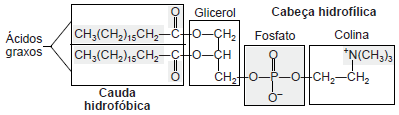
Disponível em: <https://www.researchgate.net/figure>.
Acesso em: set. 2019.
A ilustração representa a estrutura de um tipo de fosfolipídio presente na constituição das membranas celulares. Os fosfolipídios são considerados moléculas anfipáticas, ou seja, apresentam uma porção polar e uma outra porção apolar, como registrado na imagem.
Essa propriedade irá determinar algumas consequências biológicas expressas pelas membranas da célula, como:
Provas
Em 1982, o químico norte-americano Thomas Cech descobriu ribozimas que funcionam com RNA catalítico independente e, em 2002, o biólogo molecular Gerald Joyce produziu uma enzima RNA capaz de se copiar, permitindo crescimento exponencial e evolução autossustentável. Estas descobertas corroboravam uma proposta da década de 1960, dos cientistas britânicos Francis Crick e Leslie Orgel, de que todos os sistemas prebióticos e protobiontes poderiam ter sido baseados no RNA – a chamada hipótese Leslie Orgel do “Mundo do RNA”.
CHAMARY, JV. 50 ideias de biologia que você precisa conhecer.
São Paulo: Planeta do Brasil, 2019. P.20.
Segundo essa hipótese, o controle genético por RNA não foi capaz de se manter como uma unidade padrão dos seres vivos ao longo do tempo, dando espaço para o estabelecimento de um novo tipo de molécula informacional baseado no DNA.
Uma das prováveis justificativas para a ocorrência desta mudança de padrão ao longo da história da vida se baseia na
Provas
Quando ligada a oxigênio, a hemoglobina é de um vermelho brilhante, o que explica a cor do sangue arterial e, também, a cor rosada dos seres humanos dito “brancos”, que têm uma pele mais clara. Um sangue cereja vivo significa envenenamento por monóxido de carbono, estado em que esta molécula usurpa o lugar no centro da hemoglobina normalmente reservado para o oxigênio.
ASHCROFT, Frances M. A vida no limite: a ciência da sobrevivência.
Rio de Janeiro: Jorge Zahar, 2001. P.46. Adaptado.
A respeito das informações presentes no texto e do conhecimento pertinente à fisiologia humana, é correto afirmar:
Provas
O primeiro a afirmar que todas as formas de vida são feitas de células, provavelmente, foi o fisiologista vegetal francês Henri Dutrochet, em 1824, mas o crédito pela ideia, em geral, é dado a dois alemães: o botânico Matthias Schleiden e o zoólogo Theodor Schwann. Em 1838, Schleiden afirmou que toda estrutura vegetal consiste em células ou seus produtos, e Schwann disse que isso se aplicaria também aos animais.
CHAMARY, JV. 50 ideias de biologia que você precisa conhecer.
São Paulo: Planeta do Brasil, 2019. P.14.
Essas afirmações, citadas no texto, passaram a ser denominadas Teoria Celular, que foi considerada uma das mais importantes generalizações da história da Biologia, delineando os caminhos para o estabelecimento desta nova ciência no século XIX.
O principal argumento que ratifica a importância dessa Teoria na estruturação das ciências biológicas é o de que
Provas

GLASBERGEN. Disponível em: <http://glasbergen.com>. Acesso em: set. 2019.
The man in this cartoon
Provas
New research has identified a potential way to reverse graying hair and treat skin pigment disorders. By studying stem cells in mice, scientists at NYU Langone Medical Center in New York City have found the molecular pathways responsible for creating the color of skin and hair. Their findings could one day lead to cosmetic treatments that restore graying locks to more youthful colors such as brown, blond and red. The research may also be useful for developing drug candidates for people with vitiligo, a disease that causes skin to lose its color and leads to blotchy white patches.
The researchers conducted a series of experiments on stem cells to investigate the biological process at work in pigmentation. They found that a certain signaling pathway – known as EdnrB – interacts with other pathways, in particular the Wnt signaling pathways, which in turn causes the proliferation of melanocyte, stem cells involved in the earliest stage of skin and hair pigmentation.
When the researchers bred mice to have EdnrB pathway deficiencies, the rodents experienced premature graying of their fur. “The mice that normally had black hair turned into grayish mice.
They looked like old people, with gray hair”, they said. Conversely, when they stimulated the mice’s EdnrB pathways, it produced a 15-fold increase in melanocyte stem cell pigment production, which caused hyperpigmentation in the mice. The researchers made small wounds on the animals and noticed that the skin was much darker when it began to heal. Finally, when researchers blocked the mice’s Wnt signaling, it slowed melanocyte growth and resulted in unpigmented gray hair. Mice with black fur became more gray.
This finding suggests that targeting the Wnt pathway may be one way to reverse gray hair.
Moreover, “if scientists can eventually find ways to activate those signaling pathways in humans with vitiligo, the melanocyte stem cells could migrate to the surface of their skin and re-pigment it”, they explained.
FIRGER, Jessica. Disponível em: <http://www.newsweek.com>. Acesso em: set. 2019. Adptado.
Considering the potential use of those signaling pathways to cure humans with vitiligo, the scientists feel that the present study seems
Provas
New research has identified a potential way to reverse graying hair and treat skin pigment disorders. By studying stem cells in mice, scientists at NYU Langone Medical Center in New York City have found the molecular pathways responsible for creating the color of skin and hair. Their findings could one day lead to cosmetic treatments that restore graying locks to more youthful colors such as brown, blond and red. The research may also be useful for developing drug candidates for people with vitiligo, a disease that causes skin to lose its color and leads to blotchy white patches.
The researchers conducted a series of experiments on stem cells to investigate the biological process at work in pigmentation. They found that a certain signaling pathway – known as EdnrB – interacts with other pathways, in particular the Wnt signaling pathways, which in turn causes the proliferation of melanocyte, stem cells involved in the earliest stage of skin and hair pigmentation.
When the researchers bred mice to have EdnrB pathway deficiencies, the rodents experienced premature graying of their fur. “The mice that normally had black hair turned into grayish mice.
They looked like old people, with gray hair”, they said. Conversely, when they stimulated the mice’s EdnrB pathways, it produced a 15-fold increase in melanocyte stem cell pigment production, which caused hyperpigmentation in the mice. The researchers made small wounds on the animals and noticed that the skin was much darker when it began to heal. Finally, when researchers blocked the mice’s Wnt signaling, it slowed melanocyte growth and resulted in unpigmented gray hair. Mice with black fur became more gray.
This finding suggests that targeting the Wnt pathway may be one way to reverse gray hair.
Moreover, “if scientists can eventually find ways to activate those signaling pathways in humans with vitiligo, the melanocyte stem cells could migrate to the surface of their skin and re-pigment it”, they explained.
FIRGER, Jessica. Disponível em: <http://www.newsweek.com>. Acesso em: set. 2019. Adptado.
As far as the experiments with mice are concerned, the text says that
Provas
Caderno Container