Foram encontradas 96 questões.
Read the text and answer questions 79, 80, 81, 82, 83 and 84.
Earthquake levels city of Antakya in southern Turkey
The Turkish city of Antakya, one of the hardest-hit towns in the earthquake zone, has been nearly destroyed by the massive 7.8 quake that struck on 6th February. Tall apartment buildings were flattened, trapping residents who were sleeping when the quake struck in the early morning hours. Thousands are __________ to be buried in their homes. Most of the city was heavily damaged and rescuers have been working around the clock to pull survivors from under the rubble, racing against time in cold weather. Many residents were left homeless and had to spend nights outdoors, burning debris to keep warm as overnight temperatures dropped below freezing. Workers pulled a man in his 30s out of the ruins as a jubilant crowd burst into cheers and tears. Not long after, they found an elderly woman. Then, a 10- year-old girl was also rescued: the child was under the rubble for 90 hours. These moments of hope among the devastation keep them going as darkness falls. More than 80 hours after the quake, rescuers using pails along with other equipment, found a man and his mother, and pulled them out alive. Amid the rubble, a group of rescuers were able to pull out lost family members alive.
Even as more help arrives, hope for finding survivors dwindles. Family members wait in the cold to see if their loved ones will be found, alive or dead. There are more than 100 bodies waiting for identification in a makeshift morgue outside the Antakya hospital. More than 600 aftershocks are slowing recovery efforts and make the task more dangerous. Little aid from the government has reached the city and the need is overwhelming. People walk the streets in tears, dazed. There is no place to go. Everything is covered in dust. Even with some 120,000 rescuers across Turkey and Syria now taking part in the effort, the task is daunting. With every passing hour, the likelihood of finding survivors diminishes.
Adapted. Internet: www.abcnews.go.com/International.
Read the sentences and choose the best alternative.
I- As time went by, the probability of finding people alive was negatively affected.
II- Under strict local laws, the rescuers were only allowed to work up to eight hours a day.
III- Most of the homes have suffered major damage due to the earthquake’s intensity.
IV- There weren’t many victims, as the government had been warned of the quake by seismologists.
V- Many people chose to spend the night outdoors because they didn’t feel safe inside their homes.
According to the text,
Provas

Read the text and answer questions 73, 74, 75, 76, 77 and 78.
Global coral reef bleaching event underway as oceans get warmer
The world’s oceans experience unprecedented rising temperatures: last month, the average global sea surface temperature reached a record 21° Celsius. Last week, the National Oceanic and Atmospheric Administration (NOAA) reported the 4th global bleaching event on record. A press release stated, “Within the last 14 months, significant coral bleaching has been documented in the Northern and Southern Hemispheres of each major ocean basin. Since 2023, the problem has become more frequent in the Atlantic, Pacific and Indian oceans.”
According to NOAA, warmer ocean temperatures can result in expulsion of algae that live in the coral tissue, leaving the coral completely white - something known as ‘coral bleaching’. This does not necessarily mean corals will die, as they can recover if the strain on their ecosystems is reduced. At a local level, storms, disease, sediments and changes in salinity can cause corals to bleach. However, mass bleaching, which is when several varieties of coral reefs are bleached, is largely caused by increased sea temperatures. When these events are sufficiently severe or prolonged, they can cause coral mortality, which hurts the people who depend on the coral reefs for their livelihoods.
In 2019, NOAA published a study that provided “resilience- based management practices” and __________ the importance of coral restoration. “We are on the frontlines of coral reef research, management and restoration, and are actively and aggressively implementing the recommendations of the 2019 study.” A buoy in Florida reported an ocean temperature of 38° Celsius in July 2023, according to meteorologists at the time. In response, NOAA started a program to attempt to offset the effects of global climate change on the local coral reefs by moving coral nurseries to deeper, cooler waters and deploying sunshades to protect corals in other areas.
Adapted. Internet: www.abcnews.go.com/International.
Choose the best alternative to fill in the blank.
Provas
Read the text and answer questions 73, 74, 75, 76, 77 and 78.
Global coral reef bleaching event underway as oceans get warmer
The world’s oceans experience unprecedented rising temperatures: last month, the average global sea surface temperature reached a record 21° Celsius. Last week, the National Oceanic and Atmospheric Administration (NOAA) reported the 4th global bleaching event on record. A press release stated, “Within the last 14 months, significant coral bleaching has been documented in the Northern and Southern Hemispheres of each major ocean basin. Since 2023, the problem has become more frequent in the Atlantic, Pacific and Indian oceans.”
According to NOAA, warmer ocean temperatures can result in expulsion of algae that live in the coral tissue, leaving the coral completely white - something known as ‘coral bleaching’. This does not necessarily mean corals will die, as they can recover if the strain on their ecosystems is reduced. At a local level, storms, disease, sediments and changes in salinity can cause corals to bleach. However, mass bleaching, which is when several varieties of coral reefs are bleached, is largely caused by increased sea temperatures. When these events are sufficiently severe or prolonged, they can cause coral mortality, which hurts the people who depend on the coral reefs for their livelihoods.
In 2019, NOAA published a study that provided “resilience- based management practices” and __________ the importance of coral restoration. “We are on the frontlines of coral reef research, management and restoration, and are actively and aggressively implementing the recommendations of the 2019 study.” A buoy in Florida reported an ocean temperature of 38° Celsius in July 2023, according to meteorologists at the time. In response, NOAA started a program to attempt to offset the effects of global climate change on the local coral reefs by moving coral nurseries to deeper, cooler waters and deploying sunshades to protect corals in other areas.
Adapted. Internet: www.abcnews.go.com/International.
The word livelihoods, in bold in the text, refers to
Provas
Read the text and answer questions 73, 74, 75, 76, 77 and 78.
Global coral reef bleaching event underway as oceans get warmer
The world’s oceans experience unprecedented rising temperatures: last month, the average global sea surface temperature reached a record 21° Celsius. Last week, the National Oceanic and Atmospheric Administration (NOAA) reported the 4th global bleaching event on record. A press release stated, “Within the last 14 months, significant coral bleaching has been documented in the Northern and Southern Hemispheres of each major ocean basin. Since 2023, the problem has become more frequent in the Atlantic, Pacific and Indian oceans.”
According to NOAA, warmer ocean temperatures can result in expulsion of algae that live in the coral tissue, leaving the coral completely white - something known as ‘coral bleaching’. This does not necessarily mean corals will die, as they can recover if the strain on their ecosystems is reduced. At a local level, storms, disease, sediments and changes in salinity can cause corals to bleach. However, mass bleaching, which is when several varieties of coral reefs are bleached, is largely caused by increased sea temperatures. When these events are sufficiently severe or prolonged, they can cause coral mortality, which hurts the people who depend on the coral reefs for their livelihoods.
In 2019, NOAA published a study that provided “resilience- based management practices” and __________ the importance of coral restoration. “We are on the frontlines of coral reef research, management and restoration, and are actively and aggressively implementing the recommendations of the 2019 study.” A buoy in Florida reported an ocean temperature of 38° Celsius in July 2023, according to meteorologists at the time. In response, NOAA started a program to attempt to offset the effects of global climate change on the local coral reefs by moving coral nurseries to deeper, cooler waters and deploying sunshades to protect corals in other areas.
Adapted. Internet: www.abcnews.go.com/International.
The word underway, in the title of the text, means that something is
Provas
Read the text and answer questions 73, 74, 75, 76, 77 and 78.
Global coral reef bleaching event underway as oceans get warmer
The world’s oceans experience unprecedented rising temperatures: last month, the average global sea surface temperature reached a record 21° Celsius. Last week, the National Oceanic and Atmospheric Administration (NOAA) reported the 4th global bleaching event on record. A press release stated, “Within the last 14 months, significant coral bleaching has been documented in the Northern and Southern Hemispheres of each major ocean basin. Since 2023, the problem has become more frequent in the Atlantic, Pacific and Indian oceans.”
According to NOAA, warmer ocean temperatures can result in expulsion of algae that live in the coral tissue, leaving the coral completely white - something known as ‘coral bleaching’. This does not necessarily mean corals will die, as they can recover if the strain on their ecosystems is reduced. At a local level, storms, disease, sediments and changes in salinity can cause corals to bleach. However, mass bleaching, which is when several varieties of coral reefs are bleached, is largely caused by increased sea temperatures. When these events are sufficiently severe or prolonged, they can cause coral mortality, which hurts the people who depend on the coral reefs for their livelihoods.
In 2019, NOAA published a study that provided “resilience- based management practices” and __________ the importance of coral restoration. “We are on the frontlines of coral reef research, management and restoration, and are actively and aggressively implementing the recommendations of the 2019 study.” A buoy in Florida reported an ocean temperature of 38° Celsius in July 2023, according to meteorologists at the time. In response, NOAA started a program to attempt to offset the effects of global climate change on the local coral reefs by moving coral nurseries to deeper, cooler waters and deploying sunshades to protect corals in other areas.
Adapted. Internet: www.abcnews.go.com/International.
According to the text, the NOAA
Provas
Read the text and answer questions 73, 74, 75, 76, 77 and 78.
Global coral reef bleaching event underway as oceans get warmer
The world’s oceans experience unprecedented rising temperatures: last month, the average global sea surface temperature reached a record 21° Celsius. Last week, the National Oceanic and Atmospheric Administration (NOAA) reported the 4th global bleaching event on record. A press release stated, “Within the last 14 months, significant coral bleaching has been documented in the Northern and Southern Hemispheres of each major ocean basin. Since 2023, the problem has become more frequent in the Atlantic, Pacific and Indian oceans.”
According to NOAA, warmer ocean temperatures can result in expulsion of algae that live in the coral tissue, leaving the coral completely white - something known as ‘coral bleaching’. This does not necessarily mean corals will die, as they can recover if the strain on their ecosystems is reduced. At a local level, storms, disease, sediments and changes in salinity can cause corals to bleach. However, mass bleaching, which is when several varieties of coral reefs are bleached, is largely caused by increased sea temperatures. When these events are sufficiently severe or prolonged, they can cause coral mortality, which hurts the people who depend on the coral reefs for their livelihoods.
In 2019, NOAA published a study that provided “resilience- based management practices” and __________ the importance of coral restoration. “We are on the frontlines of coral reef research, management and restoration, and are actively and aggressively implementing the recommendations of the 2019 study.” A buoy in Florida reported an ocean temperature of 38° Celsius in July 2023, according to meteorologists at the time. In response, NOAA started a program to attempt to offset the effects of global climate change on the local coral reefs by moving coral nurseries to deeper, cooler waters and deploying sunshades to protect corals in other areas.
Adapted. Internet: www.abcnews.go.com/International.
According to the text, coral reefs may
Provas
Read the text and answer questions 73, 74, 75, 76, 77 and 78.
Global coral reef bleaching event underway as oceans get warmer
The world’s oceans experience unprecedented rising temperatures: last month, the average global sea surface temperature reached a record 21° Celsius. Last week, the National Oceanic and Atmospheric Administration (NOAA) reported the 4th global bleaching event on record. A press release stated, “Within the last 14 months, significant coral bleaching has been documented in the Northern and Southern Hemispheres of each major ocean basin. Since 2023, the problem has become more frequent in the Atlantic, Pacific and Indian oceans.”
According to NOAA, warmer ocean temperatures can result in expulsion of algae that live in the coral tissue, leaving the coral completely white - something known as ‘coral bleaching’. This does not necessarily mean corals will die, as they can recover if the strain on their ecosystems is reduced. At a local level, storms, disease, sediments and changes in salinity can cause corals to bleach. However, mass bleaching, which is when several varieties of coral reefs are bleached, is largely caused by increased sea temperatures. When these events are sufficiently severe or prolonged, they can cause coral mortality, which hurts the people who depend on the coral reefs for their livelihoods.
In 2019, NOAA published a study that provided “resilience- based management practices” and __________ the importance of coral restoration. “We are on the frontlines of coral reef research, management and restoration, and are actively and aggressively implementing the recommendations of the 2019 study.” A buoy in Florida reported an ocean temperature of 38° Celsius in July 2023, according to meteorologists at the time. In response, NOAA started a program to attempt to offset the effects of global climate change on the local coral reefs by moving coral nurseries to deeper, cooler waters and deploying sunshades to protect corals in other areas.
Adapted. Internet: www.abcnews.go.com/International.
According to the text, warm sea temperatures
Provas
Em relação aos fenômenos elétricos, marque V para verdadeiro ou F para falso. Em seguida, assinale a alternativa com a sequência correta.
( ) Na corrente contínua (CC), o fluxo de cargas elétricas ocorre em um único sentido. Esse tipo de corrente é produzido por pilhas e células fotovoltaicas. O sentido da corrente contínua real é dado pelo sentido do fluxo dos portadores das cargas negativas.
( ) A corrente alternada (CA) é um fluxo oscilante de cargas elétricas que ora se movimenta em um sentido, ora em outro. Esse tipo de corrente é produzido por baterias e hidroelétricas. O sentido da corrente alternada real é dado pelo sentido do fluxo dos portadores das cargas positivas.
( ) O fenômeno de emissão de luz que ocorre quando uma corrente elétrica passa através de um gás rarefeito é conhecido como efeito térmico.
( ) Para medir a tensão aplicada aos terminais de um resistor, um voltímetro deve ser inserido a este de forma paralela. Além disso, para não influenciar no circuito medido, o voltímetro deve possuir a maior resistência interna possível, fazendo com que a corrente que o atravessa seja insignificante.
Provas
A figura a seguir ilustra as transformações sofridas por um gás ideal contido em um recipiente fechado com um pistão móvel. A partir da figura, avalie as afirmações abaixo e coloque V para verdadeiro ou F para falso. Em seguida assinale a alternativa com a sequência correta.
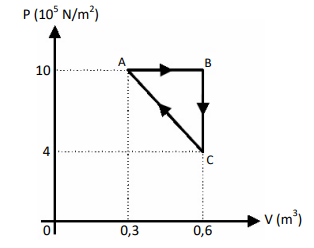
( ) O trabalho realizado pelo gás é de 3.105 J.
( ) A transformação BC se deu a volume constante, portanto é uma transformação isocórica.
( ) A quantidade de calor trocado no ciclo é igual a zero, pois temos uma transformação cíclica.
( ) O trabalho realizado sobre o gás é de 0,9.105 J.
Provas
Todos os dias pela manhã, um grupo da terceira idade caminha no parque público de sua cidade. O instrutor dessa equipe quis avaliar o rendimento de sua aluna Lúcia e observou que ela dá passos de 60 cm de comprimento a uma razão de 1 passo a cada 2 segundos. Considerando que ela se exercite durante 50 minutos, assinale a alternativa que indica corretamente qual a distância, em km, ela terá percorrido durante esse tempo.
Provas
Caderno Container