Foram encontradas 40 questões.
Leia o texto para responder à questão

The idea of comfort food sounds great in theory, but many of society’s favourite feel-good foods lack ideal nutrients. This leaves eaters feeling cranky, not comforted. “Some of the main dietary contributors to low or bad mood are too much sugar and too many starchy and refined carbohydrates,” British nutritional therapist Claudia Smith told Huffington Post. “If you eat too much of these foods, you can end up with blood sugar spikes and crashes, which can lead to symptoms such as low mood, irritability, brain fog, anxiety, fatigue and difficulty concentrating.”
Common comfort foods such as cookies or french fries activate reward triggers in our brains, Smith said. They give us something to look forward to or get excited about. Psychologist and well-being consultant Lee Chambers told Huffington Post that comfort foods do provide a hit of pleasureinducing dopamine, but that pleasure is fleeting.
“Emotional eating is a cyclical process where low mood leads to eating foods likely to spike your blood sugar, giving us a dose of dopamine, but then it drops at the same time as we start to feel guilty,” Chambers told Huffington Post. “This combination often makes us feel a lack of satisfaction, with feelings of guilt, shame and regret.”
Even worse? Comfort foods often lead to overeating. “Over time, high consumption of highly palatable foods may actually lead to a reduced sensitivity of this brain-reward response,” Smith said. “You may find yourself needing to eat more and more to experience the same effect.”
(Stephanie Vermillion. www.huffingtonpost.co.uk, 30.05.2020. Adaptado.)
No trecho do segundo parágrafo “comfort foods do provide a hit of pleasure-inducing dopamine, but that pleasure is fleeting”, o termo sublinhado equivale, em português, a
Provas

Leia o texto para responder à questão
The idea of comfort food sounds great in theory, but many of society’s favourite feel-good foods lack ideal nutrients. This leaves eaters feeling cranky, not comforted. “Some of the main dietary contributors to low or bad mood are too much sugar and too many starchy and refined carbohydrates,” British nutritional therapist Claudia Smith told Huffington Post. “If you eat too much of these foods, you can end up with blood sugar spikes and crashes, which can lead to symptoms such as low mood, irritability, brain fog, anxiety, fatigue and difficulty concentrating.”
Common comfort foods such as cookies or french fries activate reward triggers in our brains, Smith said. They give us something to look forward to or get excited about. Psychologist and well-being consultant Lee Chambers told Huffington Post that comfort foods do provide a hit of pleasureinducing dopamine, but that pleasure is fleeting.
“Emotional eating is a cyclical process where low mood leads to eating foods likely to spike your blood sugar, giving us a dose of dopamine, but then it drops at the same time as we start to feel guilty,” Chambers told Huffington Post. “This combination often makes us feel a lack of satisfaction, with feelings of guilt, shame and regret.”
Even worse? Comfort foods often lead to overeating. “Over time, high consumption of highly palatable foods may actually lead to a reduced sensitivity of this brain-reward response,” Smith said. “You may find yourself needing to eat more and more to experience the same effect.”
(Stephanie Vermillion. www.huffingtonpost.co.uk, 30.05.2020. Adaptado.)
According to the text, comfort foods provide a hit of pleasure but that’s often followed by
Provas
Leia o texto para responder à questão
The idea of comfort food sounds great in theory, but many of society’s favourite feel-good foods lack ideal nutrients. This leaves eaters feeling cranky, not comforted. “Some of the main dietary contributors to low or bad mood are too much sugar and too many starchy and refined carbohydrates,” British nutritional therapist Claudia Smith told Huffington Post. “If you eat too much of these foods, you can end up with blood sugar spikes and crashes, which can lead to symptoms such as low mood, irritability, brain fog, anxiety, fatigue and difficulty concentrating.”
Common comfort foods such as cookies or french fries activate reward triggers in our brains, Smith said. They give us something to look forward to or get excited about. Psychologist and well-being consultant Lee Chambers told Huffington Post that comfort foods do provide a hit of pleasureinducing dopamine, but that pleasure is fleeting.
“Emotional eating is a cyclical process where low mood leads to eating foods likely to spike your blood sugar, giving us a dose of dopamine, but then it drops at the same time as we start to feel guilty,” Chambers told Huffington Post. “This combination often makes us feel a lack of satisfaction, with feelings of guilt, shame and regret.”
Even worse? Comfort foods often lead to overeating. “Over time, high consumption of highly palatable foods may actually lead to a reduced sensitivity of this brain-reward response,” Smith said. “You may find yourself needing to eat more and more to experience the same effect.”
(Stephanie Vermillion. www.huffingtonpost.co.uk, 30.05.2020. Adaptado.)
The text is mainly about foods that
Provas
A figura indica, em azul, um reservatório em forma de prisma construído a partir de um paralelepípedo reto-retangular, também indicado na figura.
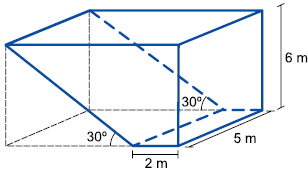
Relembrando que seno, cosseno e tangente de 30° são iguais a \( \dfrac{1}{2} \),\( \dfrac{\sqrt{3}}{2} \), \( \dfrac{\sqrt{3}}{3} \)respectivamente, o volume do reservatório, em m3, é igual a
Provas
O sistema de equações a seguir é composto por uma equação linear e uma equação logarítmica, na base 10.
\( \begin{cases} x - y = -20\\ log(x+y)=2 \end{cases} \)
Sendo (x, y) a solução do sistema, o valor de y ÷ x é igual a
Provas
A figura representa, no plano cartesiano, a trajetória de uma bola que foi chutada a partir do ponto P(–5, 0), localizado no chão, e seguiu em trajetória parabólica até bater na parede, no ponto Q(0, 2). Se não houvesse parede, a bola seguiria sua trajetória até o ponto R(1, 0), no chão.
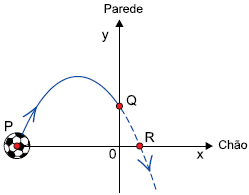
Admitindo-se que a trajetória descrita pela bola é modelada pela função quadrática f(x) = ax2 + bx + c, então a + b + c é igual a
Provas
- GeometriaGeometria PlanaCircunferências e CírculosÁrea do círculo, do setor circular e do segmento circular
A figura indica uma circunferência de centro (4, 4) e raio 4, tangente aos eixos do plano cartesiano, e uma reta que passa pela origem do sistema de eixos e pelo centro da circunferência.
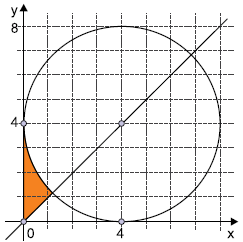
Sabendo que a área de um círculo é dada por \( \pi r^2 \), a área da região destacada em laranja na figura, em unidades de área do plano cartesiano, é igual a:
Provas
Dois jogadores, A e B, disputaram a final de um torneio de xadrez em dois jogos. Em cada partida, se ocorresse empate, cada jogador ganharia 1 ponto, caso contrário, o vencedor ganharia 2 pontos e o perdedor perderia 1 ponto. As matrizes que indicaram a pontuação obtida por cada jogador tinham, ambas, a seguinte estrutura:
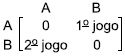
No caso do jogador A, sua matriz de pontuação foi:

Se a matriz de pontuação do jogador B era igual a matriz resultante da multiplicação matricial \( \begin{bmatrix} 0 & 1 \\-1 & 0 \end{bmatrix} \),\( \begin{bmatrix} x & y \\ z & w \end{bmatrix} \), então x + y + z + w é igual a
Provas
A figura representa uma arquibancada com degraus de mesma altura (x metros) e mesma extensão (y metros).
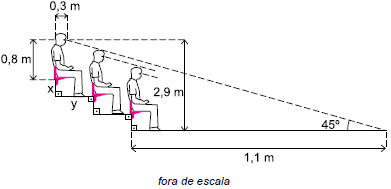
O valor de x + y será igual a
Provas
Considere o logotipo da Famema.

Admita que esse logotipo seja feito a partir da figura a seguir, sendo r e s retas paralelas, assim como as retas t e u.
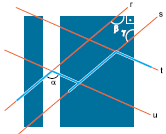
Se α + β + γ = 380º, então α é igual a
Provas
Caderno Container