Foram encontradas 80 questões.
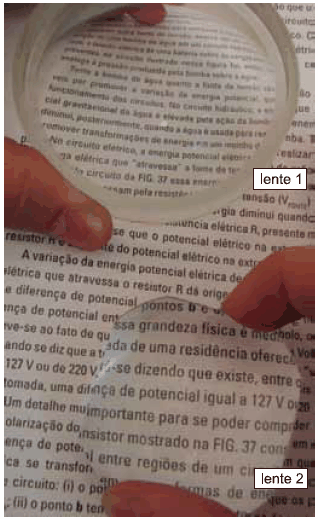
Na figura, um texto é visto através de duas lentes esféricas, 1 e 2. A imagem formada pela lente 1 aparece menor do que o próprio texto e a imagem formada pela lente 2 aparece maior.
(http://pontociencia.org.br. Adaptado.)
Pela observação da figura, constata-se que a lente 1 é e a imagem por ela formada é e que a lente 2 é e a imagem por ela formada é .
Assinale a alternativa que preenche, correta e respectivamente, as lacunas apresentadas acima.
Provas
Questão presente nas seguintes provas

729350
Ano: 2015
Disciplina: Literatura Brasileira e Estrangeira
Banca: VUNESP
Orgão: FAMERP
Disciplina: Literatura Brasileira e Estrangeira
Banca: VUNESP
Orgão: FAMERP
Provas:
Leia o poema de Álvares de Azevedo para responder a questão a seguir.
Se eu morresse amanhã!
Se eu morresse amanhã, viria ao menos
Fechar meus olhos minha triste irmã;
Minha mãe de saudades morreria
Se eu morresse amanhã!
Quanta glória pressinto em meu futuro!
Que aurora de porvir e que manhã!
Eu perdera chorando essas coroas
Se eu morresse amanhã!
Que sol! que céu azul! que doce n’alva
Acorda a natureza mais louçã!
Não me batera tanto amor no peito,
Se eu morresse amanhã!
Mas essa dor da vida que devora
A ânsia de glória, o dolorido afã…
A dor no peito emudecera ao menos
Se eu morresse amanhã!
(Lira dos vinte anos, 2000.)
Uma característica do eu lírico do poema é
Provas
Questão presente nas seguintes provas
Para realizar um experimento no litoral, um cientista precisa de 8 litros de água a 80 ºC. Como não dispõe de um termômetro, decide misturar uma porção de água a 0 ºC com outra a 100 ºC. Ele obtém água a 0 ºC a partir de uma mistura, em equilíbrio térmico, de água líquida com gelo fundente, e água a 100 ºC, a partir de água em ebulição. Considerando que haja troca de calor apenas entre as duas porções de água, os volumes, em litros, de água a 0 ºC e de água a 100 ºC que o cientista deve misturar para obter água a 80 ºC são iguais, respectivamente, a
Provas
Questão presente nas seguintes provas
Social life in youth may impact health decades later
Robert Preidt
August 6, 2015
Having good social connections at age 20 can lead to improved well-being later in life, a new study suggests. Previous research has shown that people with poor social links are at increased risk for early death. “In fact, having few social connections is equivalent to tobacco use, and [the risk is] higher than for those who drink excessive amounts of alcohol, or who suffer from obesity,” study author Cheryl Carmichael, who conducted the study while a doctoral candidate at the University of Rochester in New York, said in a university news release.
The study included 133 people who enrolled when they were 20-year-old college students in the 1970s. The participants kept track of their daily social interactions at ages 20 and 30. At age 50, they completed an online survey about the quality of their social lives and emotional well-being, including questions about loneliness and depression, and their relationships with close friends.
The findings showed that frequent social interactions at age 20 and good-quality relationships – defined as intimate and satisfying – at age 30 were associated with higher levels of well-being at age 50. The study findings were published in a recent issue of the journal Psychology and Aging.
A high number of social interactions at age 20 are beneficial later in life because they help young adults determine who they are, the researchers said. “It’s often around this age that we meet people from diverse backgrounds, with opinions and values that are different from our own, and we learn how to best manage those differences,” said Carmichael, now an assistant professor of psychology at Brooklyn College. “Considering everything else that goes on in life over those 30 years – marriage, raising a family and building a career – it is extraordinary that there appears to be a relationship between the kinds of interactions college students and young adults have and their emotional health later in life,” she concluded.
(www.nlm.nih.gov)
The study results indicate that 50 year-old people who displayed a higher degree of welfare
Provas
Questão presente nas seguintes provas
Social life in youth may impact health decades later
Robert Preidt
August 6, 2015
Having good social connections at age 20 can lead to improved well-being later in life, a new study suggests. Previous research has shown that people with poor social links are at increased risk for early death. “In fact, having few social connections is equivalent to tobacco use, and [the risk is] higher than for those who drink excessive amounts of alcohol, or who suffer from obesity,” study author Cheryl Carmichael, who conducted the study while a doctoral candidate at the University of Rochester in New York, said in a university news release.
The study included 133 people who enrolled when they were 20-year-old college students in the 1970s. The participants kept track of their daily social interactions at ages 20 and 30. At age 50, they completed an online survey about the quality of their social lives and emotional well-being, including questions about loneliness and depression, and their relationships with close friends.
The findings showed that frequent social interactions at age 20 and good-quality relationships – defined as intimate and satisfying – at age 30 were associated with higher levels of well-being at age 50. The study findings were published in a recent issue of the journal Psychology and Aging.
A high number of social interactions at age 20 are beneficial later in life because they help young adults determine who they are, the researchers said. “It’s often around this age that we meet people from diverse backgrounds, with opinions and values that are different from our own, and we learn how to best manage those differences,” said Carmichael, now an assistant professor of psychology at Brooklyn College. “Considering everything else that goes on in life over those 30 years – marriage, raising a family and building a career – it is extraordinary that there appears to be a relationship between the kinds of interactions college students and young adults have and their emotional health later in life,” she concluded.
(www.nlm.nih.gov)
No trecho do quarto parágrafo “they help young adults”, o termo em destaque refere-se a
Provas
Questão presente nas seguintes provas
A figura representa uma pirâmide com base quadrada ABCD de lado x, e altura !$ \overline{AE} !$ de medida !$ \dfrac{3x}{4} !$.
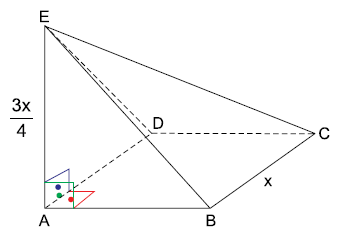
Se o volume dessa pirâmide é igual a 54 cm3, x é igual a
Provas
Questão presente nas seguintes provas
(Antonio J. T. Guerra (org.). “Processos erosivos nas encostas”.
In: Antonio J. T. Guerra e Sandra B. Cunha. Geomorfologia, 2012. Adaptado.)
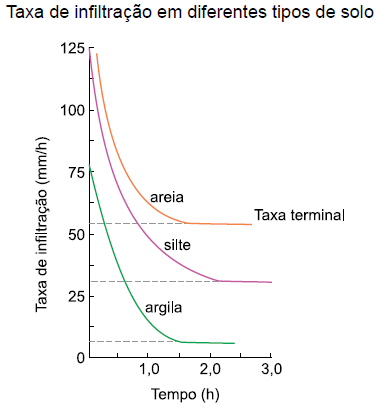
Considerando a leitura do gráfico e os conhecimentos acerca da formação dos solos, é correto afirmar que o escoamento
Provas
Questão presente nas seguintes provas
Leia o texto para responder a questão a seguir.
W.H.O. calls ‘vaccine hesitancy’ an increasing concern globally
Rick Gladstone
August 18, 2015
The World Health Organization warned Tuesday of what it called the growing problem of “vaccine hesitancy,” when people delay or refuse vaccines for themselves or their children. In a statement on its website, the organization called the problem “a growing challenge for countries seeking to close the immunization gap.” Globally, the organization said, one in five children still do not receive routine lifesaving immunizations, and 1.5 million children die each year of diseases that could have been thwarted by vaccines.
(www.nytimes.com)
De acordo com a Organização Mundial da Saúde,
Provas
Questão presente nas seguintes provas
Em uma atividade experimental, um estudante é desafiado a descobrir a resistência elétrica ôhmica do conteúdo de uma caixa que esconde componentes do circuito elétrico representado na figura. Além do conteúdo da caixa, o circuito é constituído por dois resistores ôhmicos, um gerador ideal, um amperímetro ideal e fios de resistência desprezível.
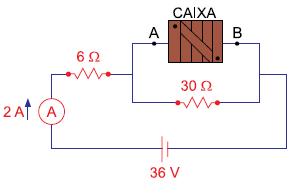
O estudante observa que, quando o circuito está em funcionamento, o amperímetro indica 2 A. Considerando essas informações, a resistência equivalente dos resistores associados dentro da caixa é igual a
Provas
Questão presente nas seguintes provas
Leia o texto para responder a questão a seguir.
W.H.O. calls ‘vaccine hesitancy’ an increasing concern globally
Rick Gladstone
August 18, 2015
The World Health Organization warned Tuesday of what it called the growing problem of “vaccine hesitancy,” when people delay or refuse vaccines for themselves or their children. In a statement on its website, the organization called the problem “a growing challenge for countries seeking to close the immunization gap.” Globally, the organization said, one in five children still do not receive routine lifesaving immunizations, and 1.5 million children die each year of diseases that could have been thwarted by vaccines.
(www.nytimes.com)
According to the text, “vaccine hesitancy”
Provas
Questão presente nas seguintes provas
Cadernos
Caderno Container