Foram encontradas 50 questões.
High-flying ideas?
A camera-equipped drone flies around the outskirts of Seoul, South Korea, hovering near an industrial plant and capturing video of pollutants. Below, on the crowded, litter-covered streets, residents wear white and black masks that cover their noses and mouths. A gray haze hangs in the sky.
The unmanned aerial vehicle, or UAV, is part of a pilot program by South Korea’s Ministry of Environment. Tasked with inspecting factory emissions in the capital’s greater metropolitan area, it’s the latest in a series of tech solutions aimed at solving Seoul’s dust dilemma. In fact, the fine dust has South Koreans so concerned they’ve cited it as their No. 1 stressor in life – more distressing than the country’s economic stagnation, its rapidly aging population and even North Korea’s erratic dictator and nuclear weapons program.
Their worries are well-founded. The World Health Organization (WHO) advises exposure to fine dust, or PM10, of no more than a daily average of 50 micrograms per cubic meter, and to ultra-fine dust, or PM2.5, of no more than 25. At one point in 2017, Seoul’s PM10 hit 179. In late March 2018, Seoul’s PM2.5 soared to over 100. PM2.5 is of greatest concern. So small it can get lodged into the lungs and penetrate the lining to enter the bloodstream, PM2.5 is comprised of black carbon, nitrates, ammonia and other harmful compounds linked to respiratory diseases and cancer. The WHO has classified fine and ultra-fine dust as carcinogenic since 2013.
Developed by the government-run National Institute of Environmental Research, the drone is the first of what the environment ministry intends to be a fleet deployed nationwide. Some South Korean tech companies, too, are stepping in with their own innovations. Although much of the new tech appears promising, Greenpeace’s Seoul office stresses the importance of addressing the root of the problem. Part of the solution is getting residents to recognize their own role in curbing carbon output. So, even though the new fixes may do a good job of measuring dust, what about actually busting it? That’s where the technology hasn’t quite caught up yet.
(Ann Babe. www.usnews.com, 08.08.2018. Adapted.)
The text concludes by stating that tech innovations in South Korea
Provas

High-flying ideas?
A camera-equipped drone flies around the outskirts of Seoul, South Korea, hovering near an industrial plant and capturing video of pollutants. Below, on the crowded, litter-covered streets, residents wear white and black masks that cover their noses and mouths. A gray haze hangs in the sky.
The unmanned aerial vehicle, or UAV, is part of a pilot program by South Korea’s Ministry of Environment. Tasked with inspecting factory emissions in the capital’s greater metropolitan area, it’s the latest in a series of tech solutions aimed at solving Seoul’s dust dilemma. In fact, the fine dust has South Koreans so concerned they’ve cited it as their No. 1 stressor in life – more distressing than the country’s economic stagnation, its rapidly aging population and even North Korea’s erratic dictator and nuclear weapons program.
Their worries are well-founded. The World Health Organization (WHO) advises exposure to fine dust, or PM10, of no more than a daily average of 50 micrograms per cubic meter, and to ultra-fine dust, or PM2.5, of no more than 25. At one point in 2017, Seoul’s PM10 hit 179. In late March 2018, Seoul’s PM2.5 soared to over 100. PM2.5 is of greatest concern. So small it can get lodged into the lungs and penetrate the lining to enter the bloodstream, PM2.5 is comprised of black carbon, nitrates, ammonia and other harmful compounds linked to respiratory diseases and cancer. The WHO has classified fine and ultra-fine dust as carcinogenic since 2013.
Developed by the government-run National Institute of Environmental Research, the drone is the first of what the environment ministry intends to be a fleet deployed nationwide. Some South Korean tech companies, too, are stepping in with their own innovations. Although much of the new tech appears promising, Greenpeace’s Seoul office stresses the importance of addressing the root of the problem. Part of the solution is getting residents to recognize their own role in curbing carbon output. So, even though the new fixes may do a good job of measuring dust, what about actually busting it? That’s where the technology hasn’t quite caught up yet.
(Ann Babe. www.usnews.com, 08.08.2018. Adapted.)
According to the third paragraph, PM2.5 is currently a topic of greatest concern in Seoul because
Provas
High-flying ideas?
A camera-equipped drone flies around the outskirts of Seoul, South Korea, hovering near an industrial plant and capturing video of pollutants. Below, on the crowded, litter-covered streets, residents wear white and black masks that cover their noses and mouths. A gray haze hangs in the sky.
The unmanned aerial vehicle, or UAV, is part of a pilot program by South Korea’s Ministry of Environment. Tasked with inspecting factory emissions in the capital’s greater metropolitan area, it’s the latest in a series of tech solutions aimed at solving Seoul’s dust dilemma. In fact, the fine dust has South Koreans so concerned they’ve cited it as their No. 1 stressor in life – more distressing than the country’s economic stagnation, its rapidly aging population and even North Korea’s erratic dictator and nuclear weapons program.
Their worries are well-founded. The World Health Organization (WHO) advises exposure to fine dust, or PM10, of no more than a daily average of 50 micrograms per cubic meter, and to ultra-fine dust, or PM2.5, of no more than 25. At one point in 2017, Seoul’s PM10 hit 179. In late March 2018, Seoul’s PM2.5 soared to over 100. PM2.5 is of greatest concern. So small it can get lodged into the lungs and penetrate the lining to enter the bloodstream, PM2.5 is comprised of black carbon, nitrates, ammonia and other harmful compounds linked to respiratory diseases and cancer. The WHO has classified fine and ultra-fine dust as carcinogenic since 2013.
Developed by the government-run National Institute of Environmental Research, the drone is the first of what the environment ministry intends to be a fleet deployed nationwide. Some South Korean tech companies, too, are stepping in with their own innovations. Although much of the new tech appears promising, Greenpeace’s Seoul office stresses the importance of addressing the root of the problem. Part of the solution is getting residents to recognize their own role in curbing carbon output. So, even though the new fixes may do a good job of measuring dust, what about actually busting it? That’s where the technology hasn’t quite caught up yet.
(Ann Babe. www.usnews.com, 08.08.2018. Adapted.)
The pilot program mentioned in the second paragraph uses UAVs primarily to
Provas
High-flying ideas?
A camera-equipped drone flies around the outskirts of Seoul, South Korea, hovering near an industrial plant and capturing video of pollutants. Below, on the crowded, litter-covered streets, residents wear white and black masks that cover their noses and mouths. A gray haze hangs in the sky.
The unmanned aerial vehicle, or UAV, is part of a pilot program by South Korea’s Ministry of Environment. Tasked with inspecting factory emissions in the capital’s greater metropolitan area, it’s the latest in a series of tech solutions aimed at solving Seoul’s dust dilemma. In fact, the fine dust has South Koreans so concerned they’ve cited it as their No. 1 stressor in life – more distressing than the country’s economic stagnation, its rapidly aging population and even North Korea’s erratic dictator and nuclear weapons program.
Their worries are well-founded. The World Health Organization (WHO) advises exposure to fine dust, or PM10, of no more than a daily average of 50 micrograms per cubic meter, and to ultra-fine dust, or PM2.5, of no more than 25. At one point in 2017, Seoul’s PM10 hit 179. In late March 2018, Seoul’s PM2.5 soared to over 100. PM2.5 is of greatest concern. So small it can get lodged into the lungs and penetrate the lining to enter the bloodstream, PM2.5 is comprised of black carbon, nitrates, ammonia and other harmful compounds linked to respiratory diseases and cancer. The WHO has classified fine and ultra-fine dust as carcinogenic since 2013.
Developed by the government-run National Institute of Environmental Research, the drone is the first of what the environment ministry intends to be a fleet deployed nationwide. Some South Korean tech companies, too, are stepping in with their own innovations. Although much of the new tech appears promising, Greenpeace’s Seoul office stresses the importance of addressing the root of the problem. Part of the solution is getting residents to recognize their own role in curbing carbon output. So, even though the new fixes may do a good job of measuring dust, what about actually busting it? That’s where the technology hasn’t quite caught up yet.
(Ann Babe. www.usnews.com, 08.08.2018. Adapted.)
The text deals with a main public interest issue in South Korea related to
Provas
O gráfico mostra a evolução e a projeção do custo (em dólares por kWh) e da densidade energética (em Wh por L) das baterias utilizadas em carros elétricos.
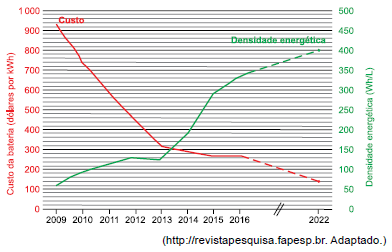
Com base no gráfico, no ano de 2009, uma bateria de 30 kWh custava em torno 28 000 dólares e tinha volume de 500 litros. Dado que 1 kWh é igual a 1 000 Wh, e de acordo com essa projeção, no ano de 2022, uma bateria de 30 kWh terá um custo e um volume iguais a
Provas
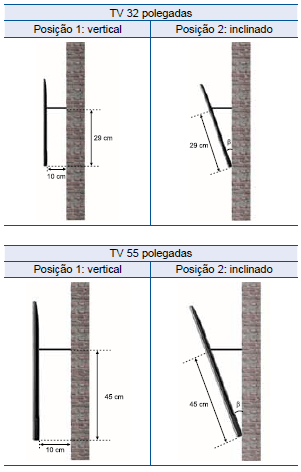
Uma empresa desenvolveu um suporte para fixação de televisores (TVs) em paredes. O suporte pode ser utilizado em TVs de 32 até 55 polegadas e permite que o aparelho fique na vertical ou inclinado, conforme a ilustração, em que !$ \beta !$ refere- se ao ângulo máximo de inclinação.
Considere os seguintes valores aproximados para seno, cosseno e tangente:
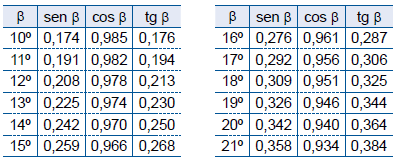
A diferença entre o ângulo máximo de inclinação da TV de 32 polegadas e da TV de 55 polegadas é um valor entre
Provas
Em uma palestra, um cientista ilustrou comparativamente o tamanho dos planetas do sistema solar com auxílio da foto a seguir.
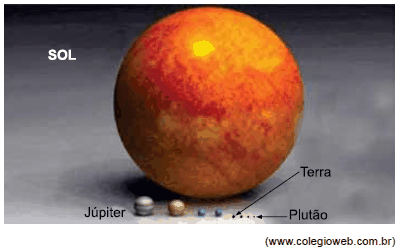
No entanto, o cientista disse que essa foto dificulta a percepção correta da diferença de tamanho entre os planetas. Para ilustrar o que dizia, ele pediu para a plateia considerar que todos os planetas são esféricos e que o tamanho do raio do planeta Júpiter é 11 vezes o tamanho do raio do planeta Terra. Em seguida, lançou a seguinte pergunta: se associarmos o planeta Terra a uma bola de futebol, o planeta Júpiter deverá ser associado, aproximadamente, a quantas dessas bolas?
A resposta correta para a pergunta do palestrante é
Provas
- GeometriaGeometria PlanaCircunferências e CírculosÁrea do círculo, do setor circular e do segmento circular
Já funciona no extremo sul da costa brasileira um radar capaz de detectar e identificar embarcações em alto-mar depois da curvatura da Terra. Feito com apoio da Marinha, o radar OTH chega a acompanhar o tráfego de navios a cerca de 370 km da costa.
(http://revistapesquisa.fapesp.br, 24.08.2018. Adaptado.)
O feixe de ondas desse radar fornece uma cobertura de 120 graus a partir da antena transmissora, conforme exemplificado na ilustração:
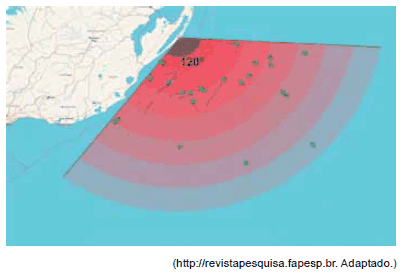
Considere que a área de cobertura indicada na figura represente um setor circular no plano. De acordo com os dados, a área de cobertura desse radar é um valor entre
Provas
O princípio de Hardy-Weinberg é utilizado no estudo da genética de populações. Por meio desse princípio, é possível predizer as frequências genotípicas de homozigotos e heterozigotos, a partir da frequência dos alelos observada em uma amostra da população.
Considerando que a frequência do alelo A é p e que a frequência do alelo a é q, de modo que p + q = 1, as frequências (f) para cada um dos possíveis genótipos (AA, Aa e aa) podem ser descritas pelas curvas presentes no gráfico:
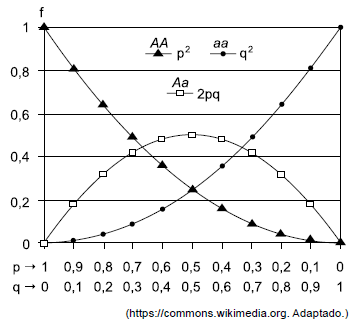
A curva obtida para o genótipo Aa, cuja frequência f é igual a 2pq, forma uma parábola que pode ser descrita, em função de p, pela expressão:
Provas
O princípio de Hardy-Weinberg é utilizado no estudo da genética de populações. Por meio desse princípio, é possível predizer as frequências genotípicas de homozigotos e heterozigotos, a partir da frequência dos alelos observada em uma amostra da população.
Considerando que a frequência do alelo A é p e que a frequência do alelo a é q, de modo que p + q = 1, as frequências (f) para cada um dos possíveis genótipos (AA, Aa e aa) podem ser descritas pelas curvas presentes no gráfico:
Se em uma população a frequência p é 0,7, então a frequência do genótipo AA é
Provas
Caderno Container