Foram encontradas 60 questões.
Read the text below.
If those who declare that there is no best method are asked why, the most immediate and frequent answer is likely to be "Because it all depends," meaning that what is best depends on whom the method is for, in what circumstances, for what purpose, and so on. That there is no best method therefore means that no single method is best for everyone, as there are important variations in the teaching context that influence what is best. The variations are of several kinds, relating to social situation, educational organization, teacher-related factors, and learner-related factors. There have been several attempts to categorize such variables systematically and comprehensively, but even the brief and random listing above shows that they are at different levels of generality, as well as of discreteness and tangibility.
PRABHU, N. S. There Is No Best Method-Why? TESOL Quarterly, Vol. 24, No. 2. (Summer, 1990), p. 161-176. [Adapted].
According to the text, the main reason why there is no best method in teaching is because
If those who declare that there is no best method are asked why, the most immediate and frequent answer is likely to be "Because it all depends," meaning that what is best depends on whom the method is for, in what circumstances, for what purpose, and so on. That there is no best method therefore means that no single method is best for everyone, as there are important variations in the teaching context that influence what is best. The variations are of several kinds, relating to social situation, educational organization, teacher-related factors, and learner-related factors. There have been several attempts to categorize such variables systematically and comprehensively, but even the brief and random listing above shows that they are at different levels of generality, as well as of discreteness and tangibility.
PRABHU, N. S. There Is No Best Method-Why? TESOL Quarterly, Vol. 24, No. 2. (Summer, 1990), p. 161-176. [Adapted].
According to the text, the main reason why there is no best method in teaching is because
Provas
Questão presente nas seguintes provas

Observe the images below.
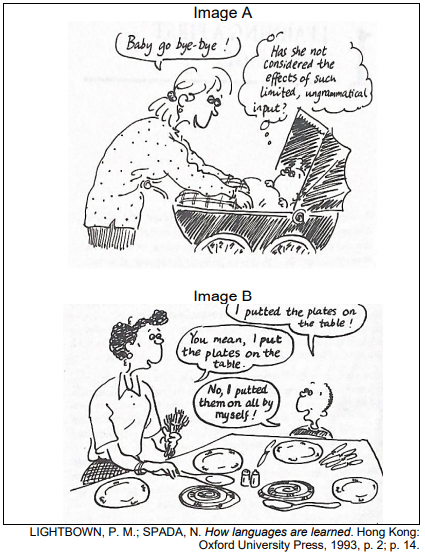
The cartoons refer to two different theoretical views regarding language acquisition/learning that serve as the base for some well-known methods of language teaching. Comparing both images, what can be affirmed about these two theories?
Provas
Questão presente nas seguintes provas
Text 6
One of the popular myths about the English language is that
somewhere people are still speaking the kind of English that
Chaucer or Shakespeare or Milton spoke. This myth does, of
course, have some foundation in fact, though the mythical
versions repeated above are gross exaggerations. The relevant
fact is that some regional dialects of English retain old forms
which have disappeared from the standard form of the language.
This conservatism in colonial varieties is, rather unfortunately,
termed 'colonial lag' - unfortunately because the term gives the
impression that the colonial variety will (or should) one day catch
up with the home variety, though this is unlikely ever to happen.
Colonial lag is a potential factor in distinguishing colonial
varieties from their home counterparts in all levels of language:
phonology, morphology, syntax, semantics and lexis.
BAUER, L. An Introduction to International Varieties of English. Hong Kong
University Press, Hong Kong, 2003. [Adapted].
Provas
Questão presente nas seguintes provas
Text 6
One of the popular myths about the English language is that
somewhere people are still speaking the kind of English that
Chaucer or Shakespeare or Milton spoke. This myth does, of
course, have some foundation in fact, though the mythical
versions repeated above are gross exaggerations. The relevant
fact is that some regional dialects of English retain old forms
which have disappeared from the standard form of the language.
This conservatism in colonial varieties is, rather unfortunately,
termed 'colonial lag' - unfortunately because the term gives the
impression that the colonial variety will (or should) one day catch
up with the home variety, though this is unlikely ever to happen.
Colonial lag is a potential factor in distinguishing colonial
varieties from their home counterparts in all levels of language:
phonology, morphology, syntax, semantics and lexis.
BAUER, L. An Introduction to International Varieties of English. Hong Kong
University Press, Hong Kong, 2003. [Adapted].
Provas
Questão presente nas seguintes provas
Text 5
When I made my way to college, I was truly astonished to find
teachers who appeared to derive their primary pleasure in the
classroom by exercising their authoritarian power over my fellow
students, crushing our spirits, and dehumanizing our minds and
bodies. I had chosen to attend Stanford University, a predominantly
white college (primarily because the financial aid packages were
better than those offered by black institutions), but I never once
considered what it would be like to study with teachers who were
racist. Even though I had attended a high school with outspokenly
racist teachers who were contemptuous and unkind, I had
romanticized college. I believed it would be a paradise of learning
where we would all be so busy studying that we’d never have time
for the petty things of this world, especially not racism.
HOOKS, B. Teaching critical thinking: practical wisdom. New York: Routledge,
2010, p. 2.
Provas
Questão presente nas seguintes provas
Text 5
When I made my way to college, I was truly astonished to find
teachers who appeared to derive their primary pleasure in the
classroom by exercising their authoritarian power over my fellow
students, crushing our spirits, and dehumanizing our minds and
bodies. I had chosen to attend Stanford University, a predominantly
white college (primarily because the financial aid packages were
better than those offered by black institutions), but I never once
considered what it would be like to study with teachers who were
racist. Even though I had attended a high school with outspokenly
racist teachers who were contemptuous and unkind, I had
romanticized college. I believed it would be a paradise of learning
where we would all be so busy studying that we’d never have time
for the petty things of this world, especially not racism.
HOOKS, B. Teaching critical thinking: practical wisdom. New York: Routledge,
2010, p. 2.
Provas
Questão presente nas seguintes provas
Text 4
It seems to me, having been involved for many years with
teaching English as a so-called second or foreign language, that
there are deep and indissoluble links between the practices,
theories, and contexts of ELT and the history of colonialism.
Such connections, I want to suggest, run far deeper than
drawing parallels between the current global expansion of
English and the colonial expansion that preceded it. Rather, I
want to argue that ELT theories and practices that emanate from
the former colonial powers still carry the traces of those colonial
histories both because of the long history of direct connections
between ELT and colonialism and because such theories and
practices derive from broader European cultures and ideologies
that themselves are products of colonialism.
PENNYCOOK, A. English and the discourses of colonialism. London:
Routledge, 2002, p. 19.
Provas
Questão presente nas seguintes provas
Text 4
It seems to me, having been involved for many years with
teaching English as a so-called second or foreign language, that
there are deep and indissoluble links between the practices,
theories, and contexts of ELT and the history of colonialism.
Such connections, I want to suggest, run far deeper than
drawing parallels between the current global expansion of
English and the colonial expansion that preceded it. Rather, I
want to argue that ELT theories and practices that emanate from
the former colonial powers still carry the traces of those colonial
histories both because of the long history of direct connections
between ELT and colonialism and because such theories and
practices derive from broader European cultures and ideologies
that themselves are products of colonialism.
PENNYCOOK, A. English and the discourses of colonialism. London:
Routledge, 2002, p. 19.
Provas
Questão presente nas seguintes provas
Read the cartoon strip below.
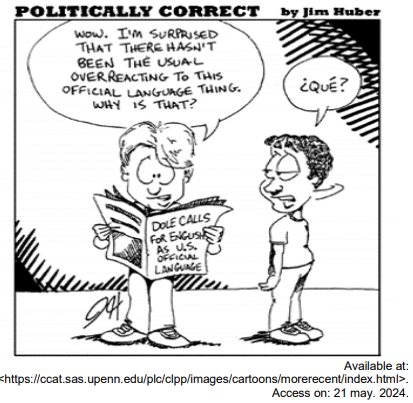
Regarding the spread of English as a world language or Lingua Franca and also its use in the U.S., the humor conveyed by the punchline is due to
Provas
Questão presente nas seguintes provas
Image 1

Provas
Questão presente nas seguintes provas
Cadernos
Caderno Container