Foram encontradas 40 questões.
READ TEXT II AND ANSWER QUESTIONS 14 TO 20:
TEXT II
THE CEREALS
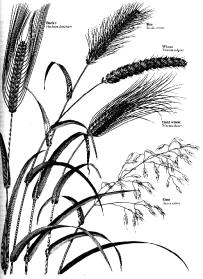
Cereals are the staff of life for most of mankind.
Even our milk and our meat derive largely from them.
They are grasses nurtured and bred by man so that their
grain is large and nourishing. Except in parts of the
5tropics where such roots as tapioca and yams are the
staple carbohydrate, and in wet cold places where the
potato plugs the gap, wheat, barley, oats, rye, rice,
maize and sorghum are what keeps us all alive and
kicking.
The cereals have all been bred from wild grasses,
and bred so far away from their parent stocks that they
are now distinct species. In fact it is sometimes difficult
to guess which wild grass a particular cereal is derived
from, and, in some cases, maize for example, the wild
15species is now probably extinct.
(from Seymour, John. The Complete Book of Self-Sufficiency,London: Faber & Faber, 1980: 56)
The plural of life (l.1) is:
Provas

READ TEXT II AND ANSWER QUESTIONS 14 TO 20:
TEXT II
THE CEREALS
Cereals are the staff of life for most of mankind.
Even our milk and our meat derive largely from them.
They are grasses nurtured and bred by man so that their
grain is large and nourishing. Except in parts of the
5tropics where such roots as tapioca and yams are the
staple carbohydrate, and in wet cold places where the
potato plugs the gap, wheat, barley, oats, rye, rice,
maize and sorghum are what keeps us all alive and
kicking.
The cereals have all been bred from wild grasses,
and bred so far away from their parent stocks that they
are now distinct species. In fact it is sometimes difficult
to guess which wild grass a particular cereal is derived
from, and, in some cases, maize for example, the wild
15species is now probably extinct.
(from Seymour, John. The Complete Book of Self-Sufficiency,London: Faber & Faber, 1980: 56)
The author says that cereals initially came from:
Provas
READ TEXT II AND ANSWER QUESTIONS 14 TO 20:
TEXT II
THE CEREALS
Cereals are the staff of life for most of mankind.
Even our milk and our meat derive largely from them.
They are grasses nurtured and bred by man so that their
grain is large and nourishing. Except in parts of the
5tropics where such roots as tapioca and yams are the
staple carbohydrate, and in wet cold places where the
potato plugs the gap, wheat, barley, oats, rye, rice,
maize and sorghum are what keeps us all alive and
kicking.
The cereals have all been bred from wild grasses,
and bred so far away from their parent stocks that they
are now distinct species. In fact it is sometimes difficult
to guess which wild grass a particular cereal is derived
from, and, in some cases, maize for example, the wild
15species is now probably extinct.
(from Seymour, John. The Complete Book of Self-Sufficiency,London: Faber & Faber, 1980: 56)
The function of the text is to:
Provas
READ TEXT II AND ANSWER QUESTIONS 14 TO 20:
TEXT II
THE CEREALS
Cereals are the staff of life for most of mankind.
Even our milk and our meat derive largely from them.
They are grasses nurtured and bred by man so that their
grain is large and nourishing. Except in parts of the
5tropics where such roots as tapioca and yams are the
staple carbohydrate, and in wet cold places where the
potato plugs the gap, wheat, barley, oats, rye, rice,
maize and sorghum are what keeps us all alive and
kicking.
The cereals have all been bred from wild grasses,
and bred so far away from their parent stocks that they
are now distinct species. In fact it is sometimes difficult
to guess which wild grass a particular cereal is derived
from, and, in some cases, maize for example, the wild
15species is now probably extinct.
(from Seymour, John. The Complete Book of Self-Sufficiency,London: Faber & Faber, 1980: 56)
The author states that in the tropics:
Provas
READ TEXT II AND ANSWER QUESTIONS 14 TO 20:
TEXT II
THE CEREALS
Cereals are the staff of life for most of mankind.
Even our milk and our meat derive largely from them.
They are grasses nurtured and bred by man so that their
grain is large and nourishing. Except in parts of the
5tropics where such roots as tapioca and yams are the
staple carbohydrate, and in wet cold places where the
potato plugs the gap, wheat, barley, oats, rye, rice,
maize and sorghum are what keeps us all alive and
kicking.
The cereals have all been bred from wild grasses,
and bred so far away from their parent stocks that they
are now distinct species. In fact it is sometimes difficult
to guess which wild grass a particular cereal is derived
from, and, in some cases, maize for example, the wild
15species is now probably extinct.
(from Seymour, John. The Complete Book of Self-Sufficiency,London: Faber & Faber, 1980: 56)
The word sometimes in "it is sometimes difficult..." (l.12) can be replaced by:
Provas
READ TEXT II AND ANSWER QUESTIONS 14 TO 20:
TEXT II
THE CEREALS
Cereals are the staff of life for most of mankind.
Even our milk and our meat derive largely from them.
They are grasses nurtured and bred by man so that their
grain is large and nourishing. Except in parts of the
5tropics where such roots as tapioca and yams are the
staple carbohydrate, and in wet cold places where the
potato plugs the gap, wheat, barley, oats, rye, rice,
maize and sorghum are what keeps us all alive and
kicking.
The cereals have all been bred from wild grasses,
and bred so far away from their parent stocks that they
are now distinct species. In fact it is sometimes difficult
to guess which wild grass a particular cereal is derived
from, and, in some cases, maize for example, the wild
15species is now probably extinct.
(from Seymour, John. The Complete Book of Self-Sufficiency,London: Faber & Faber, 1980: 56)
In "In fact it is sometimes difficult..." (l.12), the underlined expression means:
Provas
Leia o texto.
BOTANICAL GARDENS.
The original concept of a botanical garden was that literally implied by the name; that is, a garden with the plants arranged according to some system of botanical classification. In the forerunners of the modern botanical garden, such as the gardens of simples commonly associated with schools of medicine in the 16th and 17th centuries, the planting was primitive and possibly based on the use of the plants, in medicine or otherwise, rather than on the more or less crude botanical concepts of the time. A botanical garden differs from a park, where the plants are usually arranged solely with reference to securing a beautiful landscape effect. The primary purpose of a park, moreover, is recreation, while that of a botanical garden has always been science and education. A botanical garden is properly defined as a scientific and educational institution whose purpose is the advancement and diffusion of a knowledge and love of plants.
(Enclyclopaedia Britannica, vol. 3: 942)
A palavra sublinhada em “while that of a botanical garden...” substitui:
Provas
Leia o texto.
BOTANICAL GARDENS.
The original concept of a botanical garden was that literally implied by the name; that is, a garden with the plants arranged according to some system of botanical classification. In the forerunners of the modern botanical garden, such as the gardens of simples commonly associated with schools of medicine in the 16th and 17th centuries, the planting was primitive and possibly based on the use of the plants, in medicine or otherwise, rather than on the more or less crude botanical concepts of the time. A botanical garden differs from a park, where the plants are usually arranged solely with reference to securing a beautiful landscape effect. The primary purpose of a park, moreover, is recreation, while that of a botanical garden has always been science and education. A botanical garden is properly defined as a scientific and educational institution whose purpose is the advancement and diffusion of a knowledge and love of plants.
(Enclyclopaedia Britannica, vol. 3: 942)
A expressão such as em “such as the gardens ...” introduz um (a):
Provas
Leia o Texto
BOTANICAL GARDENS. The original concept of a botanical garden was that literally implied by the name; that is, a garden with the plants arranged according to some system of botanical classification. In the forerunners of the modern botanical garden, such as the gardens of simples commonly associated with schools of medicine in the 16th and 17th centuries, the planting was primitive and possibly based on the use of the plants, in medicine or otherwise, rather than on the more or less crude botanical concepts of the time. A botanical garden differs from a park, where the plants are usually arranged solely with reference to securing a beautiful landscape effect. The primary purpose of a park, moreover, is recreation, while that of a botanical garden has always been science and education. A botanical garden is properly defined as a scientific and educational institution whose purpose is the advancement and diffusion of a knowledge and love of plants.
(Enclyclopaedia Britannica, vol. 3: 942)
De acordo com o texto, diferentemente dos jardins botânicos, os parques têm por objetivo:
Provas
Texto
PLANTA
Dicionário de Símbolos
A planta simboliza a energia solar condensada e manifesta.
As plantas captam as forças ígneas da terra e recebem a energia solar. Elas acumulam essas forças; daí as suas propriedades curativas ou venenosas e seu emprego na magia.
Em relação com o princípio vital masculino, elas significam o crescimento, no sentido do Salmo 144, 12. Nossos filhos serão como plantas que crescem em sua juventude.
As plantas trazem as suas sementes. Algumas delas, tais como o hissopo, exercem um papel purificador.
As plantas simbolizam também a manifestação da energia em suas formas diversas, como a decomposição do espectro solar em cores variadas. Enquanto manifestação da vida, elas são inseparáveis da água, tanto quanto do Sol.
Os laços que unem os dois símbolos das águas e das plantas são fáceis de se compreender. As águas são portadoras de germes, de todos os germes. As plantas exprimem a manifestação do Cosmo, o aparecimento das formas. Aquilo que exprime o símbolo Lotus saindo das águas é o próprio fluxo cósmico. As águas aí representam o não-manifesto, os germes, as latências; o símbolo floral representa a manifestação, a criação cósmica. A planta, primeiro estágio da vida, simboliza, acima de tudo, o nascimento perpétuo, o fluxo incessante da energia vital.
Na tradição védica, se as plantas têm virtudes medicinais, é porque são elas próprias dádivas do céu e as raízes da vida. Invocam-nas como divindades.
"Enquanto manifestação da vida, elas são inseparáveis da água, tanto quanto do Sol"; a expressão tanto quanto indica:
Provas
Caderno Container