Foram encontradas 40 questões.
READ TEXT II AND ANSWER QUESTIONS 14 TO 20:
TEXT II
THE CEREALS
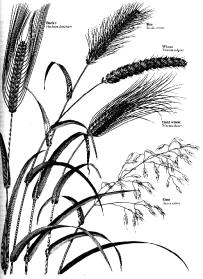
Cereals are the staff of life for most of mankind.
Even our milk and our meat derive largely from them.
They are grasses nurtured and bred by man so that their
grain is large and nourishing. Except in parts of the
5tropics where such roots as tapioca and yams are the
staple carbohydrate, and in wet cold places where the
potato plugs the gap, wheat, barley, oats, rye, rice,
maize and sorghum are what keeps us all alive and
kicking.
The cereals have all been bred from wild grasses,
and bred so far away from their parent stocks that they
are now distinct species. In fact it is sometimes difficult
to guess which wild grass a particular cereal is derived
from, and, in some cases, maize for example, the wild
15species is now probably extinct.
(from Seymour, John. The Complete Book of Self-Sufficiency,London: Faber & Faber, 1980: 56)
The opposite of wet in "in wet cold places" (l.6) is:
Provas

READ TEXT II AND ANSWER QUESTIONS 14 TO 20:
TEXT II
THE CEREALS
Cereals are the staff of life for most of mankind.
Even our milk and our meat derive largely from them.
They are grasses nurtured and bred by man so that their
grain is large and nourishing. Except in parts of the
5tropics where such roots as tapioca and yams are the
staple carbohydrate, and in wet cold places where the
potato plugs the gap, wheat, barley, oats, rye, rice,
maize and sorghum are what keeps us all alive and
kicking.
The cereals have all been bred from wild grasses,
and bred so far away from their parent stocks that they
are now distinct species. In fact it is sometimes difficult
to guess which wild grass a particular cereal is derived
from, and, in some cases, maize for example, the wild
15species is now probably extinct.
(from Seymour, John. The Complete Book of Self-Sufficiency,London: Faber & Faber, 1980: 56)
The plural of life (l.1) is:
Provas
READ TEXT II AND ANSWER QUESTIONS 14 TO 20:
TEXT II
THE CEREALS
Cereals are the staff of life for most of mankind.
Even our milk and our meat derive largely from them.
They are grasses nurtured and bred by man so that their
grain is large and nourishing. Except in parts of the
5tropics where such roots as tapioca and yams are the
staple carbohydrate, and in wet cold places where the
potato plugs the gap, wheat, barley, oats, rye, rice,
maize and sorghum are what keeps us all alive and
kicking.
The cereals have all been bred from wild grasses,
and bred so far away from their parent stocks that they
are now distinct species. In fact it is sometimes difficult
to guess which wild grass a particular cereal is derived
from, and, in some cases, maize for example, the wild
15species is now probably extinct.
(from Seymour, John. The Complete Book of Self-Sufficiency,London: Faber & Faber, 1980: 56)
The author says that cereals initially came from:
Provas
READ TEXT II AND ANSWER QUESTIONS 14 TO 20:
TEXT II
THE CEREALS
Cereals are the staff of life for most of mankind.
Even our milk and our meat derive largely from them.
They are grasses nurtured and bred by man so that their
grain is large and nourishing. Except in parts of the
5tropics where such roots as tapioca and yams are the
staple carbohydrate, and in wet cold places where the
potato plugs the gap, wheat, barley, oats, rye, rice,
maize and sorghum are what keeps us all alive and
kicking.
The cereals have all been bred from wild grasses,
and bred so far away from their parent stocks that they
are now distinct species. In fact it is sometimes difficult
to guess which wild grass a particular cereal is derived
from, and, in some cases, maize for example, the wild
15species is now probably extinct.
(from Seymour, John. The Complete Book of Self-Sufficiency,London: Faber & Faber, 1980: 56)
The function of the text is to:
Provas
READ TEXT II AND ANSWER QUESTIONS 14 TO 20:
TEXT II
THE CEREALS
Cereals are the staff of life for most of mankind.
Even our milk and our meat derive largely from them.
They are grasses nurtured and bred by man so that their
grain is large and nourishing. Except in parts of the
5tropics where such roots as tapioca and yams are the
staple carbohydrate, and in wet cold places where the
potato plugs the gap, wheat, barley, oats, rye, rice,
maize and sorghum are what keeps us all alive and
kicking.
The cereals have all been bred from wild grasses,
and bred so far away from their parent stocks that they
are now distinct species. In fact it is sometimes difficult
to guess which wild grass a particular cereal is derived
from, and, in some cases, maize for example, the wild
15species is now probably extinct.
(from Seymour, John. The Complete Book of Self-Sufficiency,London: Faber & Faber, 1980: 56)
The author states that in the tropics:
Provas
READ TEXT II AND ANSWER QUESTIONS 14 TO 20:
TEXT II
THE CEREALS
Cereals are the staff of life for most of mankind.
Even our milk and our meat derive largely from them.
They are grasses nurtured and bred by man so that their
grain is large and nourishing. Except in parts of the
5tropics where such roots as tapioca and yams are the
staple carbohydrate, and in wet cold places where the
potato plugs the gap, wheat, barley, oats, rye, rice,
maize and sorghum are what keeps us all alive and
kicking.
The cereals have all been bred from wild grasses,
and bred so far away from their parent stocks that they
are now distinct species. In fact it is sometimes difficult
to guess which wild grass a particular cereal is derived
from, and, in some cases, maize for example, the wild
15species is now probably extinct.
(from Seymour, John. The Complete Book of Self-Sufficiency,London: Faber & Faber, 1980: 56)
The word sometimes in "it is sometimes difficult..." (l.12) can be replaced by:
Provas
READ TEXT II AND ANSWER QUESTIONS 14 TO 20:
TEXT II
THE CEREALS
Cereals are the staff of life for most of mankind.
Even our milk and our meat derive largely from them.
They are grasses nurtured and bred by man so that their
grain is large and nourishing. Except in parts of the
5tropics where such roots as tapioca and yams are the
staple carbohydrate, and in wet cold places where the
potato plugs the gap, wheat, barley, oats, rye, rice,
maize and sorghum are what keeps us all alive and
kicking.
The cereals have all been bred from wild grasses,
and bred so far away from their parent stocks that they
are now distinct species. In fact it is sometimes difficult
to guess which wild grass a particular cereal is derived
from, and, in some cases, maize for example, the wild
15species is now probably extinct.
(from Seymour, John. The Complete Book of Self-Sufficiency,London: Faber & Faber, 1980: 56)
In "In fact it is sometimes difficult..." (l.12), the underlined expression means:
Provas
Leia o texto.
BOTANICAL GARDENS.
The original concept of a botanical garden was that literally implied by the name; that is, a garden with the plants arranged according to some system of botanical classification. In the forerunners of the modern botanical garden, such as the gardens of simples commonly associated with schools of medicine in the 16th and 17th centuries, the planting was primitive and possibly based on the use of the plants, in medicine or otherwise, rather than on the more or less crude botanical concepts of the time. A botanical garden differs from a park, where the plants are usually arranged solely with reference to securing a beautiful landscape effect. The primary purpose of a park, moreover, is recreation, while that of a botanical garden has always been science and education. A botanical garden is properly defined as a scientific and educational institution whose purpose is the advancement and diffusion of a knowledge and love of plants.
(Enclyclopaedia Britannica, vol. 3: 942)
A palavra sublinhada em “while that of a botanical garden...” substitui:
Provas
Leia o texto.
BOTANICAL GARDENS.
The original concept of a botanical garden was that literally implied by the name; that is, a garden with the plants arranged according to some system of botanical classification. In the forerunners of the modern botanical garden, such as the gardens of simples commonly associated with schools of medicine in the 16th and 17th centuries, the planting was primitive and possibly based on the use of the plants, in medicine or otherwise, rather than on the more or less crude botanical concepts of the time. A botanical garden differs from a park, where the plants are usually arranged solely with reference to securing a beautiful landscape effect. The primary purpose of a park, moreover, is recreation, while that of a botanical garden has always been science and education. A botanical garden is properly defined as a scientific and educational institution whose purpose is the advancement and diffusion of a knowledge and love of plants.
(Enclyclopaedia Britannica, vol. 3: 942)
A expressão such as em “such as the gardens ...” introduz um (a):
Provas
Leia o Texto
BOTANICAL GARDENS. The original concept of a botanical garden was that literally implied by the name; that is, a garden with the plants arranged according to some system of botanical classification. In the forerunners of the modern botanical garden, such as the gardens of simples commonly associated with schools of medicine in the 16th and 17th centuries, the planting was primitive and possibly based on the use of the plants, in medicine or otherwise, rather than on the more or less crude botanical concepts of the time. A botanical garden differs from a park, where the plants are usually arranged solely with reference to securing a beautiful landscape effect. The primary purpose of a park, moreover, is recreation, while that of a botanical garden has always been science and education. A botanical garden is properly defined as a scientific and educational institution whose purpose is the advancement and diffusion of a knowledge and love of plants.
(Enclyclopaedia Britannica, vol. 3: 942)
De acordo com o texto, diferentemente dos jardins botânicos, os parques têm por objetivo:
Provas
Caderno Container