Foram encontradas 140 questões.
A Lei de Responsabilidade Fiscal (LRF), oficialmente
Lei Complementar n. 101, de 4/5/2000, é a lei brasileira
que impõe o controle dos gastos de estados
e municípios, condicionado à capacidade de arrecadação
de tributos desses entes políticos. Tal medida
foi justificada pelo costume, na política brasileira, de
gestores promoverem obras de grande porte no final
de seus mandatos, deixando a conta para seus sucessores.
A LRF também promove a transparência
dos gastos públicos. A responsabilidade na gestão
fiscal pressupõe os limites abaixo determinados, exceto:
Provas
Questão presente nas seguintes provas

A adoção de um sistema federativo por um país,
como o Brasil, envolve uma série de questões
relativas à coordenação das ações estatais. Os
seguintes enunciados referem-se a esse fato.
Assinale a opção correta em relação à realidade
brasileira.
Provas
Questão presente nas seguintes provas
A administração pública deve construir um modelo
de gestão capaz de tornar o Estado mais aberto
às necessidades dos cidadãos, que responda ao
interesse público e seja eficiente na coordenação
da economia e dos serviços públicos. No Brasil, o
gerencialismo e a gestão social são duas vertentes
que se têm desenvolvido de forma paralela e em
disputa visando alcançar esses objetivos. Em
relação aos principais aspectos que diferenciam
essas vertentes, assinale a opção correta.
Provas
Questão presente nas seguintes provas
Question refer to the text below:
Why Some State Immigration Laws are Welcoming
but Others are Downright Hostile
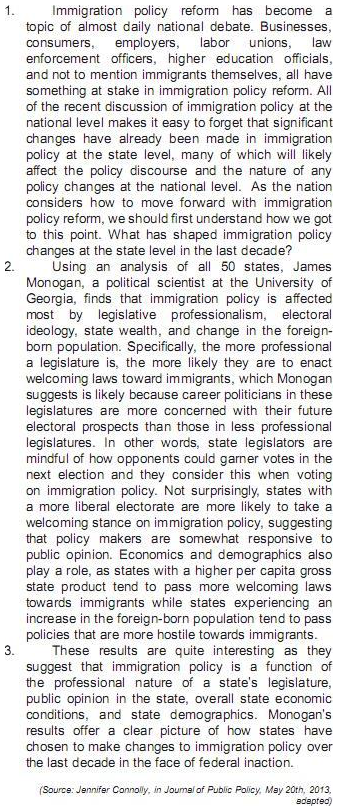
The purpose of the text is to advocate greaterWhy Some State Immigration Laws are Welcoming
but Others are Downright Hostile
Provas
Questão presente nas seguintes provas
Question refer to the text below:
Why Some State Immigration Laws are Welcoming
but Others are Downright Hostile
The reason why legislative professionalism has a bearing on immigration lawsWhy Some State Immigration Laws are Welcoming
but Others are Downright Hostile
Provas
Questão presente nas seguintes provas
Question refer to the text below:
Why Some State Immigration Laws are Welcoming
but Others are Downright Hostile
The author wraps up the text byWhy Some State Immigration Laws are Welcoming
but Others are Downright Hostile
Provas
Questão presente nas seguintes provas
Question refer to the text below:
Why Some State Immigration Laws are Welcoming
but Others are Downright Hostile
In the text above, the author posits thatWhy Some State Immigration Laws are Welcoming
but Others are Downright Hostile
Provas
Questão presente nas seguintes provas
A cooling consensus
Global warming has slowed. The rate of warming
over the past 15 years has been lower than that of
the preceding 20 years. There is no serious doubt
that our planet continues to heat, but it has heated
less than most climate scientists had predicted. Nate
Cohn of the New Republic reports: "Since 1998, the
warmest year of the twentieth century, temperatures
have not kept up with computer models that seemed
to project steady warming; they’re perilously close to
falling beneath even the lowest projections".
Mr Cohn does his best to af? rm that the urgent
necessity of acting to retard warming has not abated,
as does Brad Plumer of the Washington Post, as
does this newspaper. But there's no way around
the fact that this reprieve for the planet is bad news
for proponents of policies, such as carbon taxes
and emissions treaties, meant to slow warming by
moderating the release of greenhouse gases. The
reality is that the already meagre prospects of these
policies, in America at least, will be devastated if
temperatures do fall outside the lower bound of
the projections that environmentalists have used to
create a panicked sense of emergency. Whether
or not dramatic climate-policy interventions remain
advisable, they will become harder, if not impossible,
to sell to the public, which will feel, not unreasonably,
that the scienti? c and media establishment has cried
wolf.
(Source: The Economist, June 20th, 2013)
The text starts by citing data revealing thatGlobal warming has slowed. The rate of warming
over the past 15 years has been lower than that of
the preceding 20 years. There is no serious doubt
that our planet continues to heat, but it has heated
less than most climate scientists had predicted. Nate
Cohn of the New Republic reports: "Since 1998, the
warmest year of the twentieth century, temperatures
have not kept up with computer models that seemed
to project steady warming; they’re perilously close to
falling beneath even the lowest projections".
Mr Cohn does his best to af? rm that the urgent
necessity of acting to retard warming has not abated,
as does Brad Plumer of the Washington Post, as
does this newspaper. But there's no way around
the fact that this reprieve for the planet is bad news
for proponents of policies, such as carbon taxes
and emissions treaties, meant to slow warming by
moderating the release of greenhouse gases. The
reality is that the already meagre prospects of these
policies, in America at least, will be devastated if
temperatures do fall outside the lower bound of
the projections that environmentalists have used to
create a panicked sense of emergency. Whether
or not dramatic climate-policy interventions remain
advisable, they will become harder, if not impossible,
to sell to the public, which will feel, not unreasonably,
that the scienti? c and media establishment has cried
wolf.
(Source: The Economist, June 20th, 2013)
Provas
Questão presente nas seguintes provas
Question refer to the text below:
Why Some State Immigration Laws are Welcoming
but Others are Downright Hostile
Ms. Connolly suggests that politicians are attuned to their electorate because theyWhy Some State Immigration Laws are Welcoming
but Others are Downright Hostile
Provas
Questão presente nas seguintes provas
Os trechos a seguir constituem sequencialmente um texto adaptado de Renato Janine Ribeiro, Valor Econômico, 10/6/2013. Assinale a opção que foi transcrita com erro gramatical.
Provas
Questão presente nas seguintes provas
Cadernos
Caderno Container