Foram encontradas 50 questões.
Disciplina: Inglês (Língua Inglesa)
Banca: VUNESP
Orgão: Pref. Aparecida-SP
Leia o bilhete do aluno e o texto de Celce-Murcia, a seguir, para responder às questões de 42 a 48.
Dear teacher,
I am writing this in the intermission between classes to tell you of my extolment for your class. Your group work rouses a deep sense of admiration and joy within me. I enjoy every step of the work in your class. It comes without speaking that your class is the best. I don’t know how to give vent to my feelings. You help me with the difficultness of English. I know other guys and I suggest them to take your class. I’m so much happy to be student of a sagely teacher such as you and getting your advices. Your help is beyond valuability.
Bye for now,
Teo
What is it about the word use in Teo’s expressive letter that does not sound quite right, even though we understand the message? It appears that he knows enough about the words to communicate, but there are gaps in his word knowledge. For example, to know a word means to know a considerable amount about its meaning; Teo uses the word intermission (a short period of time between the parts of a play, film, concert, etc.) to apply to the break between classes. He knows the literal meaning of to give vent to his feelings but misses the subtle distinction that vent is usually used with negative feelings (I vented my anger). In addition, to know a word or phrase means to know its collocations, or how it is used in combination with other words; for example, every step of the way is a recognizable collocation, every step of the work is not. Knowing your word also means to know its grammatical function (e.g., suggest is a transitive verb; advice is an uncountable noun) and its word parts (e.g., difficulty rather than *difficultness, and value rather than *valuability). Finally, knowing your word means to know its register, or a level of formality. Extolment is a noun (meaning “enthusiastic praise and admiration”), but it is very formal and infrequently used.
This letter demonstrates the enormity of the word learning task. There are many words to know and many details to be known about each word.
(Celce-Murcia, M. 2001)
Ao solicitar aos alunos uma leitura rápida e global do texto com o objetivo de compreender o propósito principal do autor, o professor estará ajudando-os a desenvolver a estratégia de leitura denominada
Provas

Disciplina: Inglês (Língua Inglesa)
Banca: VUNESP
Orgão: Pref. Aparecida-SP
Leia o bilhete do aluno e o texto de Celce-Murcia, a seguir, para responder às questões de 42 a 48.
Dear teacher,
I am writing this in the intermission between classes to tell you of my extolment for your class. Your group work rouses a deep sense of admiration and joy within me. I enjoy every step of the work in your class. It comes without speaking that your class is the best. I don’t know how to give vent to my feelings. You help me with the difficultness of English. I know other guys and I suggest them to take your class. I’m so much happy to be student of a sagely teacher such as you and getting your advices. Your help is beyond valuability.
Bye for now,
Teo
What is it about the word use in Teo’s expressive letter that does not sound quite right, even though we understand the message? It appears that he knows enough about the words to communicate, but there are gaps in his word knowledge. For example, to know a word means to know a considerable amount about its meaning; Teo uses the word intermission (a short period of time between the parts of a play, film, concert, etc.) to apply to the break between classes. He knows the literal meaning of to give vent to his feelings but misses the subtle distinction that vent is usually used with negative feelings (I vented my anger). In addition, to know a word or phrase means to know its collocations, or how it is used in combination with other words; for example, every step of the way is a recognizable collocation, every step of the work is not. Knowing your word also means to know its grammatical function (e.g., suggest is a transitive verb; advice is an uncountable noun) and its word parts (e.g., difficulty rather than *difficultness, and value rather than *valuability). Finally, knowing your word means to know its register, or a level of formality. Extolment is a noun (meaning “enthusiastic praise and admiration”), but it is very formal and infrequently used.
This letter demonstrates the enormity of the word learning task. There are many words to know and many details to be known about each word.
(Celce-Murcia, M. 2001)
In the words of Celce-Murcia, “knowing your word means to know its register, or a level of formality”.
In the sentences below, the one with the appropriate degree of formality is
Provas
Disciplina: Inglês (Língua Inglesa)
Banca: VUNESP
Orgão: Pref. Aparecida-SP
Leia o bilhete do aluno e o texto de Celce-Murcia, a seguir, para responder às questões de 42 a 48.
Dear teacher,
I am writing this in the intermission between classes to tell you of my extolment for your class. Your group work rouses a deep sense of admiration and joy within me. I enjoy every step of the work in your class. It comes without speaking that your class is the best. I don’t know how to give vent to my feelings. You help me with the difficultness of English. I know other guys and I suggest them to take your class. I’m so much happy to be student of a sagely teacher such as you and getting your advices. Your help is beyond valuability.
Bye for now,
Teo
What is it about the word use in Teo’s expressive letter that does not sound quite right, even though we understand the message? It appears that he knows enough about the words to communicate, but there are gaps in his word knowledge. For example, to know a word means to know a considerable amount about its meaning; Teo uses the word intermission (a short period of time between the parts of a play, film, concert, etc.) to apply to the break between classes. He knows the literal meaning of to give vent to his feelings but misses the subtle distinction that vent is usually used with negative feelings (I vented my anger). In addition, to know a word or phrase means to know its collocations, or how it is used in combination with other words; for example, every step of the way is a recognizable collocation, every step of the work is not. Knowing your word also means to know its grammatical function (e.g., suggest is a transitive verb; advice is an uncountable noun) and its word parts (e.g., difficulty rather than *difficultness, and value rather than *valuability). Finally, knowing your word means to know its register, or a level of formality. Extolment is a noun (meaning “enthusiastic praise and admiration”), but it is very formal and infrequently used.
This letter demonstrates the enormity of the word learning task. There are many words to know and many details to be known about each word.
(Celce-Murcia, M. 2001)
The expression “it comes without speaking”, used by the student, would be a recognizable collocation if it were
Provas
Disciplina: Inglês (Língua Inglesa)
Banca: VUNESP
Orgão: Pref. Aparecida-SP
- Gramática - Língua InglesaSubstantivos e compostos | Nouns and compoundsSubstantivos contáveis e incontáveis | Countable and uncountable
Leia o bilhete do aluno e o texto de Celce-Murcia, a seguir, para responder às questões de 42 a 48.
Dear teacher,
I am writing this in the intermission between classes to tell you of my extolment for your class. Your group work rouses a deep sense of admiration and joy within me. I enjoy every step of the work in your class. It comes without speaking that your class is the best. I don’t know how to give vent to my feelings. You help me with the difficultness of English. I know other guys and I suggest them to take your class. I’m so much happy to be student of a sagely teacher such as you and getting your advices. Your help is beyond valuability.
Bye for now,
Teo
What is it about the word use in Teo’s expressive letter that does not sound quite right, even though we understand the message? It appears that he knows enough about the words to communicate, but there are gaps in his word knowledge. For example, to know a word means to know a considerable amount about its meaning; Teo uses the word intermission (a short period of time between the parts of a play, film, concert, etc.) to apply to the break between classes. He knows the literal meaning of to give vent to his feelings but misses the subtle distinction that vent is usually used with negative feelings (I vented my anger). In addition, to know a word or phrase means to know its collocations, or how it is used in combination with other words; for example, every step of the way is a recognizable collocation, every step of the work is not. Knowing your word also means to know its grammatical function (e.g., suggest is a transitive verb; advice is an uncountable noun) and its word parts (e.g., difficulty rather than *difficultness, and value rather than *valuability). Finally, knowing your word means to know its register, or a level of formality. Extolment is a noun (meaning “enthusiastic praise and admiration”), but it is very formal and infrequently used.
This letter demonstrates the enormity of the word learning task. There are many words to know and many details to be known about each word.
(Celce-Murcia, M. 2001)
The word advice was indicated by the author as an uncountable noun and, as such, not supposed to be used in the plural form, as it was in the student’s note.
Among the words below, the one that is countable and accepts a plural form is
Provas
Disciplina: Inglês (Língua Inglesa)
Banca: VUNESP
Orgão: Pref. Aparecida-SP
Leia o bilhete do aluno e o texto de Celce-Murcia, a seguir, para responder às questões de 42 a 48.
Dear teacher,
I am writing this in the intermission between classes to tell you of my extolment for your class. Your group work rouses a deep sense of admiration and joy within me. I enjoy every step of the work in your class. It comes without speaking that your class is the best. I don’t know how to give vent to my feelings. You help me with the difficultness of English. I know other guys and I suggest them to take your class. I’m so much happy to be student of a sagely teacher such as you and getting your advices. Your help is beyond valuability.
Bye for now,
Teo
What is it about the word use in Teo’s expressive letter that does not sound quite right, even though we understand the message? It appears that he knows enough about the words to communicate, but there are gaps in his word knowledge. For example, to know a word means to know a considerable amount about its meaning; Teo uses the word intermission (a short period of time between the parts of a play, film, concert, etc.) to apply to the break between classes. He knows the literal meaning of to give vent to his feelings but misses the subtle distinction that vent is usually used with negative feelings (I vented my anger). In addition, to know a word or phrase means to know its collocations, or how it is used in combination with other words; for example, every step of the way is a recognizable collocation, every step of the work is not. Knowing your word also means to know its grammatical function (e.g., suggest is a transitive verb; advice is an uncountable noun) and its word parts (e.g., difficulty rather than *difficultness, and value rather than *valuability). Finally, knowing your word means to know its register, or a level of formality. Extolment is a noun (meaning “enthusiastic praise and admiration”), but it is very formal and infrequently used.
This letter demonstrates the enormity of the word learning task. There are many words to know and many details to be known about each word.
(Celce-Murcia, M. 2001)
Celce-Murcia comenta o erro do aluno Teo quanto ao uso do verbo “suggest” – um erro por desconhecimento da estrutura gramatical em que o verbo estaria inserido.
Assinale a alternativa que apresenta uso correto do verbo “suggest” em uma frase.
Provas
Disciplina: Inglês (Língua Inglesa)
Banca: VUNESP
Orgão: Pref. Aparecida-SP
Leia o bilhete do aluno e o texto de Celce-Murcia, a seguir, para responder às questões de 42 a 48.
Dear teacher,
I am writing this in the intermission between classes to tell you of my extolment for your class. Your group work rouses a deep sense of admiration and joy within me. I enjoy every step of the work in your class. It comes without speaking that your class is the best. I don’t know how to give vent to my feelings. You help me with the difficultness of English. I know other guys and I suggest them to take your class. I’m so much happy to be student of a sagely teacher such as you and getting your advices. Your help is beyond valuability.
Bye for now,
Teo
What is it about the word use in Teo’s expressive letter that does not sound quite right, even though we understand the message? It appears that he knows enough about the words to communicate, but there are gaps in his word knowledge. For example, to know a word means to know a considerable amount about its meaning; Teo uses the word intermission (a short period of time between the parts of a play, film, concert, etc.) to apply to the break between classes. He knows the literal meaning of to give vent to his feelings but misses the subtle distinction that vent is usually used with negative feelings (I vented my anger). In addition, to know a word or phrase means to know its collocations, or how it is used in combination with other words; for example, every step of the way is a recognizable collocation, every step of the work is not. Knowing your word also means to know its grammatical function (e.g., suggest is a transitive verb; advice is an uncountable noun) and its word parts (e.g., difficulty rather than *difficultness, and value rather than *valuability). Finally, knowing your word means to know its register, or a level of formality. Extolment is a noun (meaning “enthusiastic praise and admiration”), but it is very formal and infrequently used.
This letter demonstrates the enormity of the word learning task. There are many words to know and many details to be known about each word.
(Celce-Murcia, M. 2001)
A palavra em negrito em “but misses the subtle distinction” é pronunciada /ˈs∧təl/; portanto, com a consoante /b/ muda.
Assinale, entre as palavras a seguir, a única em que a consoante /b/ é pronunciada.
Provas
Disciplina: Inglês (Língua Inglesa)
Banca: VUNESP
Orgão: Pref. Aparecida-SP
Leia a tirinha a seguir.
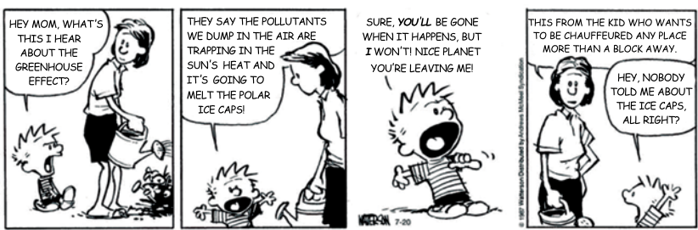
(https://www.gocomics.com/calvinandhobbes/2017/07/20)
Entre as falas de Calvin, aquela que contém ironia é:
Provas
Disciplina: Inglês (Língua Inglesa)
Banca: VUNESP
Orgão: Pref. Aparecida-SP
Leia o texto a seguir para responder às questões de números 36 a 40.
In this compelling work, Noam Chomsky, the world’s leading public intellectual, and Robert Pollin, a renowned progressive economist, map out the catastrophic consequences of unrestricted climate change – and present a realistic blueprint for change: the Green New Deal.
Together, Chomsky and Pollin show how the forecasts for a hotter planet strain the imagination: vast stretches of the Earth will become uninhabitable, plagued by extreme weather, drought, rising seas, and crop failure. Arguing against the misplaced fear of economic disaster and unemployment arising from the transition to a green economy, they show how this bogus concern encourages climate denialism.
Humanity must stop burning fossil fuels within the next thirty years and do so in a way that improves living standards and opportunities for working people. This is the goal of the Green New Deal and, as the authors make clear, it is entirely feasible. Climate change is an emergency that cannot be ignored, and it can be overcome both politically and economically.
(https://www.amazon.com.br/ Climate-Crisis-Global-Green-Deal/dp/178873985X. Adaptado)
Assinale a alternativa que apresenta corretamente palavras em que os prefixos mis- e en- carregam o mesmo significado daqueles em “misplaced” e “encourages” (2º parágrafo).
Provas
Disciplina: Inglês (Língua Inglesa)
Banca: VUNESP
Orgão: Pref. Aparecida-SP
Leia o texto a seguir para responder às questões de números 36 a 40.
In this compelling work, Noam Chomsky, the world’s leading public intellectual, and Robert Pollin, a renowned progressive economist, map out the catastrophic consequences of unrestricted climate change – and present a realistic blueprint for change: the Green New Deal.
Together, Chomsky and Pollin show how the forecasts for a hotter planet strain the imagination: vast stretches of the Earth will become uninhabitable, plagued by extreme weather, drought, rising seas, and crop failure. Arguing against the misplaced fear of economic disaster and unemployment arising from the transition to a green economy, they show how this bogus concern encourages climate denialism.
Humanity must stop burning fossil fuels within the next thirty years and do so in a way that improves living standards and opportunities for working people. This is the goal of the Green New Deal and, as the authors make clear, it is entirely feasible. Climate change is an emergency that cannot be ignored, and it can be overcome both politically and economically.
(https://www.amazon.com.br/ Climate-Crisis-Global-Green-Deal/dp/178873985X. Adaptado)
A teacher decides to use this reading text with the students. One activity involves searching for names of the people cited and their qualifications. In order to quickly find the information required, the students would apply the reading ability named
Provas
Disciplina: Inglês (Língua Inglesa)
Banca: VUNESP
Orgão: Pref. Aparecida-SP
Leia o texto a seguir para responder às questões de números 36 a 40.
In this compelling work, Noam Chomsky, the world’s leading public intellectual, and Robert Pollin, a renowned progressive economist, map out the catastrophic consequences of unrestricted climate change – and present a realistic blueprint for change: the Green New Deal.
Together, Chomsky and Pollin show how the forecasts for a hotter planet strain the imagination: vast stretches of the Earth will become uninhabitable, plagued by extreme weather, drought, rising seas, and crop failure. Arguing against the misplaced fear of economic disaster and unemployment arising from the transition to a green economy, they show how this bogus concern encourages climate denialism.
Humanity must stop burning fossil fuels within the next thirty years and do so in a way that improves living standards and opportunities for working people. This is the goal of the Green New Deal and, as the authors make clear, it is entirely feasible. Climate change is an emergency that cannot be ignored, and it can be overcome both politically and economically.
(https://www.amazon.com.br/ Climate-Crisis-Global-Green-Deal/dp/178873985X. Adaptado)
Um professor que queira relacionar propostas de engajamento dos alunos nas questões ambientais e a preocupação do ativista Noam Chomsky com as alterações climáticas poderia propor como atividade comunicativa
Provas
Caderno Container