Foram encontradas 120 questões.
Disciplina: Inglês (Língua Inglesa)
Banca: CESPE / CEBRASPE
Orgão: Pref. Aracaju-SE
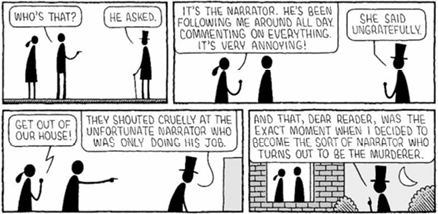
Tom Gauld. The narrator. Internet: <theguardian.com>.
According to the previous comic strip, judge the items that follow.
The sentence “Get out of our house!” is grammatically inadequate because it is missing the subject, essential part of every clause.
Provas

Disciplina: Inglês (Língua Inglesa)
Banca: CESPE / CEBRASPE
Orgão: Pref. Aracaju-SE
Tom Gauld. The narrator. Internet: <theguardian.com>.
According to the previous comic strip, judge the items that follow.
In the second panel, there are examples of four different verb tenses.
Provas
Disciplina: Inglês (Língua Inglesa)
Banca: CESPE / CEBRASPE
Orgão: Pref. Aracaju-SE
Tom Gauld. The narrator. Internet: <theguardian.com>.
According to the previous comic strip, judge the items that follow.
There are two relative clauses in the last panel of the comic strip.
Provas
Disciplina: Inglês (Língua Inglesa)
Banca: CESPE / CEBRASPE
Orgão: Pref. Aracaju-SE
Tom Gauld. The narrator. Internet: <theguardian.com>.
According to the previous comic strip, judge the items that follow.
The two sentences in the first panel compose, together, an example of reported speech.
Provas
Disciplina: Inglês (Língua Inglesa)
Banca: CESPE / CEBRASPE
Orgão: Pref. Aracaju-SE
Tom Gauld. The narrator. Internet: <theguardian.com>.
According to the previous comic strip, judge the items that follow.
The commas presented in the fragment “that, dear reader, was the exact moment” could be removed without harming the correctness of the sentence.
Provas
Disciplina: Inglês (Língua Inglesa)
Banca: CESPE / CEBRASPE
Orgão: Pref. Aracaju-SE
- Gramática - Língua InglesaAdjetivos | AdjectivesComparativo e superlativo de adjetivos | Comparative and superlative
Four types of English exist in Africa, identifiable in terms of history, functions, and linguistic characteristics. West African Pidgin English has a history going back to the 15th century, 400 years before formal colonization. Creole varieties of English have a history going back to repatriation of enslaved people from the Caribbean and the United States of America in the 19th century. Second language varieties, which are the most widespread on the continent, are prototypically associated with British colonization and its education systems. L1 (first language) English occurred mostly in Southern and East Africa and is best represented in South Africa. The latter shows significant similarities with the other major Southern Hemisphere varieties of English, spoken in Australia and New Zealand.
African Englishes From a Sociolinguistic Perspective.
Internet: <oxfordre.com> (adapted).
Considering the previous text, its ideas and linguistic features, as well as the reading strategies that apply to it, judge the following item.
The phrase “the most widespread”, in the fourth sentence of the text, is a superlative construction, with “most” modifying the adjective “widespread”.
Provas
Disciplina: Inglês (Língua Inglesa)
Banca: CESPE / CEBRASPE
Orgão: Pref. Aracaju-SE
Four types of English exist in Africa, identifiable in terms of history, functions, and linguistic characteristics. West African Pidgin English has a history going back to the 15th century, 400 years before formal colonization. Creole varieties of English have a history going back to repatriation of enslaved people from the Caribbean and the United States of America in the 19th century. Second language varieties, which are the most widespread on the continent, are prototypically associated with British colonization and its education systems. L1 (first language) English occurred mostly in Southern and East Africa and is best represented in South Africa. The latter shows significant similarities with the other major Southern Hemisphere varieties of English, spoken in Australia and New Zealand.
African Englishes From a Sociolinguistic Perspective.
Internet: <oxfordre.com> (adapted).
Considering the previous text, its ideas and linguistic features, as well as the reading strategies that apply to it, judge the following item.
In both the excerpts “has a history going back to the 15th century”, and “have a history going back to repatriation”, the expression “going back” works as a phrasal verb.
Provas
Disciplina: Inglês (Língua Inglesa)
Banca: CESPE / CEBRASPE
Orgão: Pref. Aracaju-SE
Four types of English exist in Africa, identifiable in terms of history, functions, and linguistic characteristics. West African Pidgin English has a history going back to the 15th century, 400 years before formal colonization. Creole varieties of English have a history going back to repatriation of enslaved people from the Caribbean and the United States of America in the 19th century. Second language varieties, which are the most widespread on the continent, are prototypically associated with British colonization and its education systems. L1 (first language) English occurred mostly in Southern and East Africa and is best represented in South Africa. The latter shows significant similarities with the other major Southern Hemisphere varieties of English, spoken in Australia and New Zealand.
African Englishes From a Sociolinguistic Perspective.
Internet: <oxfordre.com> (adapted).
Considering the previous text, its ideas and linguistic features, as well as the reading strategies that apply to it, judge the following item.
In the last sentence of the text, “The latter” is a noun phrase that refers to “South Africa”.
Provas
Disciplina: Inglês (Língua Inglesa)
Banca: CESPE / CEBRASPE
Orgão: Pref. Aracaju-SE
Four types of English exist in Africa, identifiable in terms of history, functions, and linguistic characteristics. West African Pidgin English has a history going back to the 15th century, 400 years before formal colonization. Creole varieties of English have a history going back to repatriation of enslaved people from the Caribbean and the United States of America in the 19th century. Second language varieties, which are the most widespread on the continent, are prototypically associated with British colonization and its education systems. L1 (first language) English occurred mostly in Southern and East Africa and is best represented in South Africa. The latter shows significant similarities with the other major Southern Hemisphere varieties of English, spoken in Australia and New Zealand.
African Englishes From a Sociolinguistic Perspective.
Internet: <oxfordre.com> (adapted).
Considering the previous text, its ideas and linguistic features, as well as the reading strategies that apply to it, judge the following item.
In the first sentence of the text, the words “history”, “functions”, and “linguistic” are working as modifiers describing “characteristics”.
Provas
Disciplina: Inglês (Língua Inglesa)
Banca: CESPE / CEBRASPE
Orgão: Pref. Aracaju-SE
Four types of English exist in Africa, identifiable in terms of history, functions, and linguistic characteristics. West African Pidgin English has a history going back to the 15th century, 400 years before formal colonization. Creole varieties of English have a history going back to repatriation of enslaved people from the Caribbean and the United States of America in the 19th century. Second language varieties, which are the most widespread on the continent, are prototypically associated with British colonization and its education systems. L1 (first language) English occurred mostly in Southern and East Africa and is best represented in South Africa. The latter shows significant similarities with the other major Southern Hemisphere varieties of English, spoken in Australia and New Zealand.
African Englishes From a Sociolinguistic Perspective.
Internet: <oxfordre.com> (adapted).
Considering the previous text, its ideas and linguistic features, as well as the reading strategies that apply to it, judge the following item.
The skimming technique would be ideal for quickly identifying time periods and their specific relevance in the text.
Provas
Caderno Container