Foram encontradas 35 questões.
Acerca do tema ‘O papel da gramática no ensino de língua Portuguesa’, é correto afirmar que:
Provas

A Campanha Publicitária em prol da Doação de Órgãos feita pelo SUS (Sistema Único de Saúde) visa à adesão de mais doadores.
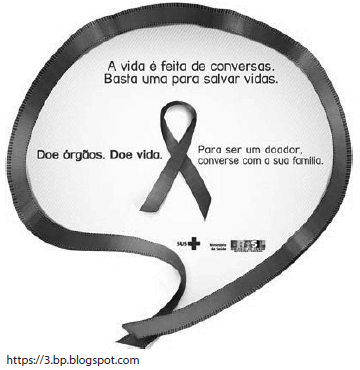
A peça publicitária revela que, para conseguir seu objetivo, o autor fez uso, sobretudo, da seguinte função da linguagem:
Provas
Leia o texto abaixo:
A assembleia dos ratos
Um gato de nome Faro-Fino deu de fazer tal destroço na rataria duma casa velha que os sobreviventes, sem ânimo de sair das tocas, estavam a ponto de morrer de fome.
Tornando-se muito sério o caso, resolveram reunir-se em assembleia para o estudo da questão. Aguardaram para isso certa noite em que Faro-Fino andava aos mios pelo telhado, fazendo sonetos à lua.
— Acho — disse um deles — que o meio de nos defendermos de Faro-Fino é lhe atarmos um guizo ao pescoço. Assim que ele se aproxime, o guizo o denuncia e pomo-nos ao fresco a tempo.
Palmas e bravos saudaram a luminosa ideia. O projeto foi aprovado com delírio. Só votou contra, um rato casmurro, que pediu a palavra e disse:
— Está tudo muito direito. Mas quem vai amarrar o guizo no pescoço de Faro-Fino?
Silêncio geral. Um desculpou-se por não saber dar nó. Outro, porque não era tolo.
Todos, porque não tinham coragem. E a assembleia dissolveu-se no meio de geral consternação.
Acerca do tema Concepções de Linguagem, é correto afirmar que:
Provas
Leia o texto abaixo:
A assembleia dos ratos
Um gato de nome Faro-Fino deu de fazer tal destroço na rataria duma casa velha que os sobreviventes, sem ânimo de sair das tocas, estavam a ponto de morrer de fome.
Tornando-se muito sério o caso, resolveram reunir-se em assembleia para o estudo da questão. Aguardaram para isso certa noite em que Faro-Fino andava aos mios pelo telhado, fazendo sonetos à lua.
— Acho — disse um deles — que o meio de nos defendermos de Faro-Fino é lhe atarmos um guizo ao pescoço. Assim que ele se aproxime, o guizo o denuncia e pomo-nos ao fresco a tempo.
Palmas e bravos saudaram a luminosa ideia. O projeto foi aprovado com delírio. Só votou contra, um rato casmurro, que pediu a palavra e disse:
— Está tudo muito direito. Mas quem vai amarrar o guizo no pescoço de Faro-Fino?
Silêncio geral. Um desculpou-se por não saber dar nó. Outro, porque não era tolo.
Todos, porque não tinham coragem. E a assembleia dissolveu-se no meio de geral consternação.
Sincronia e diacronia são conceitos distintos, que se complementam, usados na linguística para indicar diferentes perspectivas de estudo da língua.
Assinale a alternativa correta acerca do tema.
Provas
Leia o texto abaixo:
A assembleia dos ratos
Um gato de nome Faro-Fino deu de fazer tal destroço na rataria duma casa velha que os sobreviventes, sem ânimo de sair das tocas, estavam a ponto de morrer de fome.
Tornando-se muito sério o caso, resolveram reunir-se em assembleia para o estudo da questão. Aguardaram para isso certa noite em que Faro-Fino andava aos mios pelo telhado, fazendo sonetos à lua.
— Acho — disse um deles — que o meio de nos defendermos de Faro-Fino é lhe atarmos um guizo ao pescoço. Assim que ele se aproxime, o guizo o denuncia e pomo-nos ao fresco a tempo.
Palmas e bravos saudaram a luminosa ideia. O projeto foi aprovado com delírio. Só votou contra, um rato casmurro, que pediu a palavra e disse:
— Está tudo muito direito. Mas quem vai amarrar o guizo no pescoço de Faro-Fino?
Silêncio geral. Um desculpou-se por não saber dar nó. Outro, porque não era tolo.
Todos, porque não tinham coragem. E a assembleia dissolveu-se no meio de geral consternação.
O texto acima é uma fábula.
Esse tipo de gênero tem como principal função:
Provas
Disciplina: Inglês (Língua Inglesa)
Banca: FEPESE
Orgão: Pref. Araranguá-SC
Durante visita ao Brasil, no começo do ano passado, o presidente dos Estados Unidos da América recebeu um grupo de estudantes brasileiros selecionados em suas escolas.
Supondo que você foi um desses estudantes escolhidos e que pretende entrevistá-lo, com o auxílio de um intérprete para ajudá-lo, o que você deveria usar nessa situação de comunicação?
Provas
Disciplina: Inglês (Língua Inglesa)
Banca: FEPESE
Orgão: Pref. Araranguá-SC
When reading, you are likely to come across words that are unfamiliar - words that you don’t know.
Strategies can be used to work out the meaning of unfamiliar words, such as:
Provas
Disciplina: Inglês (Língua Inglesa)
Banca: FEPESE
Orgão: Pref. Araranguá-SC
Reality Television
Reality television is a genre of television programming which, it is claimed, presents unscripted dramatic or humorous situations, documents actual events, and features ordinary people rather than professional actors. It could be described as a form of artificial or “heightened” documentary. Although the genre has existed in some form or another since the early years of television, the current explosion of popularity dates from around 2000.
Reality television covers a wide range of television programming formats, from game or quiz shows which resemble the frantic, often demeaning programmes produced in Japan in the 1980s and 1990s (a modern example is Gaki no tsukai), to surveillance-focused productions such as Big Brother.
Critics say that the term “reality television” is somewhat of a misnomer and that such shows frequently portray a modified and highly influenced form of reality, with participants put in exotic locations or abnormal situations, sometimes coached to act in certain ways by off-screen handlers, and with events on screen manipulated through editing and other post-production techniques.
Part of reality television’s appeal is due to its ability to place ordinary people in extraordinary situations. For example, on the ABC show, The Bachelor, an eligible male dates a dozen women simultaneously, travelling on extraordinary dates to scenic locales. Reality television also has the potential to turn its participants into national celebrities, outwardly in talent and performance programs such as Pop Idol, though frequently Survivor and Big Brother participants also reach some degree of celebrity.
Some commentators have said that the name “reality television” is an inaccurate description for several styles of program included in the genre. In competition-based programs such as Big Brother and Survivor, and other special-living-environment shows like The Real World, the producers design the format of the show and control the day-to-day activities and the environment, creating a completely fabricated world in which the competition plays out. Producers specifically select the participants, and use carefully designed scenarios, challenges, events, and settings to encourage particular behaviours and conflicts. Mark Burnett, creator of Survivor and other reality shows, has agreed with this assessment, and avoids the word “reality” to describe his shows; he has said, “I tell good stories. It really is not reality TV. It really is unscripted drama.”
Complete the following sentence:
“Teaching English as a second language has become important because it is a for communication.”
Choose the alternative that correctly completes the spaces in the sentence.
Provas
Disciplina: Inglês (Língua Inglesa)
Banca: FEPESE
Orgão: Pref. Araranguá-SC
Reality Television
Reality television is a genre of television programming which, it is claimed, presents unscripted dramatic or humorous situations, documents actual events, and features ordinary people rather than professional actors. It could be described as a form of artificial or “heightened” documentary. Although the genre has existed in some form or another since the early years of television, the current explosion of popularity dates from around 2000.
Reality television covers a wide range of television programming formats, from game or quiz shows which resemble the frantic, often demeaning programmes produced in Japan in the 1980s and 1990s (a modern example is Gaki no tsukai), to surveillance-focused productions such as Big Brother.
Critics say that the term “reality television” is somewhat of a misnomer and that such shows frequently portray a modified and highly influenced form of reality, with participants put in exotic locations or abnormal situations, sometimes coached to act in certain ways by off-screen handlers, and with events on screen manipulated through editing and other post-production techniques.
Part of reality television’s appeal is due to its ability to place ordinary people in extraordinary situations. For example, on the ABC show, The Bachelor, an eligible male dates a dozen women simultaneously, travelling on extraordinary dates to scenic locales. Reality television also has the potential to turn its participants into national celebrities, outwardly in talent and performance programs such as Pop Idol, though frequently Survivor and Big Brother participants also reach some degree of celebrity.
Some commentators have said that the name “reality television” is an inaccurate description for several styles of program included in the genre. In competition-based programs such as Big Brother and Survivor, and other special-living-environment shows like The Real World, the producers design the format of the show and control the day-to-day activities and the environment, creating a completely fabricated world in which the competition plays out. Producers specifically select the participants, and use carefully designed scenarios, challenges, events, and settings to encourage particular behaviours and conflicts. Mark Burnett, creator of Survivor and other reality shows, has agreed with this assessment, and avoids the word “reality” to describe his shows; he has said, “I tell good stories. It really is not reality TV. It really is unscripted drama.”
Match the words on column 1 with their definitions on column 2.
Column 1 Words
1. portray
2. frantic
3. outwardly
4. dozen
Column 2 Definitions
( ) on the outside: externally.
( ) a group or set of twelve.
( ) describe (someone or something) in a particular way.
( ) wild or distraught with fear.
Choose the alternative which presents the correct sequence, from top to bottom.
Provas
Disciplina: Inglês (Língua Inglesa)
Banca: FEPESE
Orgão: Pref. Araranguá-SC
Reality Television
Reality television is a genre of television programming which, it is claimed, presents unscripted dramatic or humorous situations, documents actual events, and features ordinary people rather than professional actors. It could be described as a form of artificial or “heightened” documentary. Although the genre has existed in some form or another since the early years of television, the current explosion of popularity dates from around 2000.
Reality television covers a wide range of television programming formats, from game or quiz shows which resemble the frantic, often demeaning programmes produced in Japan in the 1980s and 1990s (a modern example is Gaki no tsukai), to surveillance-focused productions such as Big Brother.
Critics say that the term “reality television” is somewhat of a misnomer and that such shows frequently portray a modified and highly influenced form of reality, with participants put in exotic locations or abnormal situations, sometimes coached to act in certain ways by off-screen handlers, and with events on screen manipulated through editing and other post-production techniques.
Part of reality television’s appeal is due to its ability to place ordinary people in extraordinary situations. For example, on the ABC show, The Bachelor, an eligible male dates a dozen women simultaneously, travelling on extraordinary dates to scenic locales. Reality television also has the potential to turn its participants into national celebrities, outwardly in talent and performance programs such as Pop Idol, though frequently Survivor and Big Brother participants also reach some degree of celebrity.
Some commentators have said that the name “reality television” is an inaccurate description for several styles of program included in the genre. In competition-based programs such as Big Brother and Survivor, and other special-living-environment shows like The Real World, the producers design the format of the show and control the day-to-day activities and the environment, creating a completely fabricated world in which the competition plays out. Producers specifically select the participants, and use carefully designed scenarios, challenges, events, and settings to encourage particular behaviours and conflicts. Mark Burnett, creator of Survivor and other reality shows, has agreed with this assessment, and avoids the word “reality” to describe his shows; he has said, “I tell good stories. It really is not reality TV. It really is unscripted drama.”
The words ‘Although’ and ‘though’, in the text mean ‘in spite of something’.
In the text, they are discourse markers that are:
Provas
Caderno Container