Foram encontradas 50 questões.
Disciplina: Inglês (Língua Inglesa)
Banca: FGV
Orgão: Pref. Caraguatatuba-SP
Text
Digital Inclusion for All
Shaping our Digital Future
Digital technologies – the internet, mobile phones, and all the other tools to collect, store, analyze, and share information digitally – have spread rapidly in much of the world. Many of us depend on them to work, to educate the young, and reach out to our friends and family. These technologies have enabled digital public services, digital payments, online learning, telehealth, online shopping and more. However, about half the world's people access and use the Internet, the other half do not. Millions of people cannot work or go to school remotely or access technology and its benefits. Many of the unconnected live in least developed countries, landlocked developing countries and small island developing states, and within countries in rural and remote areas or urban impoverished areas.
Digital divide still persists between more and less connected countries, communities, and people. Enabling all the world's people to access and use digital technologies (the Internet including mobile technologies) – and closing digital divides – remains a challenge that needs to be addressed if the world community is to achieve the United Nations Sustainable Development Goals (SDGs) by 2030.
Adapted from: https://www.un.org/development/desa/dspd/wp-content/uploads/sites/22/2021/02/Draft-DigitalInclusion4All-OnlineGlobalForum2021-12Feb.pdf
In “Digital divide still persists” (2nd paragraph) the verb is similar in meaning to:
Provas

Disciplina: Inglês (Língua Inglesa)
Banca: FGV
Orgão: Pref. Caraguatatuba-SP
Text
Digital Inclusion for All
Shaping our Digital Future
Digital technologies – the internet, mobile phones, and all the other tools to collect, store, analyze, and share information digitally – have spread rapidly in much of the world. Many of us depend on them to work, to educate the young, and reach out to our friends and family. These technologies have enabled digital public services, digital payments, online learning, telehealth, online shopping and more. However, about half the world's people access and use the Internet, the other half do not. Millions of people cannot work or go to school remotely or access technology and its benefits. Many of the unconnected live in least developed countries, landlocked developing countries and small island developing states, and within countries in rural and remote areas or urban impoverished areas.
Digital divide still persists between more and less connected countries, communities, and people. Enabling all the world's people to access and use digital technologies (the Internet including mobile technologies) – and closing digital divides – remains a challenge that needs to be addressed if the world community is to achieve the United Nations Sustainable Development Goals (SDGs) by 2030.
Adapted from: https://www.un.org/development/desa/dspd/wp-content/uploads/sites/22/2021/02/Draft-DigitalInclusion4All-OnlineGlobalForum2021-12Feb.pdf
“However” in “However, about half the world's people access and use the Internet, the other half do not” (1st paragraph) introduces a:
Provas
Disciplina: Inglês (Língua Inglesa)
Banca: FGV
Orgão: Pref. Caraguatatuba-SP
Text
Digital Inclusion for All
Shaping our Digital Future
Digital technologies – the internet, mobile phones, and all the other tools to collect, store, analyze, and share information digitally – have spread rapidly in much of the world. Many of us depend on them to work, to educate the young, and reach out to our friends and family. These technologies have enabled digital public services, digital payments, online learning, telehealth, online shopping and more. However, about half the world's people access and use the Internet, the other half do not. Millions of people cannot work or go to school remotely or access technology and its benefits. Many of the unconnected live in least developed countries, landlocked developing countries and small island developing states, and within countries in rural and remote areas or urban impoverished areas.
Digital divide still persists between more and less connected countries, communities, and people. Enabling all the world's people to access and use digital technologies (the Internet including mobile technologies) – and closing digital divides – remains a challenge that needs to be addressed if the world community is to achieve the United Nations Sustainable Development Goals (SDGs) by 2030.
Adapted from: https://www.un.org/development/desa/dspd/wp-content/uploads/sites/22/2021/02/Draft-DigitalInclusion4All-OnlineGlobalForum2021-12Feb.pdf
The opposite of “least” in “least developed countries” (1st paragraph) is:
Provas
Disciplina: Inglês (Língua Inglesa)
Banca: FGV
Orgão: Pref. Caraguatatuba-SP
Text
Digital Inclusion for All
Shaping our Digital Future
Digital technologies – the internet, mobile phones, and all the other tools to collect, store, analyze, and share information digitally – have spread rapidly in much of the world. Many of us depend on them to work, to educate the young, and reach out to our friends and family. These technologies have enabled digital public services, digital payments, online learning, telehealth, online shopping and more. However, about half the world's people access and use the Internet, the other half do not. Millions of people cannot work or go to school remotely or access technology and its benefits. Many of the unconnected live in least developed countries, landlocked developing countries and small island developing states, and within countries in rural and remote areas or urban impoverished areas.
Digital divide still persists between more and less connected countries, communities, and people. Enabling all the world's people to access and use digital technologies (the Internet including mobile technologies) – and closing digital divides – remains a challenge that needs to be addressed if the world community is to achieve the United Nations Sustainable Development Goals (SDGs) by 2030.
Adapted from: https://www.un.org/development/desa/dspd/wp-content/uploads/sites/22/2021/02/Draft-DigitalInclusion4All-OnlineGlobalForum2021-12Feb.pdf
The word “challenge” in “remains a challenge” (2nd paragraph) means something:
Provas
Disciplina: Inglês (Língua Inglesa)
Banca: FGV
Orgão: Pref. Caraguatatuba-SP
Text
Digital Inclusion for All
Shaping our Digital Future
Digital technologies – the internet, mobile phones, and all the other tools to collect, store, analyze, and share information digitally – have spread rapidly in much of the world. Many of us depend on them to work, to educate the young, and reach out to our friends and family. These technologies have enabled digital public services, digital payments, online learning, telehealth, online shopping and more. However, about half the world's people access and use the Internet, the other half do not. Millions of people cannot work or go to school remotely or access technology and its benefits. Many of the unconnected live in least developed countries, landlocked developing countries and small island developing states, and within countries in rural and remote areas or urban impoverished areas.
Digital divide still persists between more and less connected countries, communities, and people. Enabling all the world's people to access and use digital technologies (the Internet including mobile technologies) – and closing digital divides – remains a challenge that needs to be addressed if the world community is to achieve the United Nations Sustainable Development Goals (SDGs) by 2030.
Adapted from: https://www.un.org/development/desa/dspd/wp-content/uploads/sites/22/2021/02/Draft-DigitalInclusion4All-OnlineGlobalForum2021-12Feb.pdf
The text concludes that to reach the United Nations Sustainable Development Goals (SDGs) by 2030 the world community should:
Provas
Disciplina: Inglês (Língua Inglesa)
Banca: FGV
Orgão: Pref. Caraguatatuba-SP
Text
Digital Inclusion for All
Shaping our Digital Future
Digital technologies – the internet, mobile phones, and all the other tools to collect, store, analyze, and share information digitally – have spread rapidly in much of the world. Many of us depend on them to work, to educate the young, and reach out to our friends and family. These technologies have enabled digital public services, digital payments, online learning, telehealth, online shopping and more. However, about half the world's people access and use the Internet, the other half do not. Millions of people cannot work or go to school remotely or access technology and its benefits. Many of the unconnected live in least developed countries, landlocked developing countries and small island developing states, and within countries in rural and remote areas or urban impoverished areas.
Digital divide still persists between more and less connected countries, communities, and people. Enabling all the world's people to access and use digital technologies (the Internet including mobile technologies) – and closing digital divides – remains a challenge that needs to be addressed if the world community is to achieve the United Nations Sustainable Development Goals (SDGs) by 2030.
Adapted from: https://www.un.org/development/desa/dspd/wp-content/uploads/sites/22/2021/02/Draft-DigitalInclusion4All-OnlineGlobalForum2021-12Feb.pdf
Based on the text, mark the statements below as TRUE (T) or FALSE (F).
( ) Digital technologies have undergone fast proliferation.
( ) Every place in the world has access to the internet.
( ) Digital exclusion needs to come to an end.
The statements are, respectively,
Provas
Disciplina: Inglês (Língua Inglesa)
Banca: FGV
Orgão: Pref. Caraguatatuba-SP
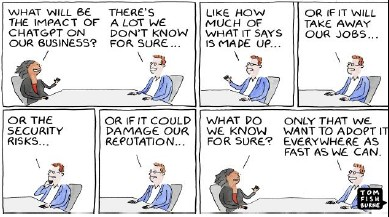
From: https://marketoonist.com/2023/06/impact-of-chatgpt.html
“For sure” in the last panel is similar in meaning to:
Provas
Disciplina: Inglês (Língua Inglesa)
Banca: FGV
Orgão: Pref. Caraguatatuba-SP
From: https://marketoonist.com/2023/06/impact-of-chatgpt.html
Regarding the fast adoption of CHATGPT, this cartoon aims at:
Provas
Disciplina: TI - Sistemas Operacionais
Banca: FGV
Orgão: Pref. Caraguatatuba-SP
Com relação aos sistemas de arquivos em Linux e Windows e às políticas de backup, analise os itens a seguir.
I. O sistema de arquivos NTFS é exclusivo do Windows e não é reconhecido pelo Linux. II. No Linux, o comando “tar” é frequentemente utilizado para criar arquivos compactados (tarball). III. Para recuperar um backup diferencial é necessária a cópia inicial completa e os backups intermediários para restauração completa do ambiente. IV. Ext4 e NTFS são os formatos dos arquivos padrão usados pelos sistemas operacional Linux e Windows, respectivamente.
Está correto o que se afirma em
Provas
Disciplina: TI - Segurança da Informação
Banca: FGV
Orgão: Pref. Caraguatatuba-SP
- Certificado DigitalAC: Autoridade Certificadora
- Certificado DigitalInfraestrutura de Chaves Públicas (PKI)
- Certificado DigitalPadrão X.509
- Certificado DigitalRevogação de CertificadosCRL: Lista de Certificados Revogados
Durante uma reunião de treinamento para os funcionários sobre o uso de certificados digitais, foram levantadas as seguintes observações:
I. em uma PKI, uma autoridade certificadora emite e gerencia certificados para uma determinada comunidade. II. a estrutura denominada CRL possui uma lista de certificados revogados. III. X.509 é um formato padrão para certificados de chave pública, garantindo a segura associação de pares de chaves criptográficas a identidades, como sites, indivíduos ou organizações.
Está correto o que se afirma em
Provas
Caderno Container