Foram encontradas 2.369 questões.
Text I
The BNCC and Twenty-First Century Skills
The most ambitious feature of the BNCC, which only appeared in the document’s third version, was to establish ten core competencies that all students should develop throughout basic education, starting in early childhood. These competencies include lifelong learning, critical thinking, aesthetic sensibilities, communication skills, digital literacy, entrepreneurship, self-care, empathy, citizenship and ethics. The core competencies broaden the goals of basic education well-beyond academic skills to twenty-first century skills widely regarded as essential to preparing the next generations for the challenges of the 4th industrial revolution.
As ambitious as it was, the BNCC was criticized for the lack of explicit links between the ten core competencies and the subject specific competencies and skills, leaving cities and states with the responsibility of making these links themselves. In addition to this, the core competencies are not generally integrated into teacher training programs and are often de-prioritized for the more basic literacy and numeracy needs. In this context, the Ministry of Education and its partners in the third sector have developed orientations, produced videos and online courses aimed at filling this gap, and helped cities and states integrate the ten core competencies in their curricula.
[…]
Ensuring all Brazilian students master the ten core competencies laid out by the BNCC by the end of high school is a long-term, extremely ambitious goal. Before we can set a timeframe for when we will be able to achieve this feat, we need to know where we stand. Due to the core competencies’ complexity, each involves several skills, attitudes and sometimes values, it is unclear whether we will be capable of measuring all ten of them and by when. Until then we are in the company of the OECD, which is already tackling this challenge and will likely pave the way for Brazil in this respect
Note: BNCC: Base Nacional Comum Curricular;
OECD: The Organization for Economic Cooperation and Development.
Adapted from https://link.springer.com/chapter/10.1007/978-3-030-41882-3_2
Provas

Text I
The BNCC and Twenty-First Century Skills
The most ambitious feature of the BNCC, which only appeared in the document’s third version, was to establish ten core competencies that all students should develop throughout basic education, starting in early childhood. These competencies include lifelong learning, critical thinking, aesthetic sensibilities, communication skills, digital literacy, entrepreneurship, self-care, empathy, citizenship and ethics. The core competencies broaden the goals of basic education well-beyond academic skills to twenty-first century skills widely regarded as essential to preparing the next generations for the challenges of the 4th industrial revolution.
As ambitious as it was, the BNCC was criticized for the lack of explicit links between the ten core competencies and the subject specific competencies and skills, leaving cities and states with the responsibility of making these links themselves. In addition to this, the core competencies are not generally integrated into teacher training programs and are often de-prioritized for the more basic literacy and numeracy needs. In this context, the Ministry of Education and its partners in the third sector have developed orientations, produced videos and online courses aimed at filling this gap, and helped cities and states integrate the ten core competencies in their curricula.
[…]
Ensuring all Brazilian students master the ten core competencies laid out by the BNCC by the end of high school is a long-term, extremely ambitious goal. Before we can set a timeframe for when we will be able to achieve this feat, we need to know where we stand. Due to the core competencies’ complexity, each involves several skills, attitudes and sometimes values, it is unclear whether we will be capable of measuring all ten of them and by when. Until then we are in the company of the OECD, which is already tackling this challenge and will likely pave the way for Brazil in this respect
Note: BNCC: Base Nacional Comum Curricular;
OECD: The Organization for Economic Cooperation and Development.
Adapted from https://link.springer.com/chapter/10.1007/978-3-030-41882-3_2
I. Teacher education programs today focus more on the ten core competencies than on other needs the students may have. II. The BNCC has been the object of some resistance. III. Core competencies can now be measured in a simple way.
Choose the correct answer:
Provas
Text I
The BNCC and Twenty-First Century Skills
The most ambitious feature of the BNCC, which only appeared in the document’s third version, was to establish ten core competencies that all students should develop throughout basic education, starting in early childhood. These competencies include lifelong learning, critical thinking, aesthetic sensibilities, communication skills, digital literacy, entrepreneurship, self-care, empathy, citizenship and ethics. The core competencies broaden the goals of basic education well-beyond academic skills to twenty-first century skills widely regarded as essential to preparing the next generations for the challenges of the 4th industrial revolution.
As ambitious as it was, the BNCC was criticized for the lack of explicit links between the ten core competencies and the subject specific competencies and skills, leaving cities and states with the responsibility of making these links themselves. In addition to this, the core competencies are not generally integrated into teacher training programs and are often de-prioritized for the more basic literacy and numeracy needs. In this context, the Ministry of Education and its partners in the third sector have developed orientations, produced videos and online courses aimed at filling this gap, and helped cities and states integrate the ten core competencies in their curricula.
[…]
Ensuring all Brazilian students master the ten core competencies laid out by the BNCC by the end of high school is a long-term, extremely ambitious goal. Before we can set a timeframe for when we will be able to achieve this feat, we need to know where we stand. Due to the core competencies’ complexity, each involves several skills, attitudes and sometimes values, it is unclear whether we will be capable of measuring all ten of them and by when. Until then we are in the company of the OECD, which is already tackling this challenge and will likely pave the way for Brazil in this respect
Note: BNCC: Base Nacional Comum Curricular;
OECD: The Organization for Economic Cooperation and Development.
Adapted from https://link.springer.com/chapter/10.1007/978-3-030-41882-3_2
Provas
Text I
The BNCC and Twenty-First Century Skills
The most ambitious feature of the BNCC, which only appeared in the document’s third version, was to establish ten core competencies that all students should develop throughout basic education, starting in early childhood. These competencies include lifelong learning, critical thinking, aesthetic sensibilities, communication skills, digital literacy, entrepreneurship, self-care, empathy, citizenship and ethics. The core competencies broaden the goals of basic education well-beyond academic skills to twenty-first century skills widely regarded as essential to preparing the next generations for the challenges of the 4th industrial revolution.
As ambitious as it was, the BNCC was criticized for the lack of explicit links between the ten core competencies and the subject specific competencies and skills, leaving cities and states with the responsibility of making these links themselves. In addition to this, the core competencies are not generally integrated into teacher training programs and are often de-prioritized for the more basic literacy and numeracy needs. In this context, the Ministry of Education and its partners in the third sector have developed orientations, produced videos and online courses aimed at filling this gap, and helped cities and states integrate the ten core competencies in their curricula.
[…]
Ensuring all Brazilian students master the ten core competencies laid out by the BNCC by the end of high school is a long-term, extremely ambitious goal. Before we can set a timeframe for when we will be able to achieve this feat, we need to know where we stand. Due to the core competencies’ complexity, each involves several skills, attitudes and sometimes values, it is unclear whether we will be capable of measuring all ten of them and by when. Until then we are in the company of the OECD, which is already tackling this challenge and will likely pave the way for Brazil in this respect
Note: BNCC: Base Nacional Comum Curricular;
OECD: The Organization for Economic Cooperation and Development.
Adapted from https://link.springer.com/chapter/10.1007/978-3-030-41882-3_2
( ) The core competencies are not solely restricted to academic skills. ( ) Mastering the ten core competencies by the end of high school can be easily achieved. ( ) The core competencies established by the BNCC for basic education were a later development.
The statements are, respectively:
Provas
Observe a imagem a seguir:

Fonte: https://brasil.elpais.com/brasil/2015/01 /07/album/1420632020_829679.html#foto_gal_3
A imagem é a capa da revista Charlie Hebdo, edição seguinte ao ataque terrorista sofrido pela sede da edição em 2015, em Paris. Ela apresenta um homem com vestimentas muçulmanas e um cartunista com a camisa escrita “Charlie Hebdo” se beijando. Seu título é “O amor é mais forte que o ódio” em português.
É possível relacionar os ataques terroristas à França com as políticas internacionais do país relacionadas ao Oriente Médio. Assinale a afirmativa que descreve corretamente uma das atuações francesas sobre a região.
Provas
Observe a imagem a seguir:
Fonte:https://elpais.com/cultura/2015/10/08/actualidad/1444316985_737930.html
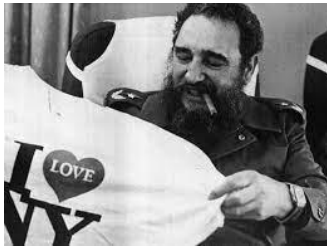
A foto retrata Fidel Castro, em sua visita à cidade de Nova Iorque, Estados Unidos, segurando uma camisa que contém o seguinte escrito “I love NY” que significa “Eu amo Nova Iorque” em português.
A respeito das relações políticas entre Cuba e Estados Unidos, assinale a afirmativa que descreve corretamente um dos motivos que resultou no afastamento entre os dois países após a Revolução de 1959.
Provas
Adaptado de: CUETO, Marcos. La “cultura de la sobrevivência” y la salud pública internacional en América Latina: la Guerra Fría y la erradicación de enfermedades a mediados del siglo XX. História, Ciências, Saúde – Manguinhos, Rio de Janeiro, v.22, n.1, jan.-mar. 2015, p.257.
As afirmativas a seguir apresentam corretamente fatores da atuação sanitária dos Estados Unidos, à exceção de uma. Assinale-a.
Provas
1. Governo Castelo Branco 2. Governo Costa e Silva 3. Governo Emílio Médici
( ) Criou o Programa de Integração Nacional (PIN) com o objetivo de ocupar e integrar partes da região norte e utilizou o lema “Brasil: ame-o ou deixo-o” como propaganda política patriótica. ( ) Instaurou o Ato Institucional número 5 como ferramenta para intimidar os opositores do governo, intensificando os instrumentos de repressão, e criou a Fundação Nacional do Índio (FUNAI). ( ) Formou Serviço Nacional de Informações (SNI) com o objetivo de controlar informações que interessavam a Segurança Nacional, e foi durante seu governo que o Banco Central foi criado.
Assinale a afirmativa que apresenta a relação correta, na ordem apresentada.
Provas
( ) O movimento de aspirações socialistas foi abafado pelo governo salazarista que intensificou suas atividades após a derrota do movimento. ( ) O movimento teve como centro de suas críticas a atuação militar que repreendeu os manifestantes durante os protestos nas regiões urbanas. ( ) O movimento apoiou a independência das possessões portuguesas no continente africano.
A respeito do movimento, está correto o que se afirma em
Provas
Observe as duas imagens a seguir:
Fonte: Mercado de Escravos no Rio de Janeiro. In: ENCICLOPÉDIA Itaú Cultural de Arte e Cultura Brasileira. São Paulo: Itaú Cultural, 2023. Disponível em: http://enciclopedia.itaucultural.org.br/obra9872/mercado-de-escravos-no-rio-dejaneiro.
Fonte: https://www.gov.br/palmares/pt-br/assuntos/noticias/cais-do-valongoganha-titulo-de-patrimonio-mundial-da-unesco
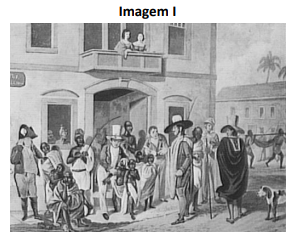
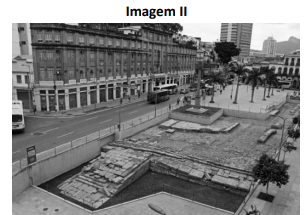
A imagem I retrata o Mercado de escravos na cidade do Rio de Janeiro no século XIX. Na cena pintada por Augustus Earle em 1824, estão representados homens em vestimentas próprias das classes abastadas e homens afrodescendentes despidos ou semidespidos em condição de cativo sendo comercializados. A imagem II é uma fotografia atual da mesma região da imagem I, que é o Sitio Arqueológico do Cais do Valongo, onde contém vestígios materiais da presença de afrodescentes escravizados na cidade carioca.
A análise das duas imagens em perspectiva comparada foi proposta por um docente como atividade didática sobre a escravidão, tendo o uso histórico dos espaços urbanos como objeto de estudo.
A respeito dessa atividade, avalie se as afirmativas a seguir são verdadeiras (V) ou falsas (F).
( ) Promove estudos e reflexões sobre a presença na atualidade de elementos materiais e mentais de outros tempos e incentivar reflexões sobre as relações entre presente e passado, entre espaços locais, regionais, nacionais e mundiais;
( ) Promove estudos e reflexões sobre a diversidade de modos de vida e de costumes que convivem na mesma localidade;
( ) Propõe estudos das relações e reflexões que destaquem diferenças, semelhanças, transformações, permanências, continuidades e descontinuidades históricas. Assinale a afirmativa que apresenta a sequência correta, de cima para baixo.
Assinale a afirmativa que apresenta a sequência correta, de cima para baixo.
Provas
Caderno Container