Foram encontradas 2.131 questões.
De acordo com Irandé Antunes (Aula de Português:
encontro e interação, 2003), o ensino de oralidade deveria abordar
Provas
Questão presente nas seguintes provas

Leia a história em quadrinhos a seguir, circulante em post do Instagram, para responder à questão.
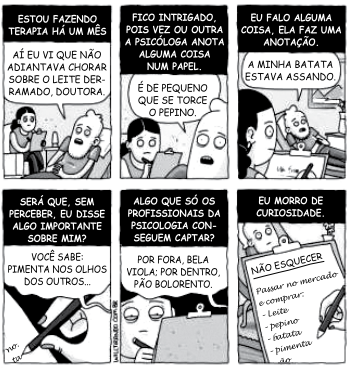
(Disponível em: https://www.instagram.com)
Provas
Questão presente nas seguintes provas
Leia a história em quadrinhos a seguir, circulante em post do Instagram, para responder à questão.
(Disponível em: https://www.instagram.com)
Provas
Questão presente nas seguintes provas
Leia a história em quadrinhos a seguir, circulante em post do Instagram, para responder à questão.
(Disponível em: https://www.instagram.com)
No que diz respeito à questão dos modos e tempos verbais, nas passagens “Estou fazendo terapia há um mês.” e “Será que, sem perceber, eu disse algo importante sobre mim?”, as formas destacadas estão flexionadas, correta e respectivamente, nos tempos
Provas
Questão presente nas seguintes provas
Leia a história em quadrinhos a seguir, circulante em post do Instagram, para responder à questão.
(Disponível em: https://www.instagram.com)
Nesse sentido, conclui-se corretamente que a coerência do post implica que o leitor entenda a utilização dos ditados populares em relação à lista do último quadro como uma estratégia do autor para
Provas
Questão presente nas seguintes provas
Leia o texto para responder à questão.
Consider these anecdotes:
1. An ESL teacher instructs a group of 7 children every day
for 45 minutes. They sing “I’m a Little Teapot” over and over
again. Standing, they make gestures to show the tea pouring
out. “I’m a little teapot, short and stout, here is my handle,
here is my spout. When I get it all steamed up, hear me shout,
just tip me over and pour me out”. And then the group starts
again…
2. In visiting a class of a successful ESL teacher, you are
struck that each activity lasts no more than ten minutes, that
children are usually in movement - making something, holding
something, moving their hands and walking somewhere.
There are few major contrasts that we can make between
child and adult ESL learners. Children are more likely to play
with language than adults are. In general, children are more
holistic learners who need to use language for authentic
communication in ESL classes.
In a children’s class, activities need to be child centered
and communication should be authentic. Several themes
repeatedly come up:
• Focus on meaning, not correctness.
• Focus on the value of the activity, not the value of language.
• Focus on collaboration and social development.
• Provide a rich context, including movement, the senses,
objects and pictures, and a variety of activities.
• Teach ESL holistically, integrating the four skills.
• Treat learners appropriately in the light of their age and
interests.
• Treat language as a tool for children to use for their own
social and academic ends.
(S. Peck. Developing Children´s Listening and Speaking. IN: Marianne
Cerce-Murcia(ed). Teaching English as a second or foreign language.
Boston, Massachusstes: Heinle&Heinle. 2nd edition. 2001. Adaptado)
Provas
Questão presente nas seguintes provas
Leia o texto para responder à questão.
Consider these anecdotes:
1. An ESL teacher instructs a group of 7 children every day
for 45 minutes. They sing “I’m a Little Teapot” over and over
again. Standing, they make gestures to show the tea pouring
out. “I’m a little teapot, short and stout, here is my handle,
here is my spout. When I get it all steamed up, hear me shout,
just tip me over and pour me out”. And then the group starts
again…
2. In visiting a class of a successful ESL teacher, you are
struck that each activity lasts no more than ten minutes, that
children are usually in movement - making something, holding
something, moving their hands and walking somewhere.
There are few major contrasts that we can make between
child and adult ESL learners. Children are more likely to play
with language than adults are. In general, children are more
holistic learners who need to use language for authentic
communication in ESL classes.
In a children’s class, activities need to be child centered
and communication should be authentic. Several themes
repeatedly come up:
• Focus on meaning, not correctness.
• Focus on the value of the activity, not the value of language.
• Focus on collaboration and social development.
• Provide a rich context, including movement, the senses,
objects and pictures, and a variety of activities.
• Teach ESL holistically, integrating the four skills.
• Treat learners appropriately in the light of their age and
interests.
• Treat language as a tool for children to use for their own
social and academic ends.
(S. Peck. Developing Children´s Listening and Speaking. IN: Marianne
Cerce-Murcia(ed). Teaching English as a second or foreign language.
Boston, Massachusstes: Heinle&Heinle. 2nd edition. 2001. Adaptado)
Provas
Questão presente nas seguintes provas
Leia o texto para responder à questão.
Consider these anecdotes:
1. An ESL teacher instructs a group of 7 children every day
for 45 minutes. They sing “I’m a Little Teapot” over and over
again. Standing, they make gestures to show the tea pouring
out. “I’m a little teapot, short and stout, here is my handle,
here is my spout. When I get it all steamed up, hear me shout,
just tip me over and pour me out”. And then the group starts
again…
2. In visiting a class of a successful ESL teacher, you are
struck that each activity lasts no more than ten minutes, that
children are usually in movement - making something, holding
something, moving their hands and walking somewhere.
There are few major contrasts that we can make between
child and adult ESL learners. Children are more likely to play
with language than adults are. In general, children are more
holistic learners who need to use language for authentic
communication in ESL classes.
In a children’s class, activities need to be child centered
and communication should be authentic. Several themes
repeatedly come up:
• Focus on meaning, not correctness.
• Focus on the value of the activity, not the value of language.
• Focus on collaboration and social development.
• Provide a rich context, including movement, the senses,
objects and pictures, and a variety of activities.
• Teach ESL holistically, integrating the four skills.
• Treat learners appropriately in the light of their age and
interests.
• Treat language as a tool for children to use for their own
social and academic ends.
(S. Peck. Developing Children´s Listening and Speaking. IN: Marianne
Cerce-Murcia(ed). Teaching English as a second or foreign language.
Boston, Massachusstes: Heinle&Heinle. 2nd edition. 2001. Adaptado)
Provas
Questão presente nas seguintes provas
Leia o texto para responder à questão.
Consider these anecdotes:
1. An ESL teacher instructs a group of 7 children every day
for 45 minutes. They sing “I’m a Little Teapot” over and over
again. Standing, they make gestures to show the tea pouring
out. “I’m a little teapot, short and stout, here is my handle,
here is my spout. When I get it all steamed up, hear me shout,
just tip me over and pour me out”. And then the group starts
again…
2. In visiting a class of a successful ESL teacher, you are
struck that each activity lasts no more than ten minutes, that
children are usually in movement - making something, holding
something, moving their hands and walking somewhere.
There are few major contrasts that we can make between
child and adult ESL learners. Children are more likely to play
with language than adults are. In general, children are more
holistic learners who need to use language for authentic
communication in ESL classes.
In a children’s class, activities need to be child centered
and communication should be authentic. Several themes
repeatedly come up:
• Focus on meaning, not correctness.
• Focus on the value of the activity, not the value of language.
• Focus on collaboration and social development.
• Provide a rich context, including movement, the senses,
objects and pictures, and a variety of activities.
• Teach ESL holistically, integrating the four skills.
• Treat learners appropriately in the light of their age and
interests.
• Treat language as a tool for children to use for their own
social and academic ends.
(S. Peck. Developing Children´s Listening and Speaking. IN: Marianne
Cerce-Murcia(ed). Teaching English as a second or foreign language.
Boston, Massachusstes: Heinle&Heinle. 2nd edition. 2001. Adaptado)
Provas
Questão presente nas seguintes provas
Leia o texto para responder à questão.
One of the major foci of applied linguistics scholarship
has been the foreign or second language classroom. A glance
through the past century or so of language teaching gives us
an interesting picture of varied interpretations of the best way
to teach a foreign language. As schools of thought have come
and gone, so have language teaching trends waxed and
waned in popularity.
Albert Marckwardt (1972) saw these “changing winds and
shifting sands” as a cyclical pattern where a new paradigm
of teaching methodology emerged about every quarter of a
century, with each new method breaking from the old but at
the same time taking with it some of the positive aspects of the
previous paradigm. One of the best examples of the cyclical
nature of methods is seen in the revolutionary Audiolingual
Method (ALM) of the late 1940s and 1950s. The ALM borrowed
principles and beliefs from its predecessor by almost half
a century, the Direct Method, while breaking away entirely
from the Grammar-Translation paradigm. Within a short time,
however, ALM critics were advocating more attention to rules
of language which, to some, smacked a return to Grammar
Translation.
(BROWN, H.Douglas. Principles of language learning and teaching.
5th ed. Longman, 2000. Adaptado)
Provas
Questão presente nas seguintes provas
Cadernos
Caderno Container