Foram encontradas 30 questões.
Choose the alternative that contains irregular verbs correctly conjugated in the simple past.
Provas
Questão presente nas seguintes provas

Analyze the following statements and select the CORRECT alternative.
Provas
Questão presente nas seguintes provas

What is the best translation for the term “would like”?
Provas
Questão presente nas seguintes provas
- Gramática - Língua InglesaVerbos | VerbsPresente perfeito | Present perfect
- Gramática - Língua InglesaVerbos | VerbsPassado simples | Simple past
- Gramática - Língua InglesaVerbos | VerbsFuturo simples | Simple future
Analyze strips I, II and II below:
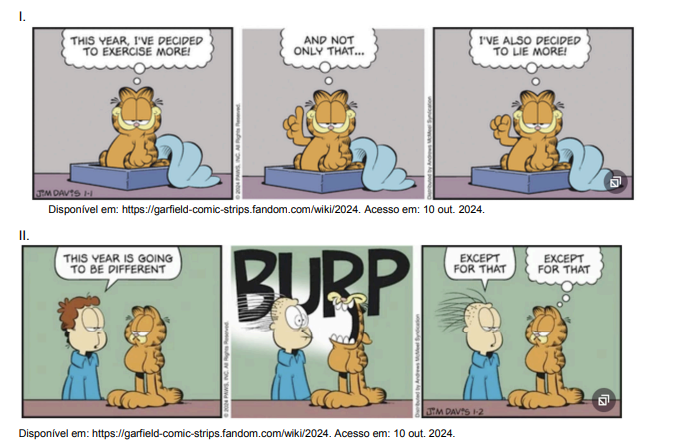

What verb tenses are in strips I, II and III, respectively?
Provas
Questão presente nas seguintes provas
Complete correctly the following sentences using “in”, “on” or “at”.
1. There’s a bug _____ your face. 2. We love to travel ____ the summer. 3. His birthday is ____ June. 4. Our flight arrived ____ nine o’clock. 5. The girls play tennis ____ Mondays.
Select the alternative that presents the words that correctly fill in the gaps, considering the sentences from top to bottom.
1. There’s a bug _____ your face. 2. We love to travel ____ the summer. 3. His birthday is ____ June. 4. Our flight arrived ____ nine o’clock. 5. The girls play tennis ____ Mondays.
Select the alternative that presents the words that correctly fill in the gaps, considering the sentences from top to bottom.
Provas
Questão presente nas seguintes provas
Which of the sentences below are CORRECT?
I. I study Portuguese on the afternoon. II. I never get out in the winter. III. He was born at 1995. IV. Rio de Janeiro gets too hot on December. V. My videogame is in the bedroom. VI. We could live together, walking on the moon.
Are CORRECT only the alternatives
I. I study Portuguese on the afternoon. II. I never get out in the winter. III. He was born at 1995. IV. Rio de Janeiro gets too hot on December. V. My videogame is in the bedroom. VI. We could live together, walking on the moon.
Are CORRECT only the alternatives
Provas
Questão presente nas seguintes provas
How healthy is broccoli?
The dinnertime standard is a nutritional multitasker.
New York Times
By Caroline Hopkins Legaspi.
Oct. 14, 2024
Children may not want to hear this, but broccoli more than deserves its place on our plates. The florets and stems
are filled with nutrients that help keep your heart and bones healthy — and may reduce the risk of cancer.
“Broccoli is a multitasking vegetable,” said Emily Ho, a professor of nutrition and the director of the Linus Pauling
Institute at Oregon State University: It has a range of vitamins, minerals and phytochemicals that give your body “a boost.”
Along with cauliflower, brussels sprouts and other cruciferous vegetables, broccoli is a source of a sulfur-based
nutrient called sulforaphane. It’s the compound behind broccoli’s odor and slightly bitter flavor. It also has anticancer
properties, scientists believe.
Research suggests the sulforaphane in broccoli could help your body produce more of the enzymes that get rid of
toxins like air pollution and cigarette smoke, Dr. Ho said.
In addition, sulforaphane is an antioxidant that can protect your body from inflammation. The theory “is that broccoli
is protecting cells from the inflammation that promotes the growth of cancer,” said Ingrid Adams, a registered dietitian and
associate professor of medical dietetics at Ohio State University.
In a recent analysis, 17 out of 23 studies found associations between eating broccoli and having lower risks of
common cancers, including lung, colon and breast cancer. Taken together, the studies suggested that people who ate
broccoli at least once a week were 36 percent less likely to develop cancer than those who didn’t.
Still, researchers haven’t definitively proven that broccoli helps prevent cancer, said Trygve Tollefsbol, a distinguished
professor of biology at the O’Neal Comprehensive Cancer Center at the University of Alabama at Birmingham. People who
regularly eat broccoli tend to have other healthy habits, too, Dr. Tollefsbol said, so studies can’t single out broccoli as the
reason someone doesn’t develop a disease.
The vitamin K in broccoli helps your body regulate blood circulation and clotting, said Anna L. Fogel, a registered
dietitian at Harborview Medical Center in Seattle. Dietary guidelines generally recommend that adult women consume
around 90 micrograms and men consume around 120 micrograms of vitamin K per day. One cup of chopped raw
broccoli has about 93 micrograms.
That cup of broccoli also contains a decent amount (288 milligrams) of potassium. Potassium can help lower high
blood pressure, Dr. Adams said.
Broccoli is high in fiber, as well, which can lower your bad cholesterol levels and risk of coronary heart disease.
Those high levels of vitamin K could also benefit your bones, Dr. Ho said. The vitamin plays a key role in activating
several of the proteins that form your bones and keep them strong.
The vitamin C in broccoli is also important here. Vitamin C helps with bone mineralization, which keeps bones from
becoming brittle, in part by stimulating collagen production. One cup of raw broccoli contains more vitamin C than a cup of
grapefruit.
Is there a best way to eat broccoli?
Just avoid boiling or overcooking it, the experts said.
Broccoli contains an active enzyme, called myrosinase, that’s released when you chew and digest it. Myrosinase
activates the broccoli’s sulforaphane — but if you cook broccoli too long, you risk losing much of its myrosinase.
You’re fine as long as there’s still a slight crunch to the vegetable, Dr. Ho said. “If it’s not fully mushy, you still have
some live cell walls, which means you still have some active enzyme.”
There’s another reason that boiling broccoli isn’t the first choice of experts: Some of broccoli’s water-soluble vitamins,
like vitamin C, can leach out during the boiling process, Ms. Fogel said.
Disponível em: https://www.nytimes.com/2024/10/14/well/eat/broccoli-health-benefitsrecipes.html#:~:text=The%20dinnertime%20standard%20is%20a%20nutritional%20multitasker.&text=Children%20may%20not%20want%20to,reduce
%20the%20risk%20of%20cancer. Acesso em: 10 out. 2024.
Provas
Questão presente nas seguintes provas
How healthy is broccoli?
The dinnertime standard is a nutritional multitasker.
New York Times
By Caroline Hopkins Legaspi.
Oct. 14, 2024
Children may not want to hear this, but broccoli more than deserves its place on our plates. The florets and stems
are filled with nutrients that help keep your heart and bones healthy — and may reduce the risk of cancer.
“Broccoli is a multitasking vegetable,” said Emily Ho, a professor of nutrition and the director of the Linus Pauling
Institute at Oregon State University: It has a range of vitamins, minerals and phytochemicals that give your body “a boost.”
Along with cauliflower, brussels sprouts and other cruciferous vegetables, broccoli is a source of a sulfur-based
nutrient called sulforaphane. It’s the compound behind broccoli’s odor and slightly bitter flavor. It also has anticancer
properties, scientists believe.
Research suggests the sulforaphane in broccoli could help your body produce more of the enzymes that get rid of
toxins like air pollution and cigarette smoke, Dr. Ho said.
In addition, sulforaphane is an antioxidant that can protect your body from inflammation. The theory “is that broccoli
is protecting cells from the inflammation that promotes the growth of cancer,” said Ingrid Adams, a registered dietitian and
associate professor of medical dietetics at Ohio State University.
In a recent analysis, 17 out of 23 studies found associations between eating broccoli and having lower risks of
common cancers, including lung, colon and breast cancer. Taken together, the studies suggested that people who ate
broccoli at least once a week were 36 percent less likely to develop cancer than those who didn’t.
Still, researchers haven’t definitively proven that broccoli helps prevent cancer, said Trygve Tollefsbol, a distinguished
professor of biology at the O’Neal Comprehensive Cancer Center at the University of Alabama at Birmingham. People who
regularly eat broccoli tend to have other healthy habits, too, Dr. Tollefsbol said, so studies can’t single out broccoli as the
reason someone doesn’t develop a disease.
The vitamin K in broccoli helps your body regulate blood circulation and clotting, said Anna L. Fogel, a registered
dietitian at Harborview Medical Center in Seattle. Dietary guidelines generally recommend that adult women consume
around 90 micrograms and men consume around 120 micrograms of vitamin K per day. One cup of chopped raw
broccoli has about 93 micrograms.
That cup of broccoli also contains a decent amount (288 milligrams) of potassium. Potassium can help lower high
blood pressure, Dr. Adams said.
Broccoli is high in fiber, as well, which can lower your bad cholesterol levels and risk of coronary heart disease.
Those high levels of vitamin K could also benefit your bones, Dr. Ho said. The vitamin plays a key role in activating
several of the proteins that form your bones and keep them strong.
The vitamin C in broccoli is also important here. Vitamin C helps with bone mineralization, which keeps bones from
becoming brittle, in part by stimulating collagen production. One cup of raw broccoli contains more vitamin C than a cup of
grapefruit.
Is there a best way to eat broccoli?
Just avoid boiling or overcooking it, the experts said.
Broccoli contains an active enzyme, called myrosinase, that’s released when you chew and digest it. Myrosinase
activates the broccoli’s sulforaphane — but if you cook broccoli too long, you risk losing much of its myrosinase.
You’re fine as long as there’s still a slight crunch to the vegetable, Dr. Ho said. “If it’s not fully mushy, you still have
some live cell walls, which means you still have some active enzyme.”
There’s another reason that boiling broccoli isn’t the first choice of experts: Some of broccoli’s water-soluble vitamins,
like vitamin C, can leach out during the boiling process, Ms. Fogel said.
Disponível em: https://www.nytimes.com/2024/10/14/well/eat/broccoli-health-benefitsrecipes.html#:~:text=The%20dinnertime%20standard%20is%20a%20nutritional%20multitasker.&text=Children%20may%20not%20want%20to,reduce
%20the%20risk%20of%20cancer. Acesso em: 10 out. 2024.
Provas
Questão presente nas seguintes provas
How healthy is broccoli?
The dinnertime standard is a nutritional multitasker.
New York Times
By Caroline Hopkins Legaspi.
Oct. 14, 2024
Children may not want to hear this, but broccoli more than deserves its place on our plates. The florets and stems
are filled with nutrients that help keep your heart and bones healthy — and may reduce the risk of cancer.
“Broccoli is a multitasking vegetable,” said Emily Ho, a professor of nutrition and the director of the Linus Pauling
Institute at Oregon State University: It has a range of vitamins, minerals and phytochemicals that give your body “a boost.”
Along with cauliflower, brussels sprouts and other cruciferous vegetables, broccoli is a source of a sulfur-based
nutrient called sulforaphane. It’s the compound behind broccoli’s odor and slightly bitter flavor. It also has anticancer
properties, scientists believe.
Research suggests the sulforaphane in broccoli could help your body produce more of the enzymes that get rid of
toxins like air pollution and cigarette smoke, Dr. Ho said.
In addition, sulforaphane is an antioxidant that can protect your body from inflammation. The theory “is that broccoli
is protecting cells from the inflammation that promotes the growth of cancer,” said Ingrid Adams, a registered dietitian and
associate professor of medical dietetics at Ohio State University.
In a recent analysis, 17 out of 23 studies found associations between eating broccoli and having lower risks of
common cancers, including lung, colon and breast cancer. Taken together, the studies suggested that people who ate
broccoli at least once a week were 36 percent less likely to develop cancer than those who didn’t.
Still, researchers haven’t definitively proven that broccoli helps prevent cancer, said Trygve Tollefsbol, a distinguished
professor of biology at the O’Neal Comprehensive Cancer Center at the University of Alabama at Birmingham. People who
regularly eat broccoli tend to have other healthy habits, too, Dr. Tollefsbol said, so studies can’t single out broccoli as the
reason someone doesn’t develop a disease.
The vitamin K in broccoli helps your body regulate blood circulation and clotting, said Anna L. Fogel, a registered
dietitian at Harborview Medical Center in Seattle. Dietary guidelines generally recommend that adult women consume
around 90 micrograms and men consume around 120 micrograms of vitamin K per day. One cup of chopped raw
broccoli has about 93 micrograms.
That cup of broccoli also contains a decent amount (288 milligrams) of potassium. Potassium can help lower high
blood pressure, Dr. Adams said.
Broccoli is high in fiber, as well, which can lower your bad cholesterol levels and risk of coronary heart disease.
Those high levels of vitamin K could also benefit your bones, Dr. Ho said. The vitamin plays a key role in activating
several of the proteins that form your bones and keep them strong.
The vitamin C in broccoli is also important here. Vitamin C helps with bone mineralization, which keeps bones from
becoming brittle, in part by stimulating collagen production. One cup of raw broccoli contains more vitamin C than a cup of
grapefruit.
Is there a best way to eat broccoli?
Just avoid boiling or overcooking it, the experts said.
Broccoli contains an active enzyme, called myrosinase, that’s released when you chew and digest it. Myrosinase
activates the broccoli’s sulforaphane — but if you cook broccoli too long, you risk losing much of its myrosinase.
You’re fine as long as there’s still a slight crunch to the vegetable, Dr. Ho said. “If it’s not fully mushy, you still have
some live cell walls, which means you still have some active enzyme.”
There’s another reason that boiling broccoli isn’t the first choice of experts: Some of broccoli’s water-soluble vitamins,
like vitamin C, can leach out during the boiling process, Ms. Fogel said.
Disponível em: https://www.nytimes.com/2024/10/14/well/eat/broccoli-health-benefitsrecipes.html#:~:text=The%20dinnertime%20standard%20is%20a%20nutritional%20multitasker.&text=Children%20may%20not%20want%20to,reduce
%20the%20risk%20of%20cancer. Acesso em: 10 out. 2024.
Provas
Questão presente nas seguintes provas
INSTRUÇÃO: Consider the following text to answer this question.
Luisa and Marina are visiting their grandmother's house. Her grandmother ______ to donate her comic book collection to them:
− Girls, I have a gift for you that was from your great grandfather. That he ______ me and today will be yours. I ______ all these comic books for years. They are unique editions that my father ______ to me more than 30 years ago. But, first, you need to promise that you will take care of them just like I ______.
Fonte: O elaborador, 2024.
Select the alternative that presents the words that correctly fill in the gaps, considering the order of the text.
Luisa and Marina are visiting their grandmother's house. Her grandmother ______ to donate her comic book collection to them:
− Girls, I have a gift for you that was from your great grandfather. That he ______ me and today will be yours. I ______ all these comic books for years. They are unique editions that my father ______ to me more than 30 years ago. But, first, you need to promise that you will take care of them just like I ______.
Fonte: O elaborador, 2024.
Select the alternative that presents the words that correctly fill in the gaps, considering the order of the text.
Provas
Questão presente nas seguintes provas
Cadernos
Caderno Container