Foram encontradas 859 questões.
Disciplina: Inglês (Língua Inglesa)
Banca: FUNDEP
Orgão: Pref. Lagoa Santa-MG
PROFESSOR B – INGLÊS
INSTRUCTIONS: This test comprises 10 questions based on the following two texts. Read them carefully and then mark the alternative that answers the questions or completes the sentences presented after each.
TEXT 1
Learning a language – things you need to know
Thinking about learning a foreign language? From ignoring your age to avoiding the F-word, our multilingual experts share their tips
Holly Young
1. Make realistic, specific goals
You have decided to learn another language. Now what? On our recent live chat our panellists first piece of advice was to ask yourself: what do you want to achieve and by when? Donavan Whyte, vice president of enterprise and education at Rosetta Stone, says: “Language learning is best when broken down into manageable goals that are achievable over a few months. This is far more motivating and realistic.”
You might be feeling wildly optimistic when you start but aiming to be fluent is not necessarily the best idea. Phil McGowan, director at Verbmaps, recommends making these goals tangible and specific: “Why not set yourself a target of being able to read a newspaper article in the target language without having to look up any words in the dictionary?”
2. Remind yourself why you are learning
It might sound obvious, but recognising exactly why you want to learn a language is really important. Alex Rawlings, a language teacher now learning his 13th language, says: “Motivation is usually the first thing to go, especially among students who are teaching themselves.” To keep the momentum going he suggests writing down 10 reasons you are learning a language and sticking it to the front of the file you are using: “I turn to these in times of self-doubt.”
3. Focus on exactly what you want to learn
Often the discussion around how to learn a language slides into a debate about so-called traditional v tech approaches. For Aaron Ralby, director of Linguisticator, this debate misses the point: “The question is not so much about online v offline or app v book. Rather it should be how can we assemble the necessary elements of language for a particular objective, present them in a user-friendly way, and provide a means for students to understand those elements.”
When signing up to a particular method or approach, think about the substance behind the style or technology. “Ultimately,” he says, “the learning takes place inside you rather that outside, regardless of whether it’s a computer or book or a teacher in front of you.”
4. Read for pleasure
For many of our panellists, reading was not only great for making progress, but one of the most rewarding aspects of the learning experience. Alex Rawlings explains that reading for pleasure “exposes you to all sorts of vocabulary that you won’t find in day-to-day life, and normalises otherwise baffling and complicated grammatical structures. The first book you ever finish in a foreign language is a monumental achievement that you’ll remember for a long time.”
5. Learn vocabulary in context
Memorising lists of vocabulary can be challenging, not to mention potentially dull. Ed Cooke, co-founder and chief executive of Memrise, believes that association is key to retaining new words: “A great way to build vocabulary is to make sure the lists you’re learning come from situations or texts that you have experienced yourself, so that the content is always relevant and connects to background experience.”
6. Ignore the myths: age is just a number
You are a monolingual adult: have you missed the language boat? Ralby argues “a key language myth is that it’s harder as an adult”. Adults and children may learn in different ways but that shouldn’t deter you from committing to learning another language. “Languages are simultaneously organic and systematic. As children we learn languages organically and instinctively; as adults we can learn them systematically.”
7. Do some revision of your native language
Speaking your first language may be second nature, but that doesn’t necessarily mean you understand it well. Kerstin Hammes, editor of the Fluent Language Blog, believes you can’t make good progress in a second language until you understand your own. “I think understanding your native language and just generally how language works is so essential before you launch yourself at a bunch of foreign phrases.”
8. Don’t underestimate the importance of translation
Different approaches may be necessary at different stages of the learning process. Once you have reached a certain level of proficiency and can say quite a bit, fairly accurately, Rebecca Braun, senior lecturer in German studies at Lancaster University, says it is typical to feel a slowing down in progress. “Translation,” she says, “is such an important exercise for helping you get over a certain plateau that you will reach as a language learner ... Translation exercises don’t allow you to paraphrase and force the learner on to the next level.”.
Available at: <https://www.theguardian.com>.
Accessed on: November 8th, 2018 (Adapted).
The present text deals with
Provas

Analise as pirâmides etárias a seguir.



Disponível em: <https://www.populationpyramid.net/pt/brasil> Acesso em: 10 ago. 2018. (Adaptação).
Assinale a alternativa que apresenta uma interpretação incorreta sobre a dinâmica demográfica brasileira, ilustrada nas pirâmides, entre as décadas de 1960 e 2040.
Provas
Pode-se afirmar que os mais de 30 países que formam a América Latina enfrentam alguns problemas comuns na década atual, mas utilizam estratégias diferentes na busca de soluções.
São estratégias utilizadas, exceto:
Provas
Em 28/10/2018, o jornal Folha de São Paulo publicou um paralelo entre as propostas de dois candidatos à presidência do Brasil.
No item Política Externa, um dos candidatos incluiu:
- Fortalecimento dos BRICS
- Fortalecimento do MERCOSUL e UNASUL
As alternativas a seguir apresentam estratégias para o cumprimento dessas propostas, exceto:
Provas
No Brasil, desde o último quartel do séc. XX, a evolução da demanda de trabalho no país mostra as seguintes características, exceto:
Provas
Para estudar a evolução de uma economia, a Geografia se apropria de termos de outras ciências.
Alguns desses termos estão definidos de forma correta nas alternativas, exceto.
Provas
Observe a charge a seguir.

Disponível em: <http://petsociaisaqa.wixsite.com/petcsoaqa/
single-post/2016/11/08/>. Acesso em: 10 out. 2018.
A charge satiriza o processo conhecido como gentrificação e a fase de reestruturação urbana que se percebe no século XXI.
Sobre essas mudanças, assinale a alternativa incorreta.
Provas
Observe o mapa a seguir.

Disponível em: <http://3.bp.blogspot.com/-d4SzzmMzZe4/TcbjWVnHdWI/AAAAAAAAAxg/seDBrRQJUxQ/s1600/
Mapa+de+Relevo+Jurandyr+Ross.jpg>. Acesso em: 14 out. 2018.
O geógrafo Jurandyr Ross elaborou uma classificação bastante detalhada do relevo brasileiro em unidades morfoestruturais, usando como suporte técnico o material produzido pelo Projeto RADAMBRASIL. Essa classificação teve o mérito de identificar a unidade de depressões, não considerada em trabalhos antecessores ao de Ross.
Sobre características e usos econômicos de algumas depressões brasileiras, assinale a alternativa incorreta.
Provas
Os aquíferos, parcelas consideráveis das águas subterrâneas, são parte importante do ciclo hidrológico, conectada aos suprimentos em superfície.
Sobre os diferentes tipos de aquíferos e a exploração destes, assinale a alternativa incorreta.
Provas
Observe o mapa a seguir.
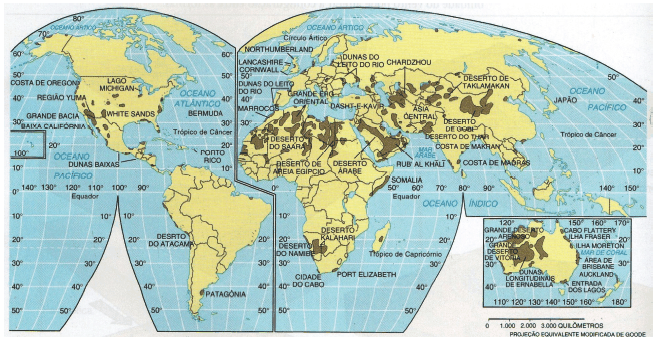
CHRISTOPHERSON, R. W. Geossistemas - Uma Introdução à Geografia Física.
Trad. Francisco Eliseu Aquino et al. Porto Alegre: Bookman. 7. ed. 2012, p. 476.
As porções arenosas ativas encontradas no Planeta estão, em sua maioria, correlacionadas com áreas desérticas. Sobre essas porções arenosas, assinale a alternativa incorreta.
Provas
Caderno Container