Foram encontradas 780 questões.
Disciplina: Inglês (Língua Inglesa)
Banca: SELECON
Orgão: Pref. Lucas Rio Verde-MT
TEXTO I
What is Language Acquisition Theory? Top Theories of How We Learn to Communicate
by Anna Bohren
September 28, 2018
Language acquisition is the process by which we are able to develop and learn a language. This generally includes speaking, listening, writing, and overall communication. Our ability to acquire language is a uniquely human trait because although bonobos, a species of primate, can produce vocalizations with meaning, birds can produce songs, and whales have their own version of a language, no species on Earth that we know of can express an unlimited amount of abstract ideas with a limited set of symbols (gestures, words, and sounds).
The term language acquisition often refers to the first-language acquisition, which simply means that it's the first language learned as an infant (unless the child learns two or more languages at the same time). However, there is also the term second-language acquisition, which refers to the process in both children and adults when they learn additional languages apart from their native one. Each of these terms has at least one language acquisition theory behind them which seeks to answer the big question of “how do we learn a language?”
One of the most well-known and most scientifically accurate theories yet, the Nativist Theory suggests that we are born with genes that allow us to learn language. This language acquisition theory argues that there is a theoretical device known as the language acquisition device (LAD) that is somewhere in our brain. This “device” is in charge of our learning a language the same way the hypothalamus, for example, is in charge of regulating our body temperature.
This theory also suggests that there is a universal grammar (a theory by Noam Chomsky) that is shared across every language in the world because universal grammar is part of our genetic makeup. Essentially, almost all languages around the world have nouns and verbs and similar ways to structure thoughts. All languages have a finite amount of rules from which we can build an infinite amount of phrases. The core concepts from these finite rules are built into our brains (according to Universal Grammar and the Nativist Theory).
The sociocultural theory, also known as the interactionist approach, takes ideas from both biology and sociology to interpret our language acquisition.
This language acquisition theory states that children are able to learn language out of a desire to communicate with their surrounding environment and world. Language thus is dependent upon and emerges from social interaction. The theory argues that due to our language developing out of a desire to communicate, our language is dependent upon whom we hang around and with whom we want to communicate.
The learning theory is a language acquisition theory that looks at language learning as learning a new skill and that we learn language much in the same way that we learn how to count or how to tie shoes via repetition and reinforcement. When babies babble, adults coo and praise them for “talking” (and also because it's pretty adorable).
When the kids grow older, they often are praised for speaking properly and corrected when they don't. From this correction and praise comes the learning theory that language comes from stimulus and stimulus-response. However, this language acquisition theory, logical as it may be, fails to explain how new phrases and new words form since it's all about repeating and mimicking what people hear from others.
When learning a second language (an additional language to your native language), the development of meaning is one of, if not the, most important part. There are many types of meaning such as grammatical (morphology of a word, tenses, possession, etc.), semantic (word meaning), lexical (meaning that comes from our mental lexicon), and pragmatic (meaning that depends on context). Mastery of each of these is necessary when acquiring a second language. The stages of second-language acquisition are much like those of a first-language acquisition. However, people and kids learning a second language will take longer than they did with their first-language to come to full fluency in their second language.
Kids who grow up bilingual have been proven to usually take longer to begin speaking because their brains are trying to sort out the grammar between the two (or more) language systems.
For the process of language acquisition—especially when acquiring more than one language—the younger, the better. Studies have shown that learning new languages helps fight against neurodegenerative conditions such as 'Alzheimers. However, there are a multitude of reasons, and numerous studies that show how healthy for our brain it is to be bilingual.
Scientists have found brain mechanisms that assist in early language development. Phonemic awareness (one's ability to understand sound in language such as the difference between “bed” and “bad”) is essential to language development.
The study found that the way an infant's brain responds to phonetic stimuli (such as hearing someone talking) reflects their language ability, as well as their pre-reading abilities. This can be used as a predictor of how well they will be able to read and speak at age three and age five
( Text adapted)
Available in: https://blog.cognifit.com/language-acquisition-theory/.
De acordo com a autora do texto, a capacidade de aquisição da linguagem é uma capacidade exclusivamente humana, pois somos a única espécie que é capaz de:
Provas

Disciplina: Desenho Técnico e Industrial
Banca: SELECON
Orgão: Pref. Lucas Rio Verde-MT
Segundo a ABNT NBR 6492, os itens não obrigatórios em uma Planta de Situação são:
Provas
Em uma horta escolar, plantou-se uma certa quantidade de mudas de alface. A figura a seguir mostra a disposição de todas elas nesta horta, onde cada “folha de alface” corresponde a uma muda.
🥬 🥬 🥬 🥬 🥬 🥬 🥬 🥬 🥬
🥬 🥬 🥬 🥬 🥬 🥬 🥬 🥬 🥬
🥬 🥬 🥬 🥬 🥬 🥬 🥬 🥬 🥬
🥬 🥬 🥬 🥬 🥬 🥬 🥬 🥬 🥬
🥬 🥬 🥬 🥬 🥬 🥬 🥬 🥬 🥬
🥬 🥬 🥬 🥬 🥬 🥬 🥬 🥬 🥬
A quantidade de mudas plantadas é um valor compreendido entre:
Provas
Em um nivelamento trigonométrico, o topógrafo utilizou um aparelho de altura h, realizando uma leitura L em uma mira situada a uma distância horizontal D, com um ângulo de visada !$ \alpha !$.
A expressão que indica o cálculo da diferença de nível entre os pontos em que se situam o topógrafo e a mira é:
Provas
A figura a seguir apresenta as dimensões de um terreno que um topógrafo terá de representar em uma planta com escala 1/1000.
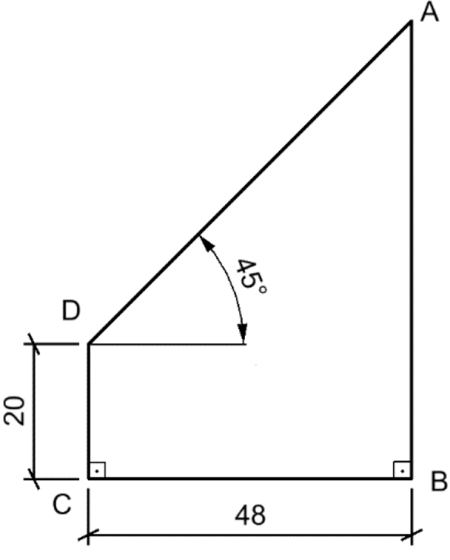
(Dimensões lineares em metros).
Em planta, a área desse terreno será de:
Provas
Na caderneta de um topógrafo foram anotados três dos ângulos internos de um terreno de aspecto quadrangular: 100 gon, 150 gon e 40 gon. A medida do quarto ângulo interno vale:
Provas
Um topógrafo, após algumas medidas realizadas em campo, obteve o triângulo indicado na figura a seguir.
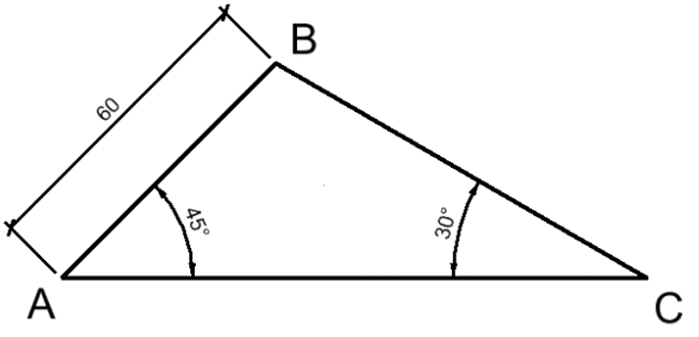
(Dimensões dos elementos lineares em metros)
|
Aproximações: |
|
!$ \sqrt{2} !$ = 1,4 |
|
!$ \sqrt{3} !$ = 1,7 |
|
!$ \sqrt{6} !$ = 2,4 |
Considerando as aproximações e as dimensões apresentadas, o lado BC do triângulo mede:
Provas
Um topógrafo realizou medidas em uma superfície plana, anotando, em sua caderneta, as coordenadas de 6 pontos que formam uma poligonal nessa superfície.
Ponto | Coord. X | Coord. Y |
1 | 0,0 m | 0,0 m |
2 | 0,0 m | 5,0 m |
3 | 4,0 m | 5,0 m |
4 | 10,0 m | -3,0 m |
5 | 4,0 m | -3,0 m |
6 | 4,0 m | 0,0 m |
O perímetro e a área delimitada pela poligonal formada pelos pontos 1-2-3-4-5-6 valem, respectivamente:
Provas
Para manter o ambiente da cozinha limpo, acordou-se limpar as geladeiras sempre de 6 em 6 dias e os armários sempre de 8 em 8 dias. Hoje, tanto as geladeiras quanto os armários foram limpos. O número mínimo de dias necessários, a partir de hoje, para que os armários e as geladeiras voltem a serem limpos simultaneamente é de:
Provas
Em um certo dia, as cozinheiras de uma escola serviram 240 refeições. Deste total, três quintos foram para os alunos do pré-escolar. A quantidade de refeições servidas para estes alunos é um valor compreendido entre:
Provas
Caderno Container